





Column
A Thousand Words
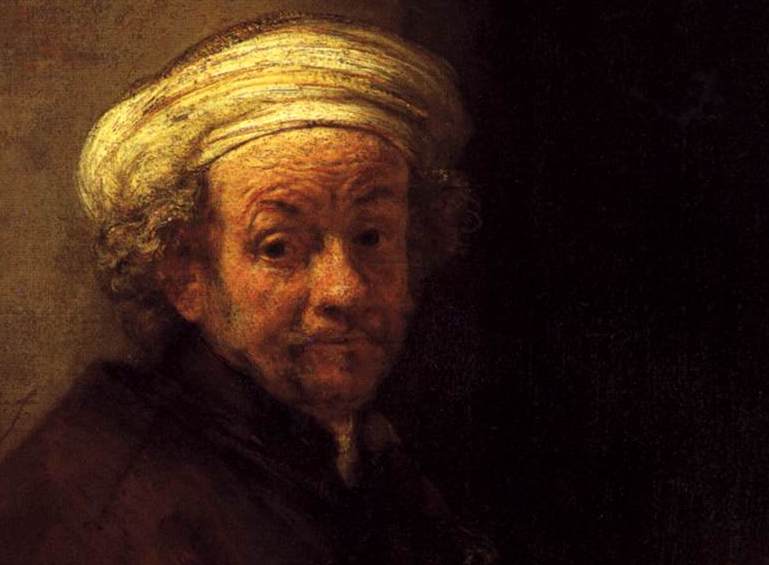
Rembrandt van Rijn's Self-Portrait as the Apostle Paul
For a prolific but not always moneyed artist like Rembrandt, it was natural to turn to the self-portrait as a means of expression: his model was always close at hand and could be summoned into service as long as the painter could afford a mirror. The most self-conscious of artists, Rembrandt painted himself many times—as a boy mugging at the mirror, as a successful young bravo, as a melancholic middle-aged man, and as a dotard. But to portray himself as an apostle? Surely this one is worthy of a little further investigation.
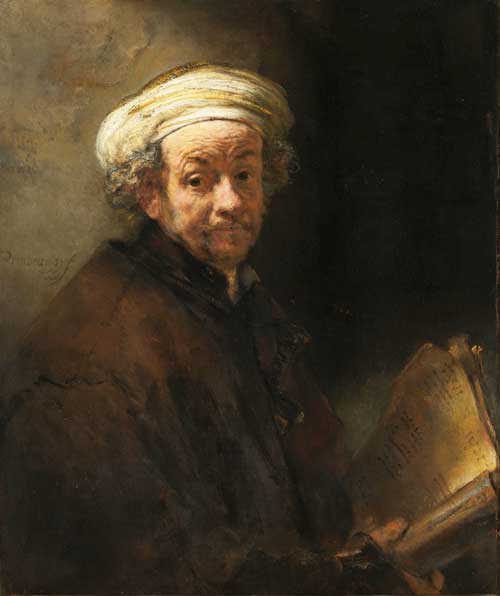
In the seventeenth century, a portrait subject was often painted in the guise of some historical figure, either by his own request or at the suggestion of the artist. Art historians call these portraits historiés, or "historiated" portraits, "history" being understood to include not only all secular and ancient historical subjects, but also biblical and mythological ones. Usually, such paintings depicted the subject with the traditional attributes of the historical character portrayed and showed him at a key moment in his drama. The portrait was presumed to give a true (if flattering) likeness of the sitter and to imply that his virtues paralleled those of the historical figure—a moral likeness, if you will (and possibly flattering in this respect, too). For example, Rembrandt had already painted the Catholic poet Joost van den Vondel as St. Paul in 1659.
THIS ARTICLE ONLY AVAILABLE TO SUBSCRIBERS.
FOR QUICK ACCESS:
Mary Elizabeth Podles is the retired curator of Renaissance and Baroque art at the Walters Art Museum in Baltimore, Maryland. She is the author of A Thousand Words: Reflections on Art and Christianity (St. James Press, 2023). She and her husband Leon, a Touchstone senior editor, have six children and live in Baltimore, Maryland. She is a contributing editor for Touchstone.
A Journal of Mere Christianity—Delivered to Your Door
- Essays on theology, culture, and the Church
- Contributors from across the Christian traditions

Six print issues (one year) of Touchstone, plus full online access and PDF downloads for only $39.95.

Get a one-year full-access subscription to the Touchstone online archives for only $19.95.
bulk subscriptions
Order Touchstone subscriptions in bulk and save $10 per sub! Each subscription includes 6 issues of Touchstone plus full online access to touchstonemag.com—including archives, videos, and pdf downloads of recent issues for only $29.95 each! Great for churches or study groups.
Transactions will be processed on a secure server.
more on art from the online archives
32.4—July/August 2019
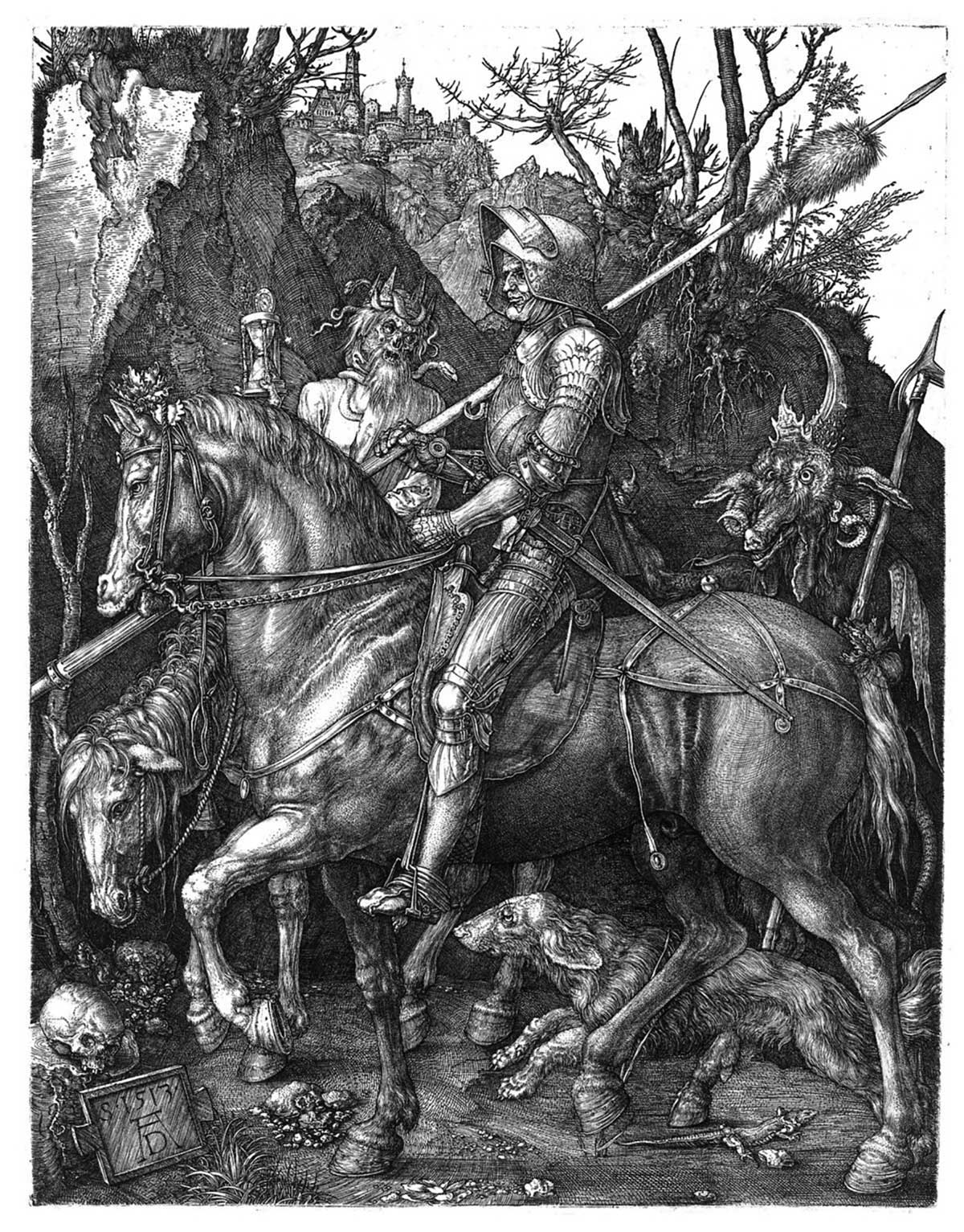
on Single-Mindedness in Durer's Ritter, Tod, und Teufel by Anthony Costello
33.2—March/April 2020
An Architectural Sign of Mere Christianity by Michael Ward
more from the online archives


26.1—Jan/Feb 2013
The Alternate & Alternative Worlds of H. P. Lovecraft & C. S. Lewis by C. R. Wiley
36.1—Jan/Feb 2023
A History of the Protestant Debate over Contraception by James A. Altena
calling all readers
Please Donate
"There are magazines worth reading but few worth saving . . . Touchstone is just such a magazine."
—Alice von Hildebrand
"Here we do not concede one square millimeter of territory to falsehood, folly, contemporary sentimentality, or fashion. We speak the truth, and let God be our judge. . . . Touchstone is the one committedly Christian conservative journal."
—Anthony Esolen, Touchstone senior editor
