




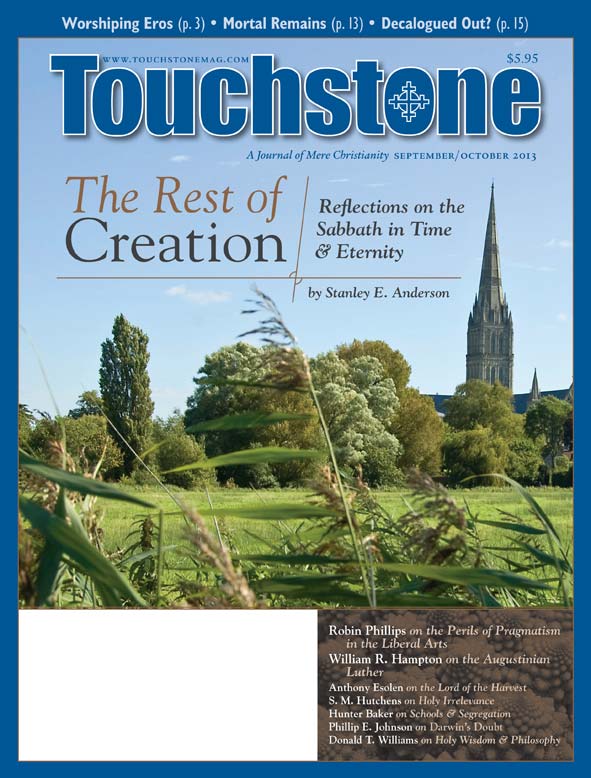
Feature
The Rest of Creation
Reflections on the Sabbath in Time & Eternity
In Dirty Harry, detective Harry Callahan (Clint Eastwood) apprehends a criminal and begins his famous monologue, "I know what you're thinking. Did he fire six bullets or only five?" If Harry had instead been a pastor confronting one of his parishioners caught doing unnecessary work on Sunday, he might have begun, "I know what you're thinking. Did God create the heavens and the earth in seven days or only six?"
The Genesis account of God's creation of the world is described as six days of "work" plus a seventh day of "rest." I have often wondered how that lonely seventh day fits in with the other six and whether it actually "counts" as part of God's creation of the world.
Unity in Rest
While listening to a homily one Sunday at Mass, an image from chemistry came to my mind (as C. S. Lewis once noted when mentioning that the inspiration for The Screwtape Letters came to him during a church service, "one could wish these things came more seasonably"). I pictured six water molecules bound together in a hexagonal shape of solid ice as representing the six days of creation. Water molecules in a liquid or gaseous state exhibit chaotic, independent motion as separate "things," but in solid form they act in unity. In scientific terminology, they are said to be in a lower energy state, or, more loosely, "at rest."
It occurred to me that this might illustrate the connection between the seemingly estranged seventh day and the other six days of creation. The emphasis would not be so much on rest as the absence of work (though that contrast is not lost, certainly), but on the formation of unity and wholeness in creation. So the seventh day, far from being the "odd man out," might be better seen as the capstone of the entire creation process.
The Catechism of the Catholic Church says, "The sabbath is for the Lord, holy and set apart for the praise of God, his work of creation, and his saving actions on behalf of Israel" (2171). When creation is seen as a series of separate works, like so many Dirty Harry bullets, it can divert our gaze away from God toward a kind of materialistic idolatry. But the Catechism's use of the singular "work" brings our attention back to God's glory. The opening of Psalm 19 says, "The heavens declare the glory of God; and the firmament shows his handiwork." We may partially glean God's glory in individual things, but we see it manifested more fully in their integration and wholeness and unity. This recognition was, for me, a way of seeing God's day of rest in a new light.
Healing & Growth in Rest
The Sabbath as a day of rest for man also reflects this unifying aspect of creation. In the very act of resting from it, our work becomes sanctified in the worship of God. But our proper spiritual rest is not simply a matter of "shutting down," the way we might shut down a computer or turn off a car engine. Jesus says that the Sabbath was made for man and not man for the Sabbath, and the Church allows for and blesses "good works" (acts of mercy and charity) on this day, reflecting Jesus' acts of healing on the Sabbath that were so frowned upon by the Pharisees. Healing goes hand in hand with wholeness and unity as an aspect of the day of rest, just as physical rest facilitates medical healing. But God intends his healing in rest to go beyond mere restoration.
The image of chaotic water molecules settling into solid ice conveys unity in rest, but it also suggests stasis or lifelessness. A richer metaphor might be seen in the making of bread or wine: dough is first kneaded, then set aside to rise; and grapes are first crushed, then allowed to ferment. In both cases, the period of "rest" helps bring the work of bread-making or wine-making to fruition.
This combination of rest and growth is also seen in sleep. Though not fully understood, such phenomena as dreams and REM states indicate that sleep is not simply a cessation of brain activity. Though in one sense at rest, the brain apparently also uses sleep time to clear out distracting elements and to bring together, sort, and integrate otherwise chaotic activity and information gathered during the day. This enables a person to wake up refreshed and ready for continued growth.
Stanley E. Anderson holds a degree in mathematics and has worked in data analysis, IT, and quality assurance in the aerospace industry. He and his wife are converts from Anglicanism to the Catholic Church.
A Journal of Mere Christianity—Delivered to Your Door
- Essays on theology, culture, and the Church
- Contributors from across the Christian traditions

Six print issues (one year) of Touchstone, plus full online access and PDF downloads for only $39.95.

Get a one-year full-access subscription to the Touchstone online archives for only $19.95.
bulk subscriptions
Order Touchstone subscriptions in bulk and save $10 per sub! Each subscription includes 6 issues of Touchstone plus full online access to touchstonemag.com—including archives, videos, and pdf downloads of recent issues for only $29.95 each! Great for churches or study groups.
Transactions will be processed on a secure server.
more from the online archives

28.2—March/April 2015
Man, Woman & the Mystery of Christ
An Evangelical Protestant Perspective by Russell D. Moore

30.5—Sept/Oct 2017
The Christian Cure for What Ails Modern Politics by David Bradshaw

33.1—January/February 2020
Speaking Truth About the Sexes Is Not Optional by Anthony Esolen
calling all readers
Please Donate
"There are magazines worth reading but few worth saving . . . Touchstone is just such a magazine."
—Alice von Hildebrand
"Here we do not concede one square millimeter of territory to falsehood, folly, contemporary sentimentality, or fashion. We speak the truth, and let God be our judge. . . . Touchstone is the one committedly Christian conservative journal."
—Anthony Esolen, Touchstone senior editor
