




Contours of Culture
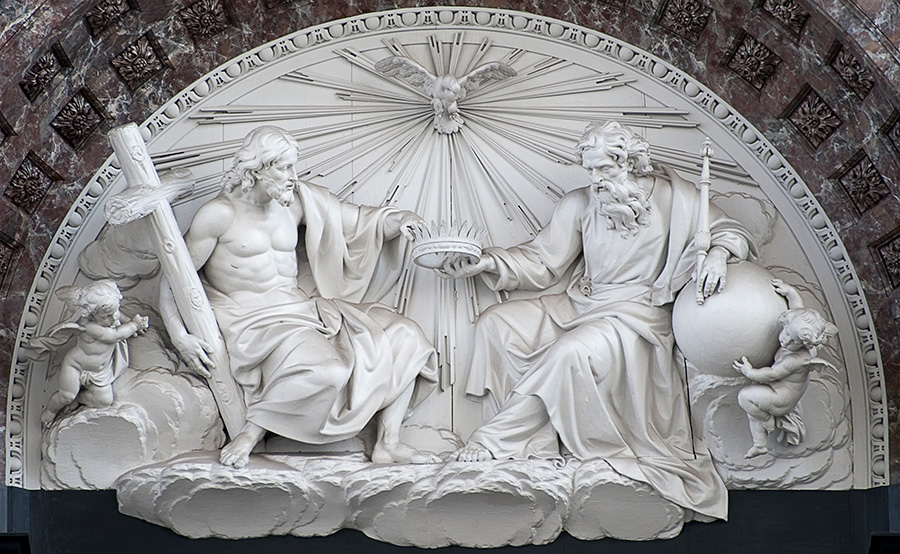
Trinity & Modernity
by Ken Myers
We have been told that to be postmodern is to approach metanarratives—the Big Stories that explain Life, the Universe, and Everything—with incredulity. Of course, this raises the question of whether or not this definition of the postmodern temperament is itself a metanarrative, but I'll leave that for finer minds than mine to explore.
Possible paradoxes notwithstanding, I have to give grudging credit to Jean-François Lyotard for making this observation, because I do detect among most younger people a yawning indifference to efforts to explain history or theology or ethics or art in terms of grand and arching chronologies or chronicles. I suspect their minds and hearts have been colonized by thousands of what Lyotard called petits récits, small accounts of highly particular and often idiosyncratic episodes, all blithely disconnected from any framework, all resistant to organization in any structure of meaning. Perpetual exposure to a numbing torrent of bewildering bursts of narrativish fragments—increasingly in fewer than 140 characters—leaves little time or mental space for attending to connections and causality.
THIS ARTICLE ONLY AVAILABLE TO SUBSCRIBERS.
FOR QUICK ACCESS:
Ken Myers is the host and producer of the Mars Hill Audio Journal. Formerly an arts editor with National Public Radio, he also serves as music director at All Saints Anglican Church in Ivy, Virginia. He is a contributing editor for Touchstone.
A Journal of Mere Christianity—Delivered to Your Door
- Essays on theology, culture, and the Church
- Contributors from across the Christian traditions

Six print issues (one year) of Touchstone, plus full online access and PDF downloads for only $39.95.

Get a one-year full-access subscription to the Touchstone online archives for only $19.95.
bulk subscriptions
Order Touchstone subscriptions in bulk and save $10 per sub! Each subscription includes 6 issues of Touchstone plus full online access to touchstonemag.com—including archives, videos, and pdf downloads of recent issues for only $29.95 each! Great for churches or study groups.
Transactions will be processed on a secure server.
more on literature from the online archives

32.2—March/April 2019
Misguided Mercy & Dante's Infernal Purgation by Joshua Hren
more from the online archives
21.10—December 2008
Early Christian Teaching on the Incarnation & Redemption by Patrick Henry Reardon

30.2—March/April 2017
The Education of Children Takes Generations of Fidelity by W. Ross Blackburn
27.2—March/April 2014
on C. S. Lewis & the New State Paganism by W. E. Knickerbocker
calling all readers
Please Donate
"There are magazines worth reading but few worth saving . . . Touchstone is just such a magazine."
—Alice von Hildebrand
"Here we do not concede one square millimeter of territory to falsehood, folly, contemporary sentimentality, or fashion. We speak the truth, and let God be our judge. . . . Touchstone is the one committedly Christian conservative journal."
—Anthony Esolen, Touchstone senior editor
