




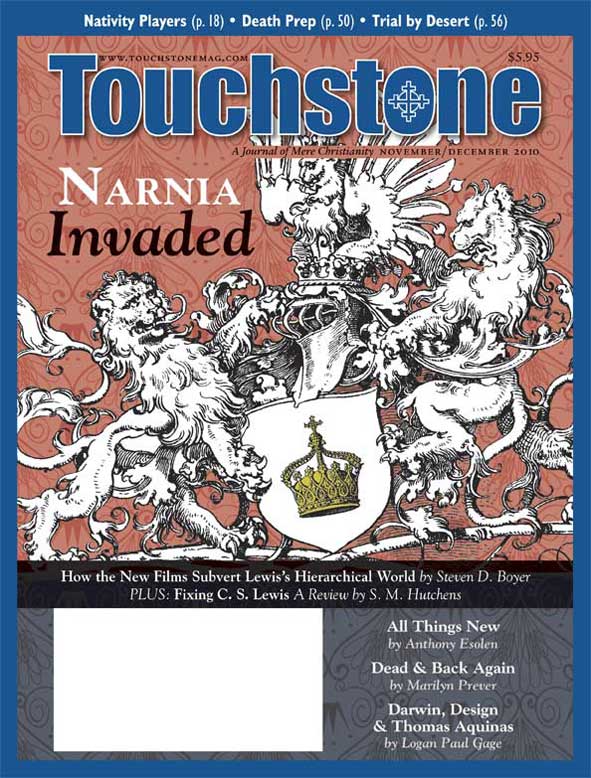
Fixing Lewis
A Sword Between the Sexes? C. S. Lewis and the Gender Debates
by Mary Stewart Van Leeuwen
Brazos Press, 2010
(272 pages, $19.99, paperback)
reviewed by S. M. Hutchens
A Sword Between the Sexes? is a thoroughly researched and masterfully composed account of a development its author detects in C. S. Lewis’s thought on gender matters that moved, as Lewis matured, from the hierarchicalism and gender essentialism of “Priestesses in the Church?” and That Hideous Strength toward the greater egalitarianism of works like The Chronicles of Narnia and Till We Have Faces, a movement influenced by his encounters with outstanding women whose qualities he earlier would have been inclined to deny or ignore.
In Van Leeuwen’s construction, the earlier Lewis is inconsistent in his opinions on gender equality, and she interprets this by offering that he was frequently a better man than his theories. In the notorious “Priestesses” essay opposing women’s ordination (1948), for example, Lewis notes that the woman is not “necessarily or even probably less holy or less charitable or stupider than a man,” thus professing the equality of women with men in the spiritual and intellectual qualities required for the priestly office. He insists, however, that she is disqualified by her sex, which cannot sacramentally reflect the people of God at the altar. The egalitarian error, he believed, arose from the belief that “sex is something superficial, irrelevant to the spiritual life,” when in fact all creation, including creation at worship, is significantly colored by its Creator with gender, of which sex is an expression that can never be overlooked or regarded as insignificant.
Van Leeuwen notes that in his essay “Membership” in The Weight of Glory, Lewis says, “I do not believe God created an egalitarian world. I believe the authority of the parent over the child, the husband over the wife, the learned over the simple, to have been as much a part of the original plan as the authority of man over beast.” In the same essay, however, he affirms the justice of women’s political and legal equality, indicating that he would “view with the strongest disapproval any proposal to abolish [universal] suffrage, or the Married Women’s Property Act.” Van Leeuwen indicates that in this and many similar instances, Lewis simply does not recognize, nor is he bothered by, the inconsistency of his views. In the same places he professes sexism in its most primitive and retrograde forms, he may be found granting imprimatur to institutions of sexual equality.
Those who know Lewis will have already seen a glimmer of the problem here: In the “Priestesses” essay, for example, used by Van Leeuwen to represent Lewis in his less enlightened period, he not only defends women’s political and legal equality, but also makes it clear he regards them as the equals of men in piety, zeal, learning, and the qualities that make for equal competence in vocations once thought to be solely the province of males. Why then, is Lewis’s clear and early belief that to some significant degree “gendered behavior is in many ways a social construction” only treated seriously as something understood by the better-sanctified Lewis of 1960?—a question that brings to mind St. Paul’s similar ignorance of what his egalitarian left hand was writing against his hierarchical right.
Interpretive Key
Given the weight and potency of Lewis’s mind, a better explanation than inconsistency, as Michael Ward notes in Planet Narnia, is that Lewis, as an orthodox Christian in the Pauline line, always believed in the fundamental equality of men and women that is in no way effaced by the hierarchies in which they also stand, an equality fully acknowledged in both his earlier and later works. It is a dubious venture to place a discount on Lewis’s earlier professions of belief in women’s equality to men in writings like “Priestesses in the Church?” only to present them at full value as his mature opinions when he exhibits them later on.
Fortunately for the reader, Van Leeuwen gives the interpretive key to her viewpoint in her approval of Kevin Giles’s teachings on the logical incoherence and un-Christian character of any attempt to impress hierarchy or its subordinations on the Godhead or humankind created in its image. This is regarded as of pagan derivation, and the long history of war between orthodox Christianity and Arianizing influences that would make the Son and Spirit inferior in divine nature to the Father is seized upon as the rightful history of egalitarianism—thus confirming the scholars of their persuasion in their Sisyphean assignment of finding ways to de-christianize all the hierarchical material found in Scripture and the long, misguided history of the Christian Church.
Van Leeuwen notes that “there certainly is a long tradition of Christian (and, indeed, non-Christian) thought which assumes hierarchy in gender relations.” This, however, she believes egalitarians have the duty and the ability to consign to history’s dustbin as incompatible with the creeds, which, because they emphatically confess the equal God-ness of the Persons of the Trinity, must therefore be regarded as teaching their non-hierarchical equality—a theology necessary for and foundational to egalitarian anthropology.
She agrees with Philip Cary that in spite of Christianity’s ancient fathers being “hierarchicalists to a man,” they inadvertently produced creeds that undermined their leftover paganism by finding equality in the very essence of God. Belief that one excludes the other makes the discovery of equality in the Trinity the end of any claim that it might also be a hierarchy. Those who hold otherwise have adopted the views of pagans and heretics that were never the true doctrine of the Church, no matter how many blinkered apostles, saints, and doctors they might quote to their advantage.
S. M. Hutchens is a senior editor and longtime writer for Touchstone.
A Journal of Mere Christianity—Delivered to Your Door
- Essays on theology, culture, and the Church
- Contributors from across the Christian traditions

Six print issues (one year) of Touchstone, plus full online access and PDF downloads for only $39.95.

Get a one-year full-access subscription to the Touchstone online archives for only $19.95.
bulk subscriptions
Order Touchstone subscriptions in bulk and save $10 per sub! Each subscription includes 6 issues of Touchstone plus full online access to touchstonemag.com—including archives, videos, and pdf downloads of recent issues for only $29.95 each! Great for churches or study groups.
Transactions will be processed on a secure server.
more on C. S. Lewis from the online archives

19.6—July/August 2006
The Three-Fold Cord of Imagination, Reason & Will in C. S. Lewis by Michael Ward


22.5—June 2009
C. S. Lewis on Civilization & the Natural Order by Timothy L. Hall
more from the online archives
18.10—December 2005
on an Apostle’s Encounter with the Son’s Children by Anthony Esolen
26.1—Jan/Feb 2013
on Abortion as a Matter of National Welfare by W. Ross Blackburn

33.3—May/June 2020
Bach's Cantata BWV 106, Gottes Zeit ist die allerbesteZeit (God's time is the very best time) by Ken Myers
calling all readers
Please Donate
"There are magazines worth reading but few worth saving . . . Touchstone is just such a magazine."
—Alice von Hildebrand
"Here we do not concede one square millimeter of territory to falsehood, folly, contemporary sentimentality, or fashion. We speak the truth, and let God be our judge. . . . Touchstone is the one committedly Christian conservative journal."
—Anthony Esolen, Touchstone senior editor
