




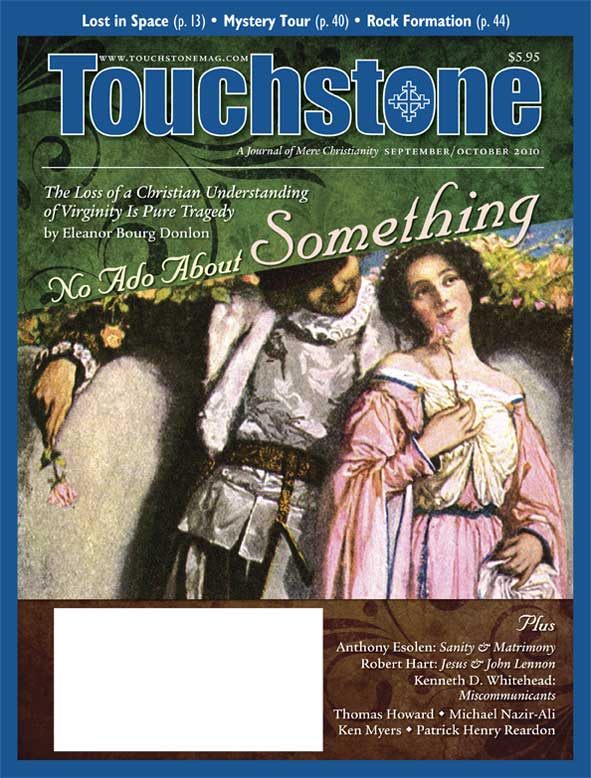
Father Urban’s Lesson
Thomas W. Jodziewicz on Real Christianity for Losers
A broad-brush approach to American history would surely accentuate the forefinger: Americans like to win; they like, even celebrate and envy, apparent winners. The traditional story of the past two American centuries usually emphasizes America’s winning ways, including the enactment of necessary reforms and the achievement of victory in war, while the culture itself is adorned with such adages as “Winning is the only thing,” “Show me a loser and I’ll show you a loser,” and “We’re (or I’m) Number One!”
For many, self-autonomy, personal gratification, and various examples of personal prosperity—despite periodic and even heart-felt calls for a retrieval of community and common values—constitute the avowed lodestone of the Americ
an enterprise in self-fulfillment, and it is not a completely misplaced or miscalculated narrative accent. We do have personal responsibility for ourselves, and any progress toward that is in some way surely a victory.
But what about a responsibility to and for others? In the tension in American history between the one and the many, the I and the We, lies a more complicated social storyline regarding being a winner. Christ’s apostles, all chastened and seasoned by grace, would surely contest this particular, mostly individualistic, American description of winning, as well as its relevance for the good life, and substitute another frame of reference: the seemingly un-American reality of losing. So, eventually, would Father Urban Roche.
The Ambitious Father Roche
Father Urban Roche is the creation of the novelist J. F. Powers (1917–1999) in his 1963 National Book Award-winning Morte D’Urban. A member of the apparently mediocre Order of St. Clement, Fr. Urban sees himself as engaged in a one-man effort to bring the Clementines up to date. Operating out of Chicago, and enjoying many of the finer things of life, he lectures and preaches widely in what he sees as a heroic quest to vivify a religious order that, in his eyes, was “unique in that they were noted for nothing at all.”
Fr. Urban himself had joined the order while under the exhilarating influence of a well-accomplished visitor, Fr. Placidus, who had carried all before him by the force of his personality and vitality. In short, Fr. Placidus was a winner in Roche’s eyes and a wonderful mentor, who had counseled his charges: “Be a winner! Never say die!” Indeed, on his own otherwise rather busy escutcheon, Fr. Urban had included only three words: “Be a winner.” It turns out, however, that at least in Fr. Urban’s view of things, Fr. Placidus had been unique among the Clementines.
Perhaps because Fr. Urban’s more worldly tendencies and pride were noticed by the provincial (the local head of the order), he gets assigned to a fairly dismal retreat house in rural Minnesota. But even here, the Clementines’ self-appointed promoter enjoys apparent successes, whether as a visiting pastor who shakes up and indeed vivifies a slumbering parish, or as a Catholic priest whose apparent non-judgmentalism and urbanity are attractive even to non-Catholics. He gets the idea of opening a golf course adjacent to the retreat house, so as to attract wealthy and influential people, the movers and shakers of society, with whom he liked to be found on his travels and who were potential donors to his cause—even if these acknowledged winners are fairly materialistic and morally tone deaf.
Fr. Urban is not a “bad” priest, and much of his activity does appear to have a good effect, but his moral imagination has been tainted by his operating definition of what it is to be a winner. In his own estimation, the increasing successes of several of his fellow Clementines in outback Minnesota come about because of his own entry into their world and his necessary courting of what at first glance does appear to be mammon:
The Clementines, competitors not so much for the alms and stipends of the faithful as for their hearts, had got nowhere until Father Urban entered the lists. He, unlike Wilf [the rector of the retreat house], had taken good care to conquer the profane world before tackling the other one, and, for that reason, was able to deal with the clergy [of the local diocese] from a sitting, rather than a kneeling, position. They loved a winner. It was as simple as that. That was what was really behind the great change.
A Journal of Mere Christianity—Delivered to Your Door
- Essays on theology, culture, and the Church
- Contributors from across the Christian traditions

Six print issues (one year) of Touchstone, plus full online access and PDF downloads for only $39.95.

Get a one-year full-access subscription to the Touchstone online archives for only $19.95.
bulk subscriptions
Order Touchstone subscriptions in bulk and save $10 per sub! Each subscription includes 6 issues of Touchstone plus full online access to touchstonemag.com—including archives, videos, and pdf downloads of recent issues for only $29.95 each! Great for churches or study groups.
Transactions will be processed on a secure server.
more on christianity from the online archives
33.3—May/June 2020
Human & Divine Societies Require Careful Thought & Discourse by Anthony Esolen

8.4—Fall 1995
The Demise of Biblical Preaching
Distortions of the Gospel and its Recovery by Donald G. Bloesch
more from the online archives

33.3—May/June 2020
Maternal Body: A Theology of Incarnation from the Christian East by Carrie Frederick Frost
Fertile Ground: A Pilgrimage Through Pregnancy by Laura S. Jansson by Agnes R. Howard
27.3—May/June 2014
Religious Freedom & Why It Matters
Working in the Spirit of John Leland by Robert P. George

calling all readers
Please Donate
"There are magazines worth reading but few worth saving . . . Touchstone is just such a magazine."
—Alice von Hildebrand
"Here we do not concede one square millimeter of territory to falsehood, folly, contemporary sentimentality, or fashion. We speak the truth, and let God be our judge. . . . Touchstone is the one committedly Christian conservative journal."
—Anthony Esolen, Touchstone senior editor
