





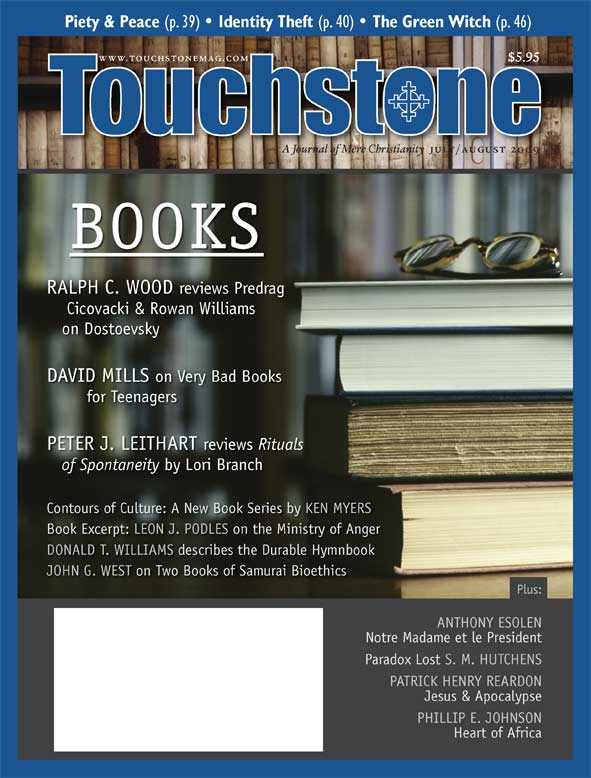
Russia’s Gospel Writer
Dostoevsky & the Affirmation of Life by Predrag Cicovacki
Dostoevsky: Language, Faith, and Fiction by Rowan Williams
reviewed by Ralph C. Wood
The literary critic Harold Bloom once defined a classic as a book that requires us permanently to rearrange the furniture of our lives. He meant, I suspect, that such a text prevents us from viewing the world through conventional lenses; it requires us not only to see the world with cleansed vision but also to reorder our lives accordingly. T. S. Eliot defined literary greatness in similar terms. “The majority of poems one outgrows and outlives, as one outgrows and outlives the majority of human passions: Dante’s [Divine Comedy] is one of those [books] which one can only just hope to grow up to at the end of life.”
THIS ARTICLE ONLY AVAILABLE TO SUBSCRIBERS.
FOR QUICK ACCESS:
Ralph C. Wood was, until his retirement, University Professor of Theology and Literature at Baylor University in Waco, Texas. His books include The Comedy of Redemption (University of Notre Dame Press), Flannery O’Connor and the Christ-Haunted South (Eerdmans), and Chesterton: The Nightmare Goodness of God (Baylor University Press).
A Journal of Mere Christianity—Delivered to Your Door
- Essays on theology, culture, and the Church
- Contributors from across the Christian traditions

Six print issues (one year) of Touchstone, plus full online access and PDF downloads for only $39.95.

Get a one-year full-access subscription to the Touchstone online archives for only $19.95.
bulk subscriptions
Order Touchstone subscriptions in bulk and save $10 per sub! Each subscription includes 6 issues of Touchstone plus full online access to touchstonemag.com—including archives, videos, and pdf downloads of recent issues for only $29.95 each! Great for churches or study groups.
Transactions will be processed on a secure server.
more from the online archives
26.1—Jan/Feb 2013
on Abortion as a Matter of National Welfare by W. Ross Blackburn
31.5—September/October 2018
The Rise of the Gnostic Liberal State After Christianity by Andrew Latham
29.2—March/April 2016
The History of Family Strength in America May Reveal Good News by Allan C. Carlson
calling all readers
Please Donate
"There are magazines worth reading but few worth saving . . . Touchstone is just such a magazine."
—Alice von Hildebrand
"Here we do not concede one square millimeter of territory to falsehood, folly, contemporary sentimentality, or fashion. We speak the truth, and let God be our judge. . . . Touchstone is the one committedly Christian conservative journal."
—Anthony Esolen, Touchstone senior editor
