




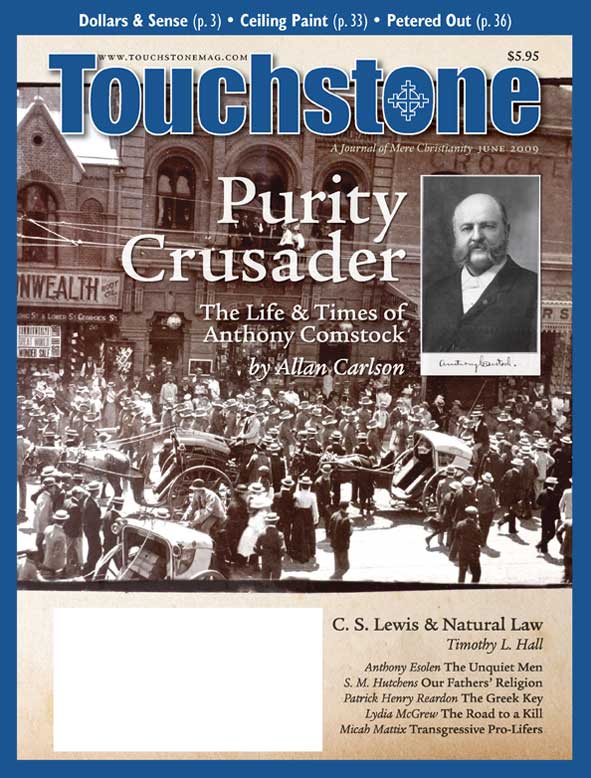
Review
Ceiling Paint
Michelangelo and the Sistine Chapel by Andrew Graham-Dixon
Skyhorse Publications, 2009
(240 pages, $24.95, hardcover)
reviewed by Mary Elizabeth Podles
One of the transcendent moments of my life happened unexpectedly on a private tour of the Vatican Museums, when I pushed open the big wooden door and stood, alone and transfixed, under Michelangelo’s Sistine Chapel ceiling. I had studied it for decades; I thought I knew what to expect; I was thoroughly jolted. I suspect it will be the same when I am called before the Judgment Seat.
After a while I was brought back to earth by my husband’s tugging at my sleeve and saying, with a minimum of irony, “Okay, tell me what I’m seeing.” Not altogether an easy task: The ceiling is one of those inescapable works of Western art, one we recognize so readily that we really don’t see it. I have a lecture in the can called “The Sistine Chapel Ceiling: I Know, I Know, But Have You Ever Really Looked at It?” But lacking a garrulous wife from the museum trade, where is one to turn for a reliable explanation?
The removal of nearly five hundred years’ worth of soot and candle smoke from the ceiling’s surface spawned an equal and opposite outpouring of ink from art historians. William Wallace’s Michelangelo: Recent Scholarship in English (1995) runs to five volumes, one of them exclusively devoted to the ceiling. There are some “studies” clearly to be avoided: The loopiest is Benjamin Blech and Roy Doliner’s The Sistine Secrets: Michelangelo’s Forbidden Messages in the Heart of the Vatican (2008). They identify kabbalistic imagery on the ceiling (some correctly, as it happens: Michelangelo would have learned it from the Neo-Platonists) and from it deduce a kind of Da Vinci Code, a message of subversive anti-Church freethinking and toleration (Michelangelo? tolerant?) and, in short, erstwhile Obama-type politics. I believe this is known as “effing the ineffable.” Ross King’s popular Michelangelo and the Pope’s Ceiling (2003) is historically sound and a gossipy good read, but says little about how to read the ceiling itself.
Art as Theology
For a reliable user’s guide, turn to Andrew Graham-Dixon’s Michelangelo and the Sistine Chapel (2009). Graham-Dixon, the longtime art critic for The Independent, sets out with a brief overview of Michelangelo’s life and times, consulting the artist’s standard biographies with the requisite, and sizeable, grain of salt. The bulk of the book is then given over to a careful reading of the ceiling, unpacking the visual texts as he imagines Michelangelo might have wanted them to be read.
And a very good job he makes of it. For one thing, he understands the Christian message to be a coherent philosophical whole, based in historical fact and a profound understanding of the human person. Many art historians find Christianity obscure and puzzling, about as approachable as the Gelug school of Tibetan Buddhism.
Graham-Dixon, though, recognizes that “pious and orthodox” are not synonyms for “simple-minded and hidebound.” He shows us the polyvalence and the novelty of Michelangelo’s visual symbolism and suggests the many levels on which his images can be read, along with the interconnections between them.
He recognizes, too, that complex as its iconography might be, the Sistine ceiling is more than just a rebus or a puzzle to be deciphered. He writes sensitively and perceptively about the power and the beauty, the immediacy and the presence of the painting itself. And in his final chapter, “ The Last Judgement, and Other Endings,” he elucidates for us the Renaissance artist’s concept of art as theology, that visual imagery can and does express theological and philosophical truths in a language unavailable to theologians and yet accessible to all.
Mary Elizabeth Podles is the retired curator of Renaissance and Baroque art at the Walters Art Museum in Baltimore, Maryland. She is the author of A Thousand Words: Reflections on Art and Christianity (St. James Press, 2023). She and her husband Leon, a Touchstone senior editor, have six children and live in Baltimore, Maryland. She is a contributing editor for Touchstone.
A Journal of Mere Christianity—Delivered to Your Door
- Essays on theology, culture, and the Church
- Contributors from across the Christian traditions

Six print issues (one year) of Touchstone, plus full online access and PDF downloads for only $39.95.

Get a one-year full-access subscription to the Touchstone online archives for only $19.95.
bulk subscriptions
Order Touchstone subscriptions in bulk and save $10 per sub! Each subscription includes 6 issues of Touchstone plus full online access to touchstonemag.com—including archives, videos, and pdf downloads of recent issues for only $29.95 each! Great for churches or study groups.
Transactions will be processed on a secure server.
more from the online archives
33.3—May/June 2020
Human & Divine Societies Require Careful Thought & Discourse by Anthony Esolen
31.6—November/December 2018
The Slow Vindication of Leon Podles by S. M. Hutchens
34.1—January/February 2021
Live Not by Lies: A Manual for Christian Dissidents by Rod Dreher by Hans Boersma
calling all readers
Please Donate
"There are magazines worth reading but few worth saving . . . Touchstone is just such a magazine."
—Alice von Hildebrand
"Here we do not concede one square millimeter of territory to falsehood, folly, contemporary sentimentality, or fashion. We speak the truth, and let God be our judge. . . . Touchstone is the one committedly Christian conservative journal."
—Anthony Esolen, Touchstone senior editor
