




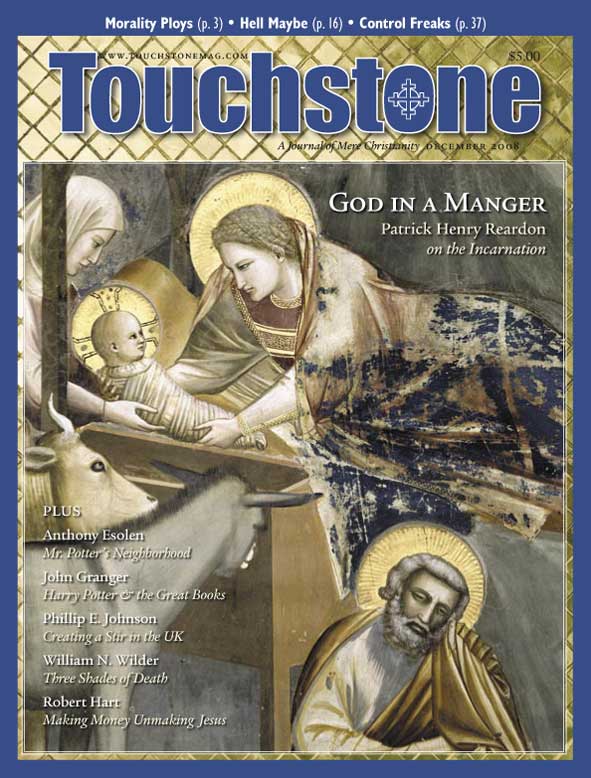
Shades of Death
William N. Wilder on Three Tales & the Demise of the Last Enemy
I’ve spent a lot of time reading fantasy literature over the past year or two. That is to say, I’ve spent a lot of time reading about death. First, there was the July 2007 publication of Harry Potter and the Deathly Hallows. This book was in many ways the fitting climax to J. K. Rowling’s delightfully imaginative and witty work. Nevertheless, it is not Harry Potter and the Happy Hallows (despite the alliterative possibilities) for a reason.
Then The Golden Compass hit the theaters last December, which led me to read His Dark Materials—the trilogy by Philip Pullman comprising The Golden Compass, The Subtle Knife, and The Amber Spyglass. One thing is clear: However golden and amber his book titles may be,
Pullman works from a dark (and none-too-subtle) palette. In short, whatever else this fantasy literature may be, it is not pure escapism—unless grappling with death is your idea of escape.
Going On
I don’t think anyone would deny that death is a major theme throughout the Harry Potter series. J. K. Rowling herself once said that these books are “largely about death”: “They open with the death of Harry’s parents. There is Voldemort’s obsession with conquering death and his quest for immortality at any price.” For Voldemort, this includes the black magic and destruction of the Horcruxes. So he takes it to an extreme, to say the least.
Yet, to be fair, Voldemort is not alone in pursuing immortality. It’s a regular stock-in-trade in the witching world. There’s Nicolas Flamel, who makes the Sorcerer’s Stone. There are the Peverell brothers, who first possess the Hallows, and Gellert Grindelwald, who (with many others) continues to seek them. Even Dumbledore gets caught up in the chase.
It is precisely in this respect that Harry is different. Unlike the others, Harry overcomes the temptation to defeat death at any price. Indeed, his greatness lies in his refusal to make life and immortality (by means of the Hallows, for instance) his primary aim. As Dumbledore tells Harry after his willingness to die at the hands of Voldemort, he is “the true master of death, because the true master does not seek to run away from death. He accepts that he must die, and understands that there are far, far worse things in the living world than dying.”
Indeed, as Dumbledore also said to Harry (though way back in the first book), “to the well-organized mind, death is but the next great adventure.” Not all feel this way, even among witches and wizards. Hogwarts itself is filled with characters—Professor Binns, Nearly Headless Nick, Moaning Myrtle—who are unprepared to board the train at King’s Cross, as it were, and simply go “On.” They turn back, through habit, regret, or revenge, to a shadowy half-existence in this world.
For me, one of the most poignant moments in The Deathly Hallows comes in Harry’s return to Godric’s Hollow. Reading from the gravestone of his slain parents, Harry misunderstands (and panics at) the final quotation: “The last enemy to be destroyed is death.” To Harry it sounds like a Death Eater idea and he says as much to Hermione. Her response: “It doesn’t mean defeating death in the way the Death Eaters mean it, Harry. . . . It means, you know, living beyond death. Living after death.”
Harry is not consoled. Real life is life in this world. As for his parents, “they were gone. The empty words could not disguise the fact that his parents’ moldering remains lay beneath snow and stone, indifferent, unknowing.” In the end, however, and without any real certainty of the hereafter, Harry is willing to give up his life for the sake of others. In so doing, he becomes, as Dumbledore admits, the true master of death. Even so, uncertainty and a pervasive sense of loss remain.
A Journal of Mere Christianity—Delivered to Your Door
- Essays on theology, culture, and the Church
- Contributors from across the Christian traditions

Six print issues (one year) of Touchstone, plus full online access and PDF downloads for only $39.95.

Get a one-year full-access subscription to the Touchstone online archives for only $19.95.
bulk subscriptions
Order Touchstone subscriptions in bulk and save $10 per sub! Each subscription includes 6 issues of Touchstone plus full online access to touchstonemag.com—including archives, videos, and pdf downloads of recent issues for only $29.95 each! Great for churches or study groups.
Transactions will be processed on a secure server.
more from the online archives
32.2—March/April 2019
Reality Shows, Even in a Popular TV Series by C. E. Smith

28.1—January/February 2015
on State Impositions & Church Acquiescence by Stephen Baskerville
calling all readers
Please Donate
"There are magazines worth reading but few worth saving . . . Touchstone is just such a magazine."
—Alice von Hildebrand
"Here we do not concede one square millimeter of territory to falsehood, folly, contemporary sentimentality, or fashion. We speak the truth, and let God be our judge. . . . Touchstone is the one committedly Christian conservative journal."
—Anthony Esolen, Touchstone senior editor
