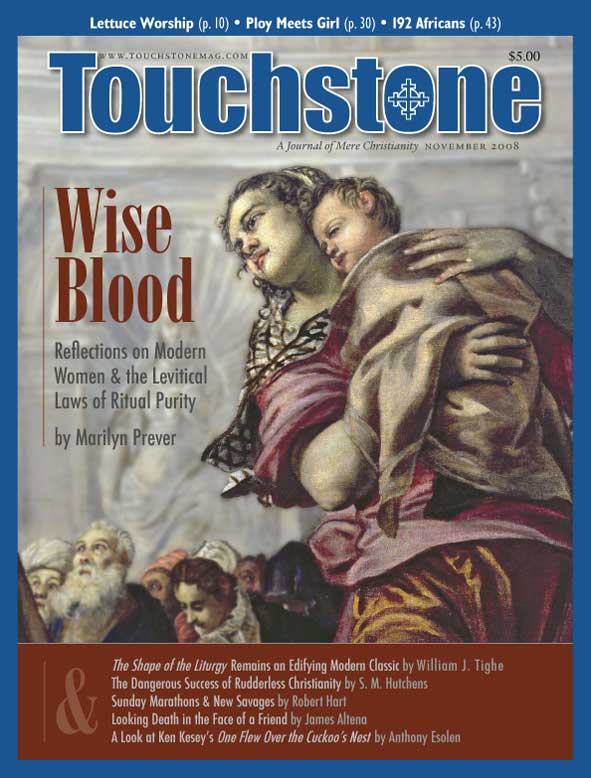
The Shape of the Liturgy
Dom Gregory Dix’s Imperfect Work Remains an Edifying Modern Classic
by William J. Tighe
In January 1945 there appeared in England a book that was to provoke controversy and debate on several fronts for many decades. The book, The Shape of the Liturgy, which straddled the line between the academic and the popular, was to have a formative impact on the liturgical thought and practice of many Anglican churches, as well as on Roman Catholics and many Protestants, including some Lutheran, Methodist, and even Reformed bodies.
The book gave force to the movement to make the Eucharist (Holy Communion or the Lord’s Supper) the principal act of worship every Sunday—or at least to make it a much more frequent service than in the past. In opposition to the view that the significance or “meaningfulness” of the sacrament would be cheapened by its frequent celebration (among Protestants) or reception (among high-church Anglicans), it insisted that the early Church saw the Lord’s commandment of “Do this in memory of me” as fulfilled by celebrating the sacrament Sunday after Sunday.
More problematically, it also gave rise in some circles to an ongoing “quest for the perfect liturgy” that resulted in incessant liturgical experimentation. It also gave rise to the view (which was not the author’s) that the worship life of the Church had gone astray at a very early date and needed radical overhauling at the behest of liturgical “experts.” Those who sponsored or implemented these changes seemed ignorant of (or unconcerned about) the fact that wherever new ideas (or old forgotten ones) are accepted by experts and “those in the know” but go against deeply ingrained customs and ways of thinking, their implementation is bound to cause distress to some, and in many cases—especially when the changes seem to be imposed needlessly and from outside—conflict.
The Monk’s Tome
The author, born George Eglington Alston Dix in 1901, took his monastic name from Pope St. Gregory VII, who, as he once explained, “deposed more bishops than any other man in history.” He had read history as an undergraduate at Keble College, Oxford, and returned there briefly after ordination in the Church of England as a chaplain and tutor in modern history, before joining in 1926 the Anglican Benedictine community of Nashdom Abbey, where he lived until his death in 1952.
According to Dix’s introduction, the 783-page book began as a paper presented to members of an Anglican religious order in August 1941. Since the first edition appeared in January 1945 and the second in August of that year, its writing was an impressive achievement—the more so as Dix spent those war years outside his monastery, serving as a supply-priest for parishes whose clergy were in military service (such as his own brother).
Dix’s “fat green book” (as he referred to it after its publication) immediately became a best-seller, and it has never gone out of print. A new impression, with an introducton by an Oxford don, Simon Jones of Merton College, was released in July 2005. Its seventeen chapters are both thematic and chronological.
This sounds like a forbidding tome, along the lines of the ancient Greek saying, “A big book is a big evil,” in both length and complexity. But as E. C. Ratcliff, an academic liturgist and Regius Professor of Divinity at Cambridge, once remarked about it, “It is an extraordinary thing to find a book that reads like a novel, but is in fact a serious contribution to scholarship.” (Perhaps Ratcliff had in mind a novel like those of Charles Dickens of comparable length to Dix’s book, but it was a strikingly accurate perception.)
The Eucharistic Theme
William J. Tighe was Professor of History at Muhlenberg College in Allentown, Pennsylvania, until his retirement in 2024. He is a member of St. Josaphat Ukrainian Catholic Church in Bethlehem, Pennsylvania.He is a senior editor for Touchstone.
A Journal of Mere Christianity—Delivered to Your Door
- Essays on theology, culture, and the Church
- Contributors from across the Christian traditions

Six print issues (one year) of Touchstone, plus full online access and PDF downloads for only $39.95.

Get a one-year full-access subscription to the Touchstone online archives for only $19.95.
bulk subscriptions
Order Touchstone subscriptions in bulk and save $10 per sub! Each subscription includes 6 issues of Touchstone plus full online access to touchstonemag.com—including archives, videos, and pdf downloads of recent issues for only $29.95 each! Great for churches or study groups.
Transactions will be processed on a secure server.
more from the online archives
calling all readers
Please Donate
"There are magazines worth reading but few worth saving . . . Touchstone is just such a magazine."
—Alice von Hildebrand
"Here we do not concede one square millimeter of territory to falsehood, folly, contemporary sentimentality, or fashion. We speak the truth, and let God be our judge. . . . Touchstone is the one committedly Christian conservative journal."
—Anthony Esolen, Touchstone senior editor