




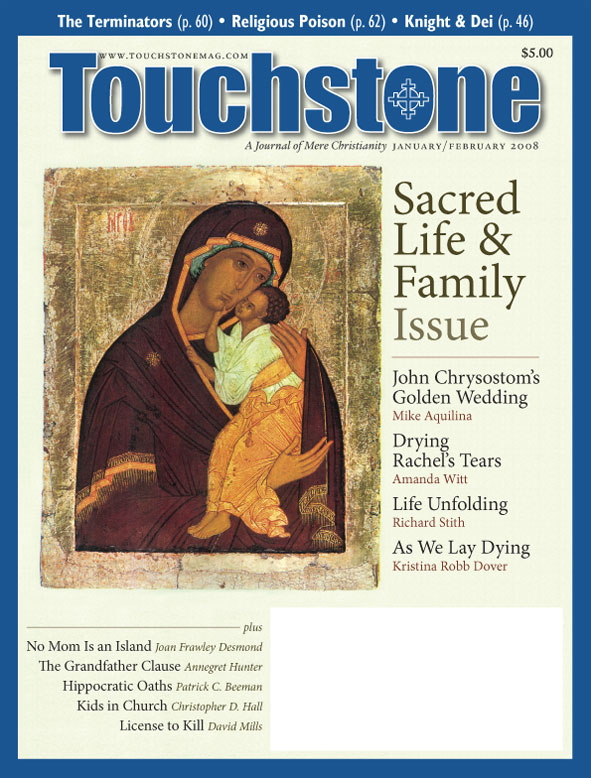
Baby Pew Sitters
Christopher D. Hall on the Disservice of Children’s Church
I understand the concept of “children’s church.” I sat in pews with small children before I was ordained. I know the constant juggling of Cheerios and crayons, the winces as plastic toys hit the tile floor, the random shrieks of babies, and the “whisper” of toddlers that carries halfway to the pulpit.
I’ve said prayers like this: “Our Father who art in . . . ssshh! Put that down . . . thy kingdom come, thy will . . . no, don’t color on that . . . Give us this day . . . ssshh! I said. . . .” It would be nice to have an hour of quiet, an hour of worship, an hour of attentiveness knowing that my children are hearing about our God and Savior.
Children’s church seeks to reach children at a level cognitively and emotionally appropriate to their age, all the while allowing parents to be attentive to worship, but it does a disservice to the children, disconnecting them from the church gathered as the complete Body of Christ, sacramentally present, serving the Body of Christ with our Lord himself. It does a disservice to adults, too, subtly giving them the impression that church is like the evening news or a PG-rated musical: adult fare that requires some maturity.
Worship Beyond Reason
We don’t, and will never, offer children’s church in the church I pastor, because the alternative—“adult church”?—is not just for adults. Worship is not simply a rational, intellectual exercise appealing to the hearing and understanding of adults. Nor is it a postmodern, emotional, narrative experience that, well, also appeals to adults.
It is an encounter with the Triune God, which does not depend upon our own mental faculties (or lack thereof) or upon our emotional backgrounds, baggage, or preferences. The Word of God works, despite our sin, despite our cognitive ability, despite our age and experience.
The church fathers called worship “reasonable” or “rational,” contrasting it with pagan worship, especially the mystery cults and the ecstatic worship of the gods. Irrational worship did not involve the intellect, but the basest appetites and impulses. Irrational worship was the entire giving of oneself over to the manipulation and influence of the gods, a losing of one’s self and awareness in the emotional experiences of the moment.
Rational worship is sober, engaging the senses in the worship of the divine, but also—especially—engaging the mind as well. It controls emotion, submitting it to the God of order: “For God is not the author of confusion but of peace, as in all the churches of the saints” (1 Cor. 14:33).
Yet worship is not only the engaging of the rational faculties. Worship is the peaceful and ordered encounter with the revealed Triune God, who through his Word speaks not just to the mind but to the entire person, to the spirit.
A Journal of Mere Christianity—Delivered to Your Door
- Essays on theology, culture, and the Church
- Contributors from across the Christian traditions

Six print issues (one year) of Touchstone, plus full online access and PDF downloads for only $39.95.

Get a one-year full-access subscription to the Touchstone online archives for only $19.95.
bulk subscriptions
Order Touchstone subscriptions in bulk and save $10 per sub! Each subscription includes 6 issues of Touchstone plus full online access to touchstonemag.com—including archives, videos, and pdf downloads of recent issues for only $29.95 each! Great for churches or study groups.
Transactions will be processed on a secure server.
more from the online archives


calling all readers
Please Donate
"There are magazines worth reading but few worth saving . . . Touchstone is just such a magazine."
—Alice von Hildebrand
"Here we do not concede one square millimeter of territory to falsehood, folly, contemporary sentimentality, or fashion. We speak the truth, and let God be our judge. . . . Touchstone is the one committedly Christian conservative journal."
—Anthony Esolen, Touchstone senior editor
