




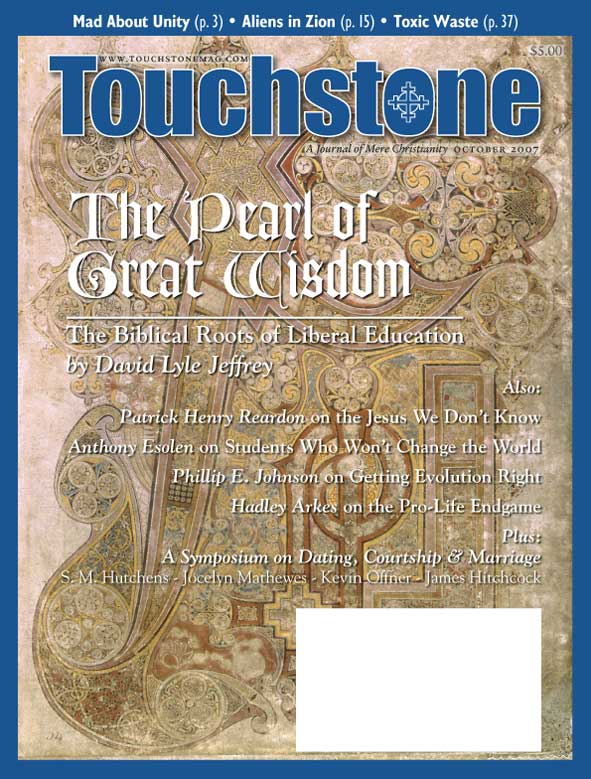
Permutations of Evolution
At a very early stage of the campaign for the 2008 presidential election, a television event was staged at which a domineering host insisted that the Republican candidates answer “yes” or “no” to his question, “Do you believe in evolution?” It was a trick question designed to embarrass, because evolution is not a single, precisely defined concept, but a set of related concepts, some of which are much better supported than others. The candidates should have demanded a precise definition before they would answer, but the format did not permit that option.
If the question had referred only to the evolutionary process by which disease-causing viruses become resistant to antiviral drugs, then all of the candidates, and all of the voters, would have answered “yes.” If the question had been whether all living organisms share a common ancestor, then the responses might have been fairly evenly divided. If the question had been, “Do you agree that the development of life from the first living cell up to and including humans was governed by Darwin’s mechanism of random mutation with natural selection, so that there was no need or room for a creator at any point?”, there might have been more answering “no” than “yes.”
By demanding a yes or no answer to his oversimplified question, “Do you believe in evolution?”, the host was refusing to allow the candidates to make sense of his question before answering it. That kind of oversimplification belongs to the realm of partisan politics or comedy, not science.
THIS ARTICLE ONLY AVAILABLE TO SUBSCRIBERS.
FOR QUICK ACCESS:
Phillip E. Johnson is Professor of Law (emeritus) at the University of California at Berkeley. He is the author of Darwin on Trial, The Wedge of Truth, The Right Questions (InterVarsity Press), and other books challenging the naturalistic assumptions that dominate modern culture. He is a contributing editor of Touchstone.
A Journal of Mere Christianity—Delivered to Your Door
- Essays on theology, culture, and the Church
- Contributors from across the Christian traditions

Six print issues (one year) of Touchstone, plus full online access and PDF downloads for only $39.95.

Get a one-year full-access subscription to the Touchstone online archives for only $19.95.
bulk subscriptions
Order Touchstone subscriptions in bulk and save $10 per sub! Each subscription includes 6 issues of Touchstone plus full online access to touchstonemag.com—including archives, videos, and pdf downloads of recent issues for only $29.95 each! Great for churches or study groups.
Transactions will be processed on a secure server.
more from the online archives


33.2—March/April 2020
Lewis, Chesterton, et al. Against the Frauds, Experts & Revisionists by Vigen Guroian

14.1—January/February 2001
A Sociologist Looks at Fatherlessness & Its Causes by David Blankenhorn
calling all readers
Please Donate
"There are magazines worth reading but few worth saving . . . Touchstone is just such a magazine."
—Alice von Hildebrand
"Here we do not concede one square millimeter of territory to falsehood, folly, contemporary sentimentality, or fashion. We speak the truth, and let God be our judge. . . . Touchstone is the one committedly Christian conservative journal."
—Anthony Esolen, Touchstone senior editor
