




Shades of Sheol
Resurrection and the Restoration of Israel: The Ultimate Victory of the
God of Life
by Jon D. Levenson
Yale University Press, 2006
(304 pages, $40.00, hardcover)
reviewed by Peter J. Leithart
When Paul commends the faith of Abraham in Romans 4, he commends not only the fact but also the content of Abraham’s faith. Like Abraham, Christians are called to trust in the God who raises the dead. For Paul, the faith of Israel has always been faith in the God who gives new life on the far side of the grave.
After his resurrection, Jesus spent forty days opening the minds of his disciples to understand the Scriptures. According to Jesus, the Scriptures teach “that the Christ should suffer and rise again from the dead on the third day” (Luke 24:46).
Modern scholars find these readings of the Old Testament incredible. According to their evolutionary reconstruction of Israelite religious history, hope for resurrection is a late and anomalous intrusion into the faith of Israel.
Early Hebrews believed that death was a natural part of creation and that all who died went to the dim underworld of “Sheol,” from which they had no hope of escape. When resurrection belief emerges after the Babylonian exile, modern scholars consider it, in Jon Levenson’s words, “a foreign importation devised to solve a new and embarrassing theological crisis.”
God’s Triumph
Levenson, Albert A. List Professor of Jewish Studies at Harvard University, challenges this reconstruction of the development of Jewish beliefs in resurrection. He agrees with the scholarly consensus that belief in individual bodily resurrection appears explicitly only after the Babylonian exile, but he argues compellingly that the faith that God will triumph over death in all its forms pervades the Hebrew Bible.
Instead of being a “jarring innovation in Second Temple Judaism,” belief in individual resurrection “developed slowly and unevenly over the preceding centuries,” particularly out of the “long-standing conviction that God would yet again prove faithful to his promises of life for his people and that he had the stupendous might it would take to do so.”
The Midrash states, “No passage lacks the resurrection of the dead, but we lack the capacity to interpretproperly” ( Sifre on Deuteronomy 32). Though Levenson doesn’t entirely endorse that claim, he finds more truth in it than most modern scholars, and his book is an effort to restore our capacity to see the triumph of the God of life as a major theme of the Bible.
Much of Levenson’s argument depends on his insight that, for ancient Hebrews, life and death are not purely biological conditions. They are instead relational and social conditions, and have to do as much with the quality of life as with the fact of having a beating heart.
Peter J. Leithart is an ordained minister in the Presbyterian Church in America and the president of Trinity House Institute for Biblical, Liturgical & Cultural Studies in Birmingham, Alabama. His many books include Defending Constantine (InterVarsity), Between Babel and Beast (Cascade), and, most recently, Gratitude: An Intellectual History (Baylor University Press). His weblog can be found at www.leithart.com. He is a contributing editor of Touchstone.
A Journal of Mere Christianity—Delivered to Your Door
- Essays on theology, culture, and the Church
- Contributors from across the Christian traditions

Six print issues (one year) of Touchstone, plus full online access and PDF downloads for only $39.95.

Get a one-year full-access subscription to the Touchstone online archives for only $19.95.
bulk subscriptions
Order Touchstone subscriptions in bulk and save $10 per sub! Each subscription includes 6 issues of Touchstone plus full online access to touchstonemag.com—including archives, videos, and pdf downloads of recent issues for only $29.95 each! Great for churches or study groups.
Transactions will be processed on a secure server.
more from the online archives
32.2—March/April 2019
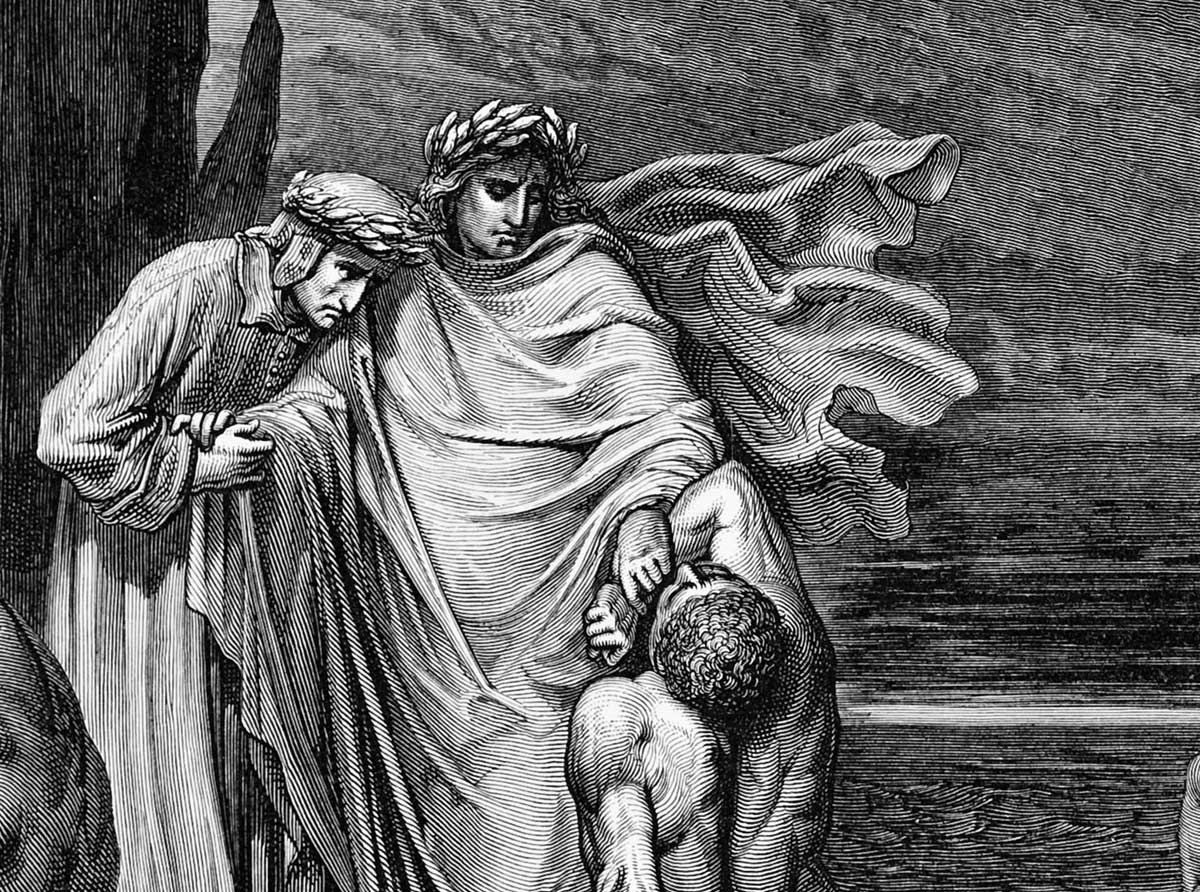
Misguided Mercy & Dante's Infernal Purgation by Joshua Hren

30.6—Nov/Dec 2017
on C. S. Lewis, Brideshead Revisited & the Middle Things by Ben Reinhard
calling all readers
Please Donate
"There are magazines worth reading but few worth saving . . . Touchstone is just such a magazine."
—Alice von Hildebrand
"Here we do not concede one square millimeter of territory to falsehood, folly, contemporary sentimentality, or fashion. We speak the truth, and let God be our judge. . . . Touchstone is the one committedly Christian conservative journal."
—Anthony Esolen, Touchstone senior editor
