




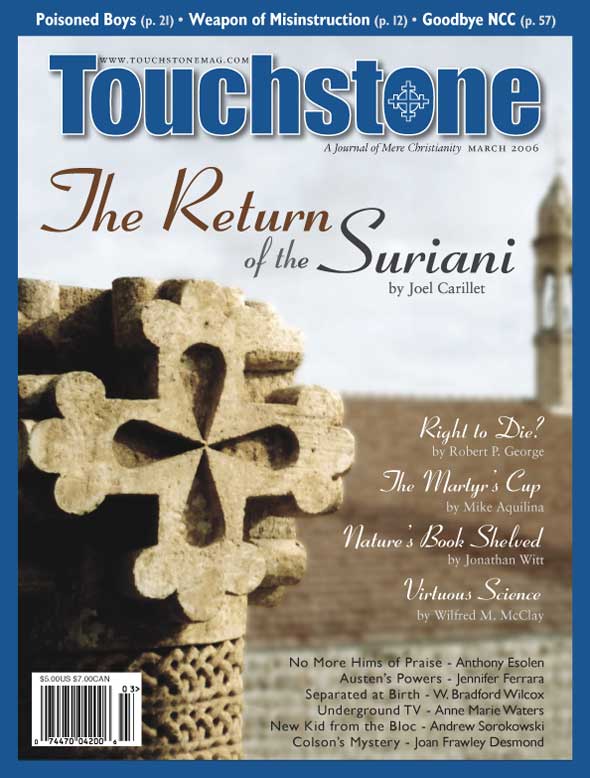
New Kid From the Bloc
Will Ukraine Help to Reorient Post-Christian Europe?
by Andrew Sorokowski
If a latter-day Vladimir the Great, baptizer of the Eastern Slavs, were to choose a new creed for his people, would he still choose Christianity? Or looking toward the European Union as his model and ally, might he instead select the new creed of the European elite: a secular humanism based on pluralism, tolerance, equality, and human rights, with its Christian roots neatly amputated?
On December 26, 2004, the Orange Revolution in Vladimir’s capital of Kiev chose Europe and the West, rather than Russian Eurasia, as Ukraine’s political and economic lodestar. What will this mean for her 25 to 30 million Christians? Will democracy, civil society, and the free market bring secularism and the end of religion? Or will the Orthodox, Catholics, and Protestants of Europe’s territorially second-largest country (Russia is first) help tip the balance between Christian and secular Europe?
Of a population of 47 million, about 33 million, or 70 percent, are religious believers. Roughly half of those are Orthodox, divided among three churches. The rest include some four million Greek-Catholics (that is, Catholics of the Byzantine-Slavonic rite); around a million Protestants; less than a million each of Roman Catholics, Jews, and Muslims; and about ten million who believe in God but do not belong to any church.
Moral Revolution
Like about a third of his fellow Ukrainians, the pro-Western leader in Kiev, Victor Yushchenko, is an Orthodox believer. The “Orange Revolution” that swept this opposition candidate into power in the closing months of 2004 was distinctly moral, demanding honesty in elections and integrity in government.
Exhibiting neither the cold ruthlessness of 1793 and 1917 nor the immature self-indulgence of 1968, the peaceful demonstrations in Kiev’s Independence Square were characterized by self-discipline and restraint—indeed, by the same personal ethics and morality that the protestors expected of their elected officials. Drugs and alcohol were banned. Observers were struck by the religious character of the protests, which began each day with prayers and included a sizeable contingent of secular and monastic clergy. At one point, representatives of Ukraine’s Jewish, Islamic, Protestant, Orthodox, and Greek-Catholic communities joined Yushchenko on the podium.
Yushchenko’s greatest support came from Western Ukraine, the most religious part of the country, where over 90 percent of the population believes in God. In this area’s L’viv and Ternopil’ regions, for example, weekly church attendance is over 44 percent. Western Ukraine is the traditional stronghold of the Ukrainian Greek-Catholic Church, banned by the Soviet regime from 1946 to 1989, whose roughly four million believers are led by the Western-educated Lubomyr Cardinal Husar. But Ukraine’s two Kiev-based independent Orthodox Churches are also strongest in Western Ukraine.
Yushchenko’s opponent, Victor Yanukovych, also an Orthodox believer, drew his strongest support from the heavily industrialized and Sovietized East and South—the least religious part of the country, where only about 55 percent of the population believes in God. Weekly church attendance in the Donets’k and Luhans’k regions, for example, barely exceeds nine percent. The population in these areas is heavily Russian or Russian-speaking, and tends to favor closer relations with Ukraine’s northern neighbor.
Of the Orthodox in that part of the country, the actively religious minority generally favors the Ukrainian Orthodox Church under the Moscow Patriarchate (UOC-MP). Formerly the Ukrainian exarchate of the Russian Orthodox Church, this is still the largest of Ukraine’s churches, at least in number of eparchies (dioceses) and parishes.
Andrew Sorokowski , a historical researcher for the Department of Justice, is the editor of A Millennium of Christian Culture in Ukraine (Ukrainian Millennium Committee in Great Britain, 1988) and the author of articles in scholarly journals such as Religion in Communist Lands and The Ukrainian Historian. From 1984 to 1987 he was a member of the research staff at Keston College in England (www. starlightsite.co.uk/keston) and from 1989 to 1990 served in Rome on the chancery staff of the late Myroslav Ivan Cardinal Lubachivsky. He lives with his wife in Rockville, Maryland, and attends Holy Trinity Ukrainian Catholic Church in Silver Spring, Maryland.
A Journal of Mere Christianity—Delivered to Your Door
- Essays on theology, culture, and the Church
- Contributors from across the Christian traditions

Six print issues (one year) of Touchstone, plus full online access and PDF downloads for only $39.95.

Get a one-year full-access subscription to the Touchstone online archives for only $19.95.
bulk subscriptions
Order Touchstone subscriptions in bulk and save $10 per sub! Each subscription includes 6 issues of Touchstone plus full online access to touchstonemag.com—including archives, videos, and pdf downloads of recent issues for only $29.95 each! Great for churches or study groups.
Transactions will be processed on a secure server.
more from the online archives
37.5—Sept/Oct 2024
An Abandoned Ruling Principle & How to Get It Back by Adam MacLeod
35.4—Jul/Aug 2022
The Death Rattle of a Tradition
Contemporary Catholic Thinking on the Question of War by Andrew Latham
calling all readers
Please Donate
"There are magazines worth reading but few worth saving . . . Touchstone is just such a magazine."
—Alice von Hildebrand
"Here we do not concede one square millimeter of territory to falsehood, folly, contemporary sentimentality, or fashion. We speak the truth, and let God be our judge. . . . Touchstone is the one committedly Christian conservative journal."
—Anthony Esolen, Touchstone senior editor
