The Well-Connected Mother by Juli Loesch Wiley

The Well-Connected Mother

The Centrality of Motherhood Is Not Just an Idea

by Juli Loesch Wiley

We get mothering wrong sometimes. We get it wrong with sexism and with feminism. We get it wrong with sentimentality and utopianism and cruelty. And when we get it wrong, a conversation about one good mother can help us get it right again: a conversation about the Mother of God—she who is more honorable than the Cherubim and more glorious than the Seraphim, as the ancient hymn put it—as a pattern and prescription for all human motherhood.

Bodily Connectors

Motherhood starts with conception. Pope John Paul II said that the Annunciation, the conception of Jesus in the womb of Mary, is a high point not only of the history of the human race but of the universe. At the Annunciation, the Word became flesh, became flesh in the body of a woman. This reminds me of how women’s bodies are different from men’s, and what this meant for Mary and what it means for us.

Men are often tempted to think that their bodies were made for their own use. To a great extent this is true for everyone: Your hands, sir, are yours, they are for your use, and mine are for my use. A man can indulge this illusion of autonomy even further by supposing that even his genitals are there for himself. They’re a source of at times almost compelling drives and intriguing sensations. Even his testes are useful for him, in that the hormones they produce provide certain secondary sexual characteristics he has an interest in maintaining.

But a woman’s body has all these nooks and crannies which are no use to us but evidently were put there for someone else. Don’t get me wrong: We women have our pleasure doodads and our own hormonal self-interest as well. But then, well, there’s the womb. That’s not there for me. I can do without it. It was obviously put there for someone else. The same is true of mature mammary glands, rich with branching ducts and reservoirs, as they are found in nursing mothers and as they are not found in childless females, however nubile and Partonesque they may be.

Our female bodies are connectors: Inter-connectedness is not just a concept, it’s built into us. This gives us the sense that we find in Mary’s Magnificat, of being, within our own bodies, the living link between past and future: “Behold, all generations will call me Blessed. . . . His mercy is on those who fear him, from generation to generation. . . . As he spoke to our ancestors, to Abraham and to his posterity forever.”

Mary sees ancestors past, and posterity future, linked in the center of her being. Her person—her body, her soul, her faithful heart—is the connector. She who is more spacious than the heavens. This makes autonomy, as an ideal, a poor fit for women. Women have a special gift, even a genius, for bondedness.

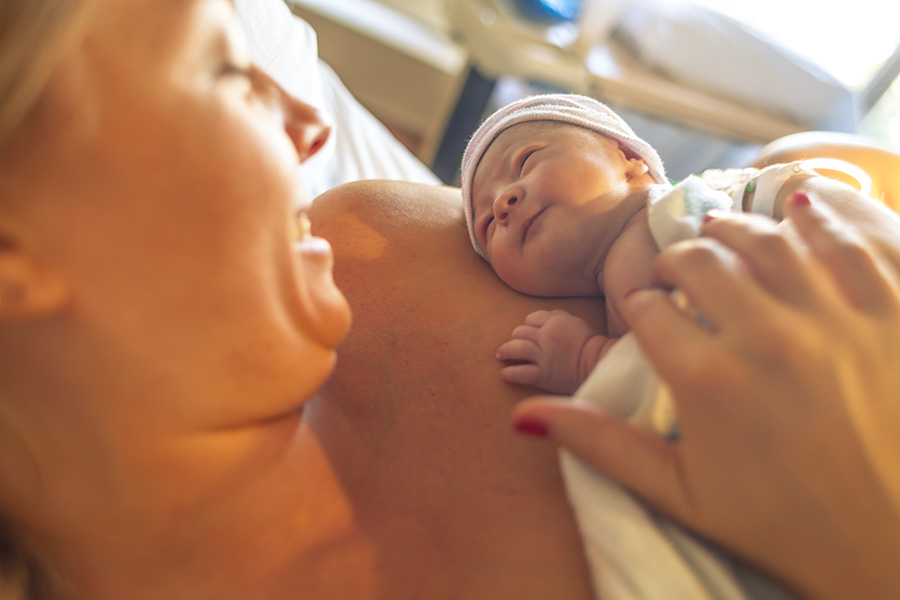
In conception and pregnancy, the mother and the child form a kind of multi-personed continuity. They are kaleidoscopically interdependent. To me, it is somewhat perverse even to imagine a pregnant woman and her unborn child separately.

I saw an ad in a Christian magazine for a book called The Wondrous Story of Where Babies Come From. The cover shows the bold and Crayola-colored image of a human embryo projected, as it were, on a huge movie screen, while a stereotypical Mom, Dad, and Two Kids gawk and point. All I could think of was some low-concept science fiction movie (“K-K-Kevin, Look! The Killer Embryo From Mars!”)


Juli Loesch Wiley is a freelance writer and long-time pro-life activist. She lives with her husband and two sons in ­Johnson City, Tennessee. She can be reached at jlw509@earthlink.net.

A Journal of Mere Christianity—Delivered to Your Door

  • Essays on theology, culture, and the Church
  • Contributors from across the Christian traditions

Subscribe (Print + Online)

Six print issues (one year) of Touchstone, plus full online access and PDF downloads for only $39.95.

Subscribe (Online Only)

Get a one-year full-access subscription to the Touchstone online archives for only $19.95.


bulk subscriptions

Order Touchstone subscriptions in bulk and save $10 per sub! Each subscription includes 6 issues of Touchstone plus full online access to touchstonemag.com—including archives, videos, and pdf downloads of recent issues for only $29.95 each! Great for churches or study groups.

Transactions will be processed on a secure server.


more on Motherhood from the online archives


more from the online archives

30.3—May/June 2017

Three Trojan Horses

Insider Attempts to Disorient the Orthodox by Alexander F. C. Webster

19.6—July/August 2006

Our Faith Observed

The Three-Fold Cord of Imagination, Reason & Will in C. S. Lewis by Michael Ward

22.8—November/December 2009

Looking for Wenceslaus

on the Real Men Behind the Christmas Carol by Michael Baum

calling all readers

Please Donate

"There are magazines worth reading but few worth saving . . . Touchstone is just such a magazine."
—Alice von Hildebrand

"Here we do not concede one square millimeter of territory to falsehood, folly, contemporary sentimentality, or fashion. We speak the truth, and let God be our judge. . . . Touchstone is the one committedly Christian conservative journal."
—Anthony Esolen, Touchstone senior editor

Support Touchstone

00