




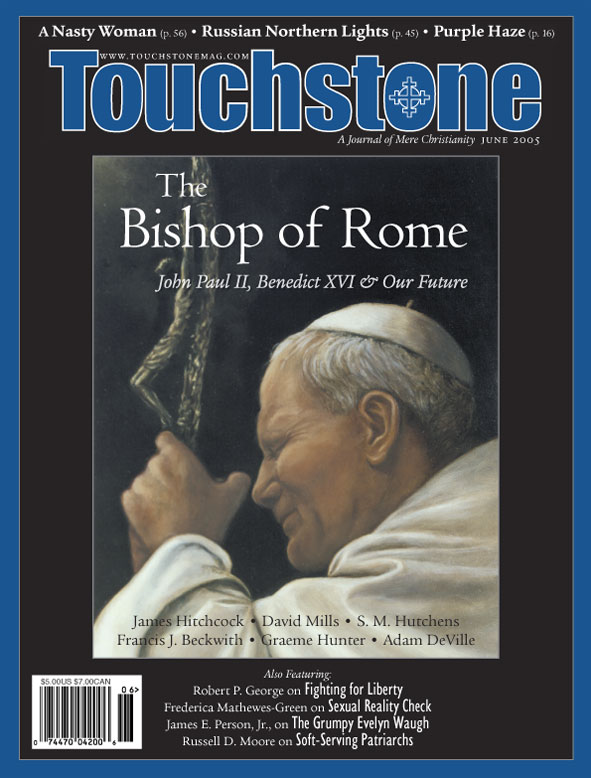
Feature
Deadly Satire, Saving Grace
The Faith & Work of Evelyn Waugh
by James E. Person, Jr.
As a writer, he could be deliciously cruel. In a book review, he once said that to behold one unfortunate writer’s fumbling attempts to use “our rich and delicate language is to experience all the horror of seeing a Sevre vase in the hands of a chimpanzee.” Of one of his friend Graham Greene’s novels, he wrote that “its selection as the Book of the Month will bring it to a much larger public than can profitably read it.”
As a man, he could be equally cruel. He bestowed upon family members as well as sworn enemies such nicknames as “Fat Fool” and “Hellswine.” He wrote of his own children, “I can only regard children as defective adults, hate their physical ineptitude, find their jokes flat and monotonous. . . . The presence of my children affects me with deep weariness and depression.” Typical was his comment on his son Auberon: “Bron is clumsy and disheveled, sly, without intellectual, aesthetic or spiritual interest.”
Yet a neighbor and friend described him as “the most charming, enchanting, absolutely outstandingly lovely man I ever met.” Greene wrote that he “had the rare quality of criticizing a friend, harshly, wittily and openly to his face, and behind the friend’s back of expressing only his kindness and charity.” His personal spiritual disciplines were rigorous, and his charity, much of it given privately, very generous.
The writer of some of the most deadly satire of his age, he crafted some of Western literature’s premiere novels exploring the mysteries of faith and the truth of Christianity. William F. Buckley, Jr., considered him the twentieth century’s “most finished writer of English prose” (Waugh himself suggested P. G. Wodehouse as the top candidate for that honor), and Russell Kirk declared that “in any good literary history of his time, he should loom nearly as large as T. S. Eliot.”
A Stronger Faith
Born a little over 100 years ago, Evelyn Waugh stripped the follies of his time in such enduring satires as Decline and Fall (1928), A Handful of Dust (1934), Scoop (1938), and The Loved One (1948). He also wrote four novels recognized as classics of Christian humanism and the struggle for order in the soul and in society: Brideshead Revisited (1945) and a trilogy of novels published in the fifties— Men at War, Officers and Gentlemen, and Unconditional Surrender—later collected and published in one volume as Sword of Honour (1965).
In a succinct summary difficult to improve upon, the historian John Lukacs once described Waugh’s view of life and faith as “a faith in God which was not only stronger than a faith in man but which included the comprehension that the two cannot be entirely separated,” which included
an understanding that the knowledge of the depravity of human nature is not enough (this is what separates Waugh from Céline, with the result that Waugh’s humor, unlike his mischief, is not necessarily black); a faith in a code of conduct which is noble rather than humanitarian, and self-sacrificing rather than merely brave; a belief in original sin which can be forgiving but which has surely nothing to do with evolution; a strict and narrow faith (faith, rather than trust) in heredity rather than in environment; an understanding that what people think and what they believe, even more than their material conditions, form their actions and their character.
Lukacs concluded that more people were coming to recognize his genius because “the opposites of these beliefs have become so evidently bankrupt.”
Waugh loved with a fierce passion the land of his birth and its heritage of faith—not the England of the present but the old England: the England of the ancient faith, deference to the rightful authority of talent and achievement, and humble inns, the community of souls who lived close to the land—the same England celebrated by G. K. Chesterton and Hilaire Belloc before him. He hated with an equally fierce passion the modern society in which he lived, satirizing its individualism, social leveling, devil-take-the-hindmost commercialism, noise, rootlessness, and disbelief in anything that could not be experienced through the agency of the five senses.
James E. Person, Jr. is the author of Russell Kirk: A Critical Biography of a Conservative Mind (Madison Books), as well as Earl Hamner: From Walton's Mountain to Tomorrow (Cumberland House Publishing), and is a longtime book reviewer. He has written on Kirk and on Evelyn Waugh for Touchstone.
A Journal of Mere Christianity—Delivered to Your Door
- Essays on theology, culture, and the Church
- Contributors from across the Christian traditions

Six print issues (one year) of Touchstone, plus full online access and PDF downloads for only $39.95.

Get a one-year full-access subscription to the Touchstone online archives for only $19.95.
bulk subscriptions
Order Touchstone subscriptions in bulk and save $10 per sub! Each subscription includes 6 issues of Touchstone plus full online access to touchstonemag.com—including archives, videos, and pdf downloads of recent issues for only $29.95 each! Great for churches or study groups.
Transactions will be processed on a secure server.
more from the online archives

35.6—Nov/Dec 2022
on the Divine Promise Fulfilled by the Child of Bethlehem by James M. Kushiner
14.6—July/August 2001
The Transformed Relics of the Fall
on the Fulfillment of History in Christ by Patrick Henry Reardon
5.3—Summer 1992
Everything You Need to Know About Morality & the Bible by David Mills
calling all readers
Please Donate
"There are magazines worth reading but few worth saving . . . Touchstone is just such a magazine."
—Alice von Hildebrand
"Here we do not concede one square millimeter of territory to falsehood, folly, contemporary sentimentality, or fashion. We speak the truth, and let God be our judge. . . . Touchstone is the one committedly Christian conservative journal."
—Anthony Esolen, Touchstone senior editor
