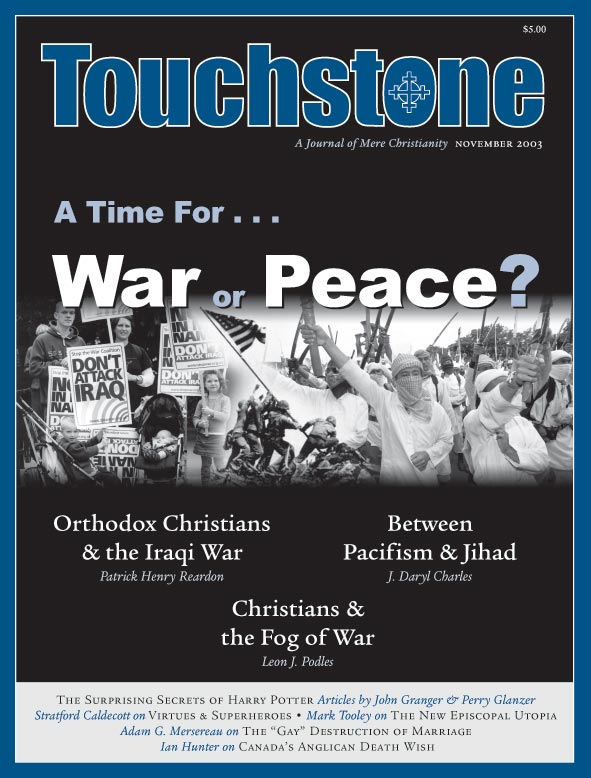
Between Pacifism & Jihad by J. Daryl Charles

Between Pacifism & Jihad

The Just-War Tradition Today

by J. Daryl Charles

The character of much current religious dissent to the use of military force has been dispiriting. A good number of the dissenting responses lack serious thinking about the role of the authorities in preserving the moral and social order and protecting the citizenry, and many fail to engage in serious moral reflection about our duty to our neighbor.

Many religious leaders seem to hold an overwhelming presumption against the use of military force and to assume that any use of force is immoral in and of itself. They seem to define peace simply as the absence of war. It is thought that the use of force among the nations can be abolished within human history, a presupposition that reflects a secular and optimistic view of human nature and human history rather than a Christian realism rooted in the biblical story.

While American foreign policy is eminently debatable, the purpose of this essay is to bring into focus once more an enduring aspect of the Christian moral tradition—an aspect deemed antiquated by many—and consider its applicability to the challenge of terrorism. I speak of just-war teaching.

The ancient question of how the use of force can serve justice and peace has been a significant part of Christian reflection for the better part of two millennia. Just-war thinking is relevant to the present day precisely because it acknowledges the need of statecraft, seeks to apply consistent ethical norms to domestic and foreign policy, and wrestles with the moral limits of engaging in conflict (traditionally called jus ad bellum), while defining the moral limits of what a nation may do within a conflict (jus in bello).

It agrees with pacifism that some resort to violence is morally wrong, but rejects the notion that violence is always wrong. It is committed to bringing to the world as much peace as is possible, but unlike pacifism, it believes that in this fallen world some resort to force is necessary to bring peace to peoples and nations. At the same time, it recognizes the tendency to violence in peoples and nations and represents an attempt to restrain and regulate this violence.

I will present a brief summary of just-war thinking later in the essay, but first we need to consider three antecedent matters that will put it in context: (1) what might be called the “non-fluid” character of justice; (2) the obligations that inhere in our duty to our neighbor; and therefore (3) the nature of Christian vocation as it applies to resisting evil. The first explains how Christians can resolve the apparent conflict between the biblical call to peace and the requirement to defend the defenseless; the second defines that requirement; and the third distinguishes the duty of the individual, bound to non-resistance, from that of the nation.

Non-Fluid Justice

Justice is developed philosophically both in pre-Christian philosophy (Plato’s Republic is dedicated to this theme) and in the Judeo-Christian moral tradition. Both describe justice in terms of giving to each person that which is due him. The language of justice fills the entire Bible, and correctly so, since justice describes how people ought to associate with one another and, therefore, how society ought to function.

While Scripture agrees with the pre-Christian philosophical tradition that justice is that which is due to others, it also explains why this is so. In Scripture, the people of God are commanded to execute justice precisely because God himself does so. Human beings bear the image of God. Thus, the Judeo-Christian tradition affirms the inherent morality of punishment. For to be created in the image of God is to be endowed with moral agency, and to be held accountable for our actions is to be treated with dignity precisely because one is a moral agent.


J. Daryl Charles is the Acton Institute Affiliated Scholar in Theology & Ethics. He is the author or editor of twenty books, including Retrieving the Natural Law (2008), Natural Law and Religious Freedom (2018), and, most recently, Just War and Christian Traditions (forthcoming). He is also co-editor of Abraham Kuyper, Common Grace: God's Gifts for a Fallen World, Volume 3 (2020). He is a contributing editor to Touchstone.

A Journal of Mere Christianity—Delivered to Your Door

  • Essays on theology, culture, and the Church
  • Contributors from across the Christian traditions

Subscribe (Print + Online)

Six print issues (one year) of Touchstone, plus full online access and PDF downloads for only $39.95.

Subscribe (Online Only)

Get a one-year full-access subscription to the Touchstone online archives for only $19.95.


bulk subscriptions

Order Touchstone subscriptions in bulk and save $10 per sub! Each subscription includes 6 issues of Touchstone plus full online access to touchstonemag.com—including archives, videos, and pdf downloads of recent issues for only $29.95 each! Great for churches or study groups.

Transactions will be processed on a secure server.


more from the online archives

31.6—November/December 2018

Tragedy & Transcendence

on Futility & the Open Door to Deliverance by Patrick Henry Reardon

32.4—July/August 2019

Malaise in Malaysia

Will Islamicization Become Its New Future by Peter Riddell

30.6—Nov/Dec 2017

Odious & Deplorable

on C. S. Lewis, Brideshead Revisited & the Middle Things by Ben Reinhard

calling all readers

Please Donate

"There are magazines worth reading but few worth saving . . . Touchstone is just such a magazine."
—Alice von Hildebrand

"Here we do not concede one square millimeter of territory to falsehood, folly, contemporary sentimentality, or fashion. We speak the truth, and let God be our judge. . . . Touchstone is the one committedly Christian conservative journal."
—Anthony Esolen, Touchstone senior editor

Support Touchstone

00