





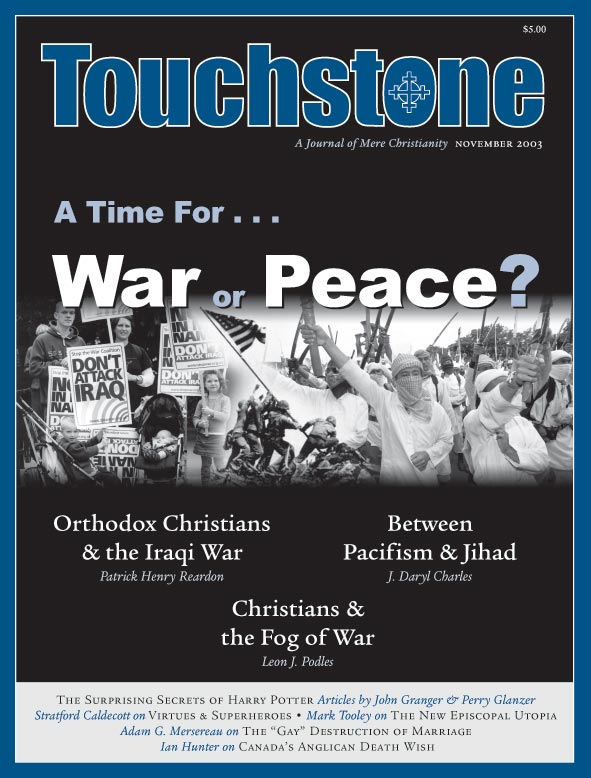
The Surprising Trouble with Harry
Perry Glanzer on Harry Potter & Public-School Moral Education
Everyone seems to love Harry Potter, except a few suspicious Christians. While many public school educators applaud how the Potter series motivates kids to read, they—not conservative Christians nervous about the witchcraft and wizardry—are the ones who should be scared of the Harry Potter series. For the books attractively challenge the moral vacuum within public schools. Those concerned with moral education in public schools—traditionalists, progressives, believers in Lawrence Kohlberg’s stages of moral development, and fans of character education—should beware the revolutionary challenge of Harry Potter’s moral world.
THIS ARTICLE ONLY AVAILABLE TO SUBSCRIBERS.
FOR QUICK ACCESS:
Perry Glanzer is an Assistant Professor in the School of Education at Baylor University and the author of The Quest for Russia?s Soul (Baylor University Press). He attends First Baptist Church in Woodway, Texas.
A Journal of Mere Christianity—Delivered to Your Door
- Essays on theology, culture, and the Church
- Contributors from across the Christian traditions

Six print issues (one year) of Touchstone, plus full online access and PDF downloads for only $39.95.

Get a one-year full-access subscription to the Touchstone online archives for only $19.95.
bulk subscriptions
Order Touchstone subscriptions in bulk and save $10 per sub! Each subscription includes 6 issues of Touchstone plus full online access to touchstonemag.com—including archives, videos, and pdf downloads of recent issues for only $29.95 each! Great for churches or study groups.
Transactions will be processed on a secure server.
more on education from the online archives

27.2—March/April 2014
Higher Education Should Advance the Glorious Liberty of the Sons of God by Anthony Esolen

26.5—Sept/Oct 2013
The Perils of Pragmatism in Christian Attitudes Toward the Liberal Arts by Robin Phillips
more from the online archives

18.4—May 2005
The Idylls, Idols & Devils That Corrupt the Moral Imagination by Vigen Guroian

26.1—Jan/Feb 2013
Manly Chastity, Hedonism & the Law of Non-contradiction by Anthony Esolen

37.5—Sept/Oct 2024
Why Law Schools Can't Teach Law
A sidebar to How Law Lost Its Way by Adam MacLeod
calling all readers
Please Donate
"There are magazines worth reading but few worth saving . . . Touchstone is just such a magazine."
—Alice von Hildebrand
"Here we do not concede one square millimeter of territory to falsehood, folly, contemporary sentimentality, or fashion. We speak the truth, and let God be our judge. . . . Touchstone is the one committedly Christian conservative journal."
—Anthony Esolen, Touchstone senior editor
