




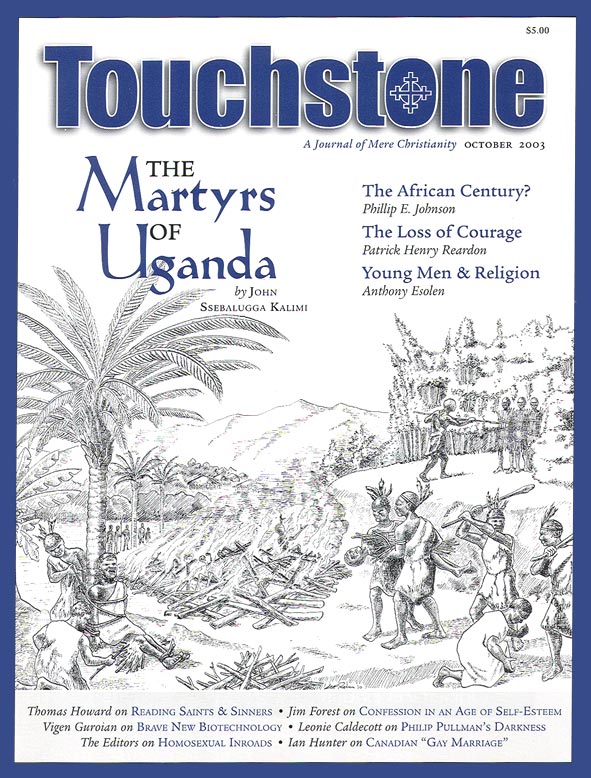
The African Cross-Bearers
John Ssebalugga Kalimi on the Martyrs of Uganda
Winston Churchill used to refer to the lush and fertile country of Uganda as “the pearl of Africa,” and legend has it that God stood in Uganda when he created the world. It is also one of the very few African countries, if not the only one, whose political leadership took the bold step of inviting missionaries to come and teach their people the Christian faith. “I and my people are in total spiritual darkness. I invite missionaries to bring the light of the Gospel to my kingdom,” wrote King Mutesa I of Buganda.
In 1877 the Anglican missionaries from the Church Missionary Society (CMS) arrived in the country, followed two years later by Catholic missionaries from the society of the White Fathers. The arrival of the Catholic missionaries was not so pleasing to the CMS missionaries, and constant rivalry, politicking, and unnecessary bickering characterized the primary stages of church planting in Uganda, to the amazement of the king, who had invited the missionaries to bring light to his country.
Suspicious of their intentions, the king lost trust in the new religion, and although he blessed the missionaries’ evangelistic campaigns around the kingdom, he never totally committed himself and, unfortunately, died unbaptized. Mwanga, the very young son who succeeded his father as king of Buganda, was equally suspicious of the missionaries’ intentions.
Disobedient Boys
Christianity took firm root nevertheless, and young converts serving at the court of the young king began to decline to participate in some of the cultural ceremonies, believing them unchristian. To do so was unheard of, and whoever was found guilty of such disobedience could be condemned to death. The boys were constantly marked absent on the court roll, having escaped to go for instructions as catechumens. They renounced any form of cultural practice that involved worshiping anything other than God the Father of Jesus Christ. In particular, they declined the young king’s luring to engage in homosexual activities with them—a practice he had newly adopted from Arab traders.
Since such disobedience was quite unheard of in the Buganda Kingdom, the king and his chiefs took it personally, assuming that the boys were deliberately despising the king for being relatively young compared to his late father. After a series of incidents of continued “disobedience,” the king summoned the young converts and told them either to renounce their Christian faith, stop attending the catechumenate classes, and live, or to continue professing their faith and be killed. These fiery and pious converts chose the latter, fully convinced that choosing the former would be denying their Master, whose newly found relationship with them gave them assurance of a better afterlife.
Despite various interventions by friends and parents trying to convince the boys to change their minds, 45 boys and men chose not to betray their newly found Friend. “You have the capacity to kill the body but not the soul,” they reminded the king. “We would rather betray the earthly king than the Heavenly King of Kings.”
As a test of their faith and as a means of dissuading the others, the executioners picked the most talkative first. In front of the other boys, they cut off the limbs of some and left them for dead. They put many others on the fire—legs first, hoping they would change their minds and survive. All these brutal acts did not dissuade the others as long as the only way to survive was by renouncing their faith.
The climax of the martyrdom came on June 3, 1886, at a place called Namugongo. Over thirty young boys and men, both Roman Catholics and Anglicans, were burnt to death by being thrown, one after another, on the fire made out of the firewood they had been forced to collect from the nearby forest. These boys did not change their mind despite various attempts to make them think otherwise. As the fires consumed them away,
O that I had wings of Angels
Here to spread and heavenward fly
I would seek the gates of Zion
Far beyond the starry sky
A Journal of Mere Christianity—Delivered to Your Door
- Essays on theology, culture, and the Church
- Contributors from across the Christian traditions

Six print issues (one year) of Touchstone, plus full online access and PDF downloads for only $39.95.

Get a one-year full-access subscription to the Touchstone online archives for only $19.95.
bulk subscriptions
Order Touchstone subscriptions in bulk and save $10 per sub! Each subscription includes 6 issues of Touchstone plus full online access to touchstonemag.com—including archives, videos, and pdf downloads of recent issues for only $29.95 each! Great for churches or study groups.
Transactions will be processed on a secure server.
more on martyrdom from the online archives
more from the online archives

37.5—Sept/Oct 2024
Why Law Schools Can't Teach Law
A sidebar to How Law Lost Its Way by Adam MacLeod
32.4—July/August 2019
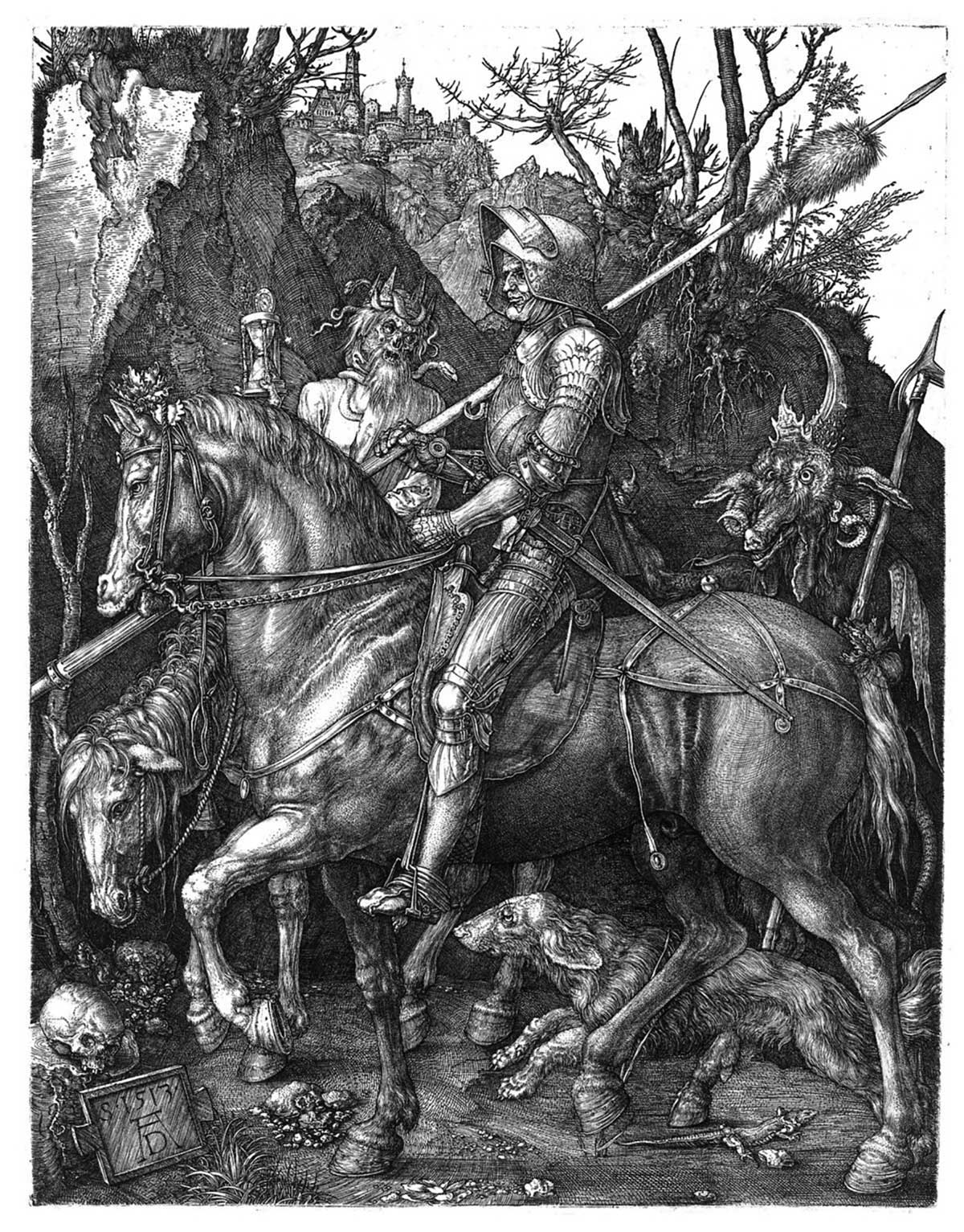
on Single-Mindedness in Durer's Ritter, Tod, und Teufel by Anthony Costello

calling all readers
Please Donate
"There are magazines worth reading but few worth saving . . . Touchstone is just such a magazine."
—Alice von Hildebrand
"Here we do not concede one square millimeter of territory to falsehood, folly, contemporary sentimentality, or fashion. We speak the truth, and let God be our judge. . . . Touchstone is the one committedly Christian conservative journal."
—Anthony Esolen, Touchstone senior editor
