Feature
Deadly Choice
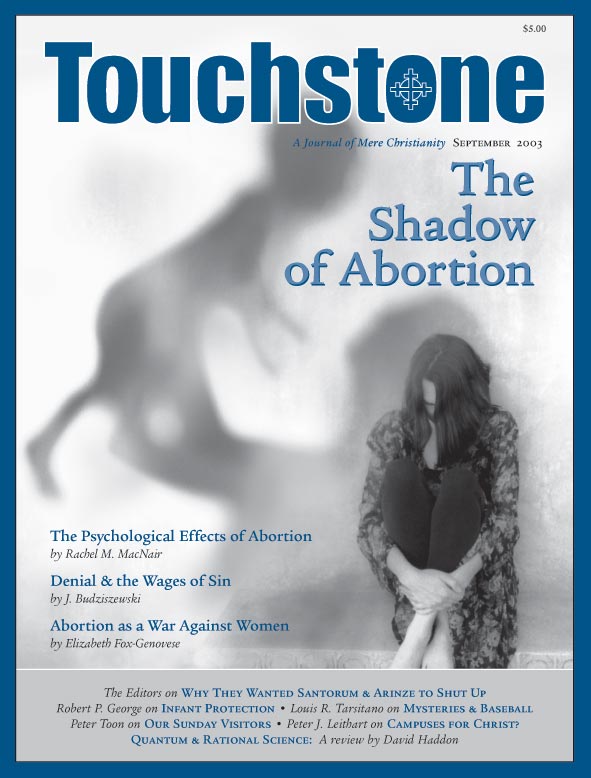
Abortion as a War Against Women
During the weeks leading up to the thirtieth anniversary of Roe v. Wade, there seemed to have been more news and commentary about abortion than there had been for years. The anniversary always elicits a flurry of opinion, but 2003 was different, and not only because of the significance of the anniversary. For one thing, in George Bush we have a president who is not merely pro-life for reasons of political discipline or expediency but, as far as one can tell, for reasons of personal conviction—and faith. For another, Republican majorities, however slim, prevail in both the House and the Senate, and we will likely see one or more vacancies on the Supreme Court, not to mention other federal courts throughout the nation.
This new political configuration has emerged at a moment when one major piece of pro-life legislation (the Born-Alive Infants Protection Act) has been enacted, and other important bills are pending before Congress: the Partial-Birth Abortion Ban Act (twice vetoed by President Clinton, and more recently stalled by Senator Daschle), the Unborn Victims of Violence Act, the Child Custody Protection Act, the RU-486 Patient Health and Safety Protection Act, and the Abortion Non-Discrimination Act. Notwithstanding the cries of panic and outrage from the pro-abortion forces—even the typically supercilious New York Times published a hysterical editorial on the demise of legal abortion—none of these bills will threaten the core of Roe v. Wade, although several undermine its logic. Presumably, the hyperbole of the pro-abortion forces derives in part from their fear of the slippery slope: If you diminish any aspect of unrestricted access to abortion, you open the door to its re-criminalization. But only in part.
The majority of Americans could live comfortably with the modest restrictions on abortion proposed in the bills now before Congress. Until recently, most apparently had only a vague impression of Roe’s provisions and assumed that it permitted first-trimester abortions but little more, except in the case of exceptional circumstances: rape, incest, or threat to the life of the mother. The pro-abortion lobby encouraged its supporters in their illusions, beginning with the claim that it was only defending a woman’s right “to choose.”
Several developments of the last few years have nonetheless jeopardized that cultivated ignorance. The debates over partial-birth abortion have highlighted abortion’s brutality and the possibility of performing it on viable, healthy babies. On the other side, the growing sophistication and use of sonography and fetoscopy have introduced innumerable couples to the human form of babies in the earliest stages of development. A mother who has seen a photograph of her “child” is less likely to turn to abortion than one who believes she is only carrying a bit of unformed tissue. In addition, a recent study shows that only five out of one hundred obstetrician/gynecologists are now willing to perform an abortion.1 These developments and many others have begun to shred the image of abortion as a “victimless crime” that is no crime at all but only failsafe protection for a decent woman who wants to make the most of herself and her life.
Gender Supplants Sex
The militancy of today’s pro-abortion campaign is beginning to expose its real goals. At the heart of those goals lies a passionate commitment to the transformation of women’s roles, relations with others, and nature. The pro-abortionists propose a radical revision of what it means to be a woman—if not the abolition of the very substance and concept of woman. By now, they have persuaded the media, who in turn have apparently persuaded most Americans, to substitute gender for sex. Presumably the campaign has succeeded because it has convinced the public that gender is more respectful of women’s varied talents and capabilities than sex. And most Americans agree that women deserve respect as persons “in their own right,” which is to say, as responsible and autonomous individuals. But most Americans—apart from college students who have been exposed to women’s, gender, or cultural studies—probably do not understand the full significance of the displacement of sex by gender.
The theoretical rationales for the preference for gender may become dizzyingly convoluted, but they rest on the common premise that biology has betrayed and oppressed women, who must be liberated from it. At first, proponents of gender argued that purported differences between the sexes were nothing but “socially constructed” gender roles, designed to keep women subordinate to men. That argument allowed for the possibility of a substratum of biological sex, but insisted that it had been distorted by society’s imposition of gender roles. More recently, cutting-edge academic theorists have dismissed sex entirely, arguing that the notion of a “real” biological sex is itself a sleight of hand—another trick of language employed to keep women in their place and to imprison the fluidity of everyone’s polymorphous sexual desires.
We may safely assume that most Americans do not fully grasp the connections that bind the preference for gender to the sanctity of a woman’s unconditional right to abortion, but they include a commitment to a woman’s right to liberation from her biological sex and especially from any children with whom her (woman’s) body may betray her.
From the start, the pro-abortionists have championed abortion as the cornerstone of women’s freedom and have fought for its recognition as a fundamental right—the necessary precondition for women’s equality with men. They have a point—albeit a deeply misguided one—and those who disagree cannot afford to underestimate its appeal. The pro-abortion forces ground their case in a comprehensive worldview. Doubtless many of their followers either do not recognize the worldview or pay it little mind. But in some ways, their uncritical acceptance makes them all the more dangerous, for they do not understand the magnitude of what they are agreeing to. And their uncritical acceptance vastly strengthens the hand of the hardcore pro-abortion faithful, who understand precisely the magnitude of their blueprint for women.
A Culture Conducive to Abortion
Elizabeth Fox-Genovese (d. 2007) was the Eleonore Raoul Professor of the Humanities and Professor of History at Emory University and a contributing editor of Touchstone. Her books include "Feminism Is Not the Story of My Life" (Anchor), Feminism Without Illusions (University of North Carolina Press), and, with her husband, The Mind of the Master Class (Cambridge University Press).
A Journal of Mere Christianity—Delivered to Your Door
- Essays on theology, culture, and the Church
- Contributors from across the Christian traditions

Six print issues (one year) of Touchstone, plus full online access and PDF downloads for only $39.95.

Get a one-year full-access subscription to the Touchstone online archives for only $19.95.
bulk subscriptions
Order Touchstone subscriptions in bulk and save $10 per sub! Each subscription includes 6 issues of Touchstone plus full online access to touchstonemag.com—including archives, videos, and pdf downloads of recent issues for only $29.95 each! Great for churches or study groups.
Transactions will be processed on a secure server.
more on abortion from the online archives

more from the online archives
19.10—December 2006
Workers of Another World United
A Personal Commemoration of Poland’s Solidarity 25 Years Later by John Harmon McElroy
calling all readers
Please Donate
"There are magazines worth reading but few worth saving . . . Touchstone is just such a magazine."
—Alice von Hildebrand
"Here we do not concede one square millimeter of territory to falsehood, folly, contemporary sentimentality, or fashion. We speak the truth, and let God be our judge. . . . Touchstone is the one committedly Christian conservative journal."
—Anthony Esolen, Touchstone senior editor