The Conservative Convert
The Life & Faith of Russell Kirk
by Eric Scheske
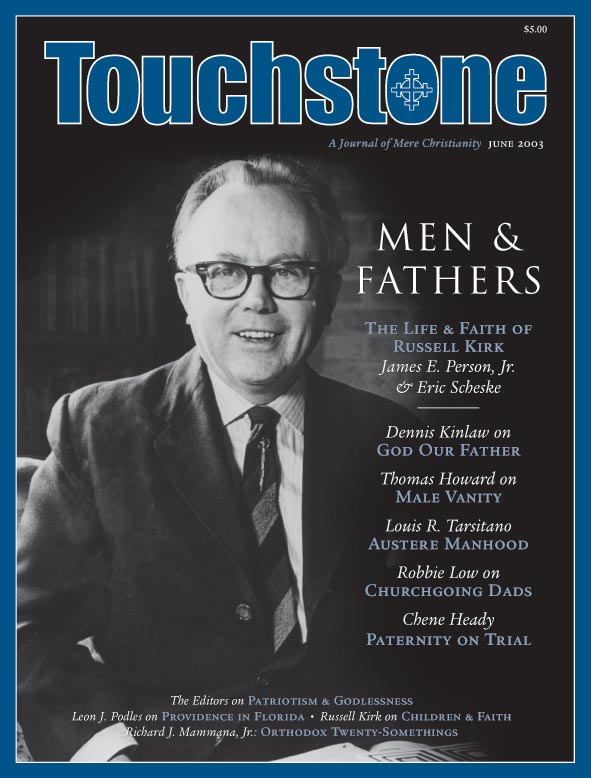
Terse Kirk. That’s one way to describe Russell Kirk, the literary critic and father of modern conservatism. He was the author of over thirty books and hundreds of articles, the founder of two quarterlies, and a busy speaker. But he was laconic when it came to his religion. Whereas many converts have a tendency to gush about their newfound faith, Kirk—a convert to Catholicism—didn’t write or talk much about it.
As a result, perhaps it is not surprising that there has been no treatment of Kirk’s religion since his death in 1994. But a sense of the transcendent informed everything he wrote. At some point, his religious background and disposition ought to be explored. This biography is a small contribution to that project.
From Ghosts to Books
Born in 1918 in Plymouth, Michigan, a small town west of Detroit, Kirk’s early life wasn’t religious. His parents were largely indifferent toward religion and declined even to have him baptized. Although his mother taught him prayers and encouraged him to attend Sunday school for a little while, he received no other religious instruction. By all appearances, his youth seeped the religious lukewarmness that God spits from his mouth.
But there was more to his upbringing. His recent ancestors weren’t just lukewarm Protestants. They were spiritual heirs of Emanuel Swedenborg, the Swedish scientist-turned-mystic who emphasized correspondence between the world of the living and the dead and whose followers gravitated toward séances and the uncanny and preternatural phenomena. Kirk’s ancestors offered their house at Piety Hill in Mecosta, Michigan (a village in the center of Michigan’s Lower Peninsula) for séances in the 1880s and 1890s after a local Spiritualist church burned down shortly after being built. Piety Hill also came to be the name of the family home, suitably enough, because of the rumors of strange goings-on that took place there, such as an aunt who levitated in her rocking chair and a fiddle that was played by invisible hands.1
These stories were passed on to Russell Kirk during his frequent and prolonged trips to Mecosta during his youth. Young Kirk himself once had a glimpse of these ghosts. He woke up one night in the front parlor and saw two men looking in the bay window. Thinking he must be seeing things, he put on his glasses and saw two men—one tall with a tall hat, the other short with a round hat. Frightened, he hid under his covers; the next morning, he looked for footprints in the snow but didn’t see any. Years later, his old Aunt Fay—a long-time resident of Piety Hill—told Kirk how, as a young girl, she had played with two men outside the bay window whom no one else could see—Dr. Cady, a tall man with a tall hat, and Patti, a short man with a turban. She knew nothing of Kirk’s experience years earlier.2
The ghostly influence of Piety Hill would stay with Kirk the rest of his life. Though his conventional religious upbringing may have been slack, this electric tinge of the supernatural would help make him receptive to sparks from the spiritual world, such as becoming aware, skeptic though he was and years before his eventual conversion, of a strong presence while standing in the vestibule of St. Teresa of Avila’s convent in Spain—a presence that has been known to cause women to flee the vestibule in tears.3
His ancestors were also cultural heirs of men like Sir Walter Scott and Nathaniel Hawthorne, fiction writers whose stories effused the moral imagination, a term Kirk borrowed from Edmund Burke. The moral imagination, Kirk said, is the “power of ethical perception which strides beyond the barriers of private experience and momentary events,” especially as embodied in poetry and art, and sustained by religion.4 By its nature, it emanates from the unseen and makes the mind’s eye aware of things the physical eye can’t see. A person with a well-developed moral imagination (like Kirk) is a natural opponent of the modernist disposition that rejects all things that aren’t susceptible of physical or statistical proof. His mother, who gave him a set of books by Scott and Hawthorne when he was seven, encouraged the type of reading that fosters the moral imagination, and his grandfather greatly contributed to it as well, spending long hours walking with the boy and talking to him about literature and historical events.
His extensive reading made him a natural student, and he excelled throughout elementary and high school, publishing his first article at age 16, “Mementos,” an essay describing his reverence for the ancestral keepsakes of his family. Notwithstanding his brilliance, he neared graduation with no prospects, not having given his future much thought (a characteristic that would mark his entire life), thinking he’d find any job that provided him with “two bowls of bread and milk daily, with leisure to read good books.”5 But his high-school principal encouraged him to test for a scholarship. He won the scholarship and entered Michigan State College (now Michigan State University) in 1936, majoring in history.
A Journal of Mere Christianity—Delivered to Your Door
- Essays on theology, culture, and the Church
- Contributors from across the Christian traditions

Six print issues (one year) of Touchstone, plus full online access and PDF downloads for only $39.95.

Get a one-year full-access subscription to the Touchstone online archives for only $19.95.
bulk subscriptions
Order Touchstone subscriptions in bulk and save $10 per sub! Each subscription includes 6 issues of Touchstone plus full online access to touchstonemag.com—including archives, videos, and pdf downloads of recent issues for only $29.95 each! Great for churches or study groups.
Transactions will be processed on a secure server.
more on conversion from the online archives
more from the online archives
27.6—Nov/Dec 2014
Tales of Forbidden Stereotypes
Real-Life Men & Women & the Tragic Loss of Human Comedy by Anthony Esolen
calling all readers
Please Donate
"There are magazines worth reading but few worth saving . . . Touchstone is just such a magazine."
—Alice von Hildebrand
"Here we do not concede one square millimeter of territory to falsehood, folly, contemporary sentimentality, or fashion. We speak the truth, and let God be our judge. . . . Touchstone is the one committedly Christian conservative journal."
—Anthony Esolen, Touchstone senior editor