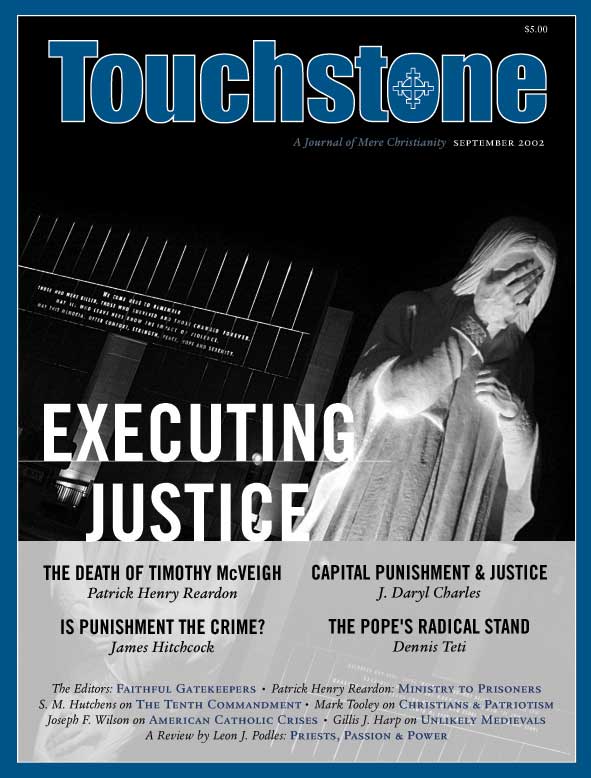
Capital Crime & Punishment by J. Daryl Charles

Capital Crime & Punishment

Reflections on Violating Human Sanctity

by J. Daryl Charles

Among Western nations there is a generally growing sentiment in favor of abolishing the death penalty. This sentiment, it should be noted, is more disposed simply to view the death penalty in unqualified terms as cruel, barbaric, and unsuited to enlightened contemporary culture than it is to wrestle with the complexities of public policy and the meaning of criminal justice—e.g., what is just, what punishments are proportionate, which categories of criminals should be permanently removed from civil society, what sorts of crimes are heinous and worthy of ultimate sanctions, what obligation the governing authorities and lawmakers have in protecting and preserving civil society, and what steps a just society should take to ensure and facilitate restitution for victims.

It is noteworthy—when uncontroversial—that the abolitionist sentiment, which would seem to be a coordinate of pacifism, is almost uniformly accepted and propagated within the academy. Resistance to capital punishment is equally strong among philosophers, theologians, ethicists, and social scientists (including criminologists).

It is similarly noteworthy that commitment to the abolitionist position, particularly as it finds expression in the academy, is equally strong among religious and non-religious types. In their manner of argumentation, religious opponents of the death penalty do not exhibit any major distinction from their non-religious counterparts; both groups have recourse to and appropriate the identical arguments—e.g., the alleged inhumanity and barbarity of capital punishment, a lack of statistical justification for its usage, the unpleasantness of executions, the deficiency of the retributive motive, excessive legal costs, abrogation of the Mosaic legal code, the criminal justice system’s arbitrariness and unevenness, potential margin for error, racial disparity, and Jesus’ purported love ethic. The last four of these are typically viewed as insuperable obstacles to the death penalty’s implementation.

Mass murder—whether in the form of Oklahoma City or more recently in New York City and Washington, D.C.—is only a more visible reminder not only that the issue of the death penalty will not go away but also that debates surrounding capital punishment—and the morality of punishment in general—must press on beyond the standard byte-sized propagandizing of the electronic and print media (both of which tend to discourage honest debate). Such discussions, moreover, must move beyond the stereotyping that not infrequently attends—indeed, stymies—criminal justice debates. Rarely does the debate over capital punishment proceed with an honest consideration of the moral merits of both sides of the issue. It will not suffice for us as a nation or a society merely to say that Timothy McVeigh, or other murderers, should or should not be executed. What matters is why people like McVeigh—whether they kill one person or multiple hundreds—should or should not forfeit their right to live. How we as a society understand and apply “justice,” a significant part of which is reflected in our (in)ability to distinguish between the criminal and the punitive act, will determine whether we are justified in conceiving of ourselves as civilized or barbaric.

Moral Responsibility & Punishment

Although behavioral theorists are thought to agree on precious little, a substantial majority would concur with B. F. Skinner that a person’s behavior is determined by a genetic endowment traceable to the evolutionary history of the species and by the environmental circumstances to which that person has been exposed. Thus, at least at the level of “science,” determinism tends to eclipse the concept of personal moral responsibility. It should be noted that philosophers and mental-health professionals, as well as journalists and pundits, are equally inclined to go along with this view.

It is therefore quite understandable, based on conventional wisdom, that the basic notions of individual responsibility and punishment, having been delegitimized, have fallen on hard times. The social-scientific consensus that punishment is bad, it goes without saying, has had an extraordinary impact on the moral landscape of American culture.

To speak of retribution is to dissent from prevailing social-scientific models of human behavior. B. F. Skinner’s Beyond Freedom and Dignity1 contains what is perhaps the most forceful attack on the traditional understanding of personal responsibility. Tellingly, many psychotherapists—be they behaviorist or non-behaviorist—agree with at least the baseline of Skinner’s message: Punishment is bad and personal moral responsibility is mythical.

Skinner’s opposition to punishment was rooted not so much in the belief that it was wrong—to condemn it as morally objectionable, after all, is to concede that there exists a fixed moral standard—as in the assumption that it was ineffective, even producing counterattack. To be sure, social-scientific evidence regarding reward and punishment can be made to say anything we wish. For example, deterrence studies can be (and typically are) adduced by both sides of the death penalty debate. But what is uncontroversial is the commonsense notion that holding a man responsible for his actions means nothing less than subjecting him to punishment2 if he breaks the law. This assumes that people, from earliest childhood on, are sensitive to and motivated by reward and punishment, which is to say, behavior is predictably subject to causal influences. The implications of this thinking for criminal justice have been patently stated by psychologist John Staddon:


J. Daryl Charles is the Acton Institute Affiliated Scholar in Theology & Ethics. He is the author or editor of twenty books, including Retrieving the Natural Law (2008), Natural Law and Religious Freedom (2018), and, most recently, Just War and Christian Traditions (forthcoming). He is also co-editor of Abraham Kuyper, Common Grace: God's Gifts for a Fallen World, Volume 3 (2020). He is a contributing editor to Touchstone.

A Journal of Mere Christianity—Delivered to Your Door

  • Essays on theology, culture, and the Church
  • Contributors from across the Christian traditions

Subscribe (Print + Online)

Six print issues (one year) of Touchstone, plus full online access and PDF downloads for only $39.95.

Subscribe (Online Only)

Get a one-year full-access subscription to the Touchstone online archives for only $19.95.


bulk subscriptions

Order Touchstone subscriptions in bulk and save $10 per sub! Each subscription includes 6 issues of Touchstone plus full online access to touchstonemag.com—including archives, videos, and pdf downloads of recent issues for only $29.95 each! Great for churches or study groups.

Transactions will be processed on a secure server.


more from the online archives

17.6—July/August 2004

Reality & Reluctant Science

Old Science Confronts a Formidable Challenge in the Scientific ID Movement by Jay W. Richards

28.2—March/April 2015

As Goes Sweden

Neo-Pagan Family Policies Doom Any Recovery by Allan C. Carlson

28.5—Sept/Oct 2015

Who's Your Teacher?

on Our Sacred Duty to Teach the Devil to Death by Marcus Johnson

calling all readers

Please Donate

"There are magazines worth reading but few worth saving . . . Touchstone is just such a magazine."
—Alice von Hildebrand

"Here we do not concede one square millimeter of territory to falsehood, folly, contemporary sentimentality, or fashion. We speak the truth, and let God be our judge. . . . Touchstone is the one committedly Christian conservative journal."
—Anthony Esolen, Touchstone senior editor

Support Touchstone

00