





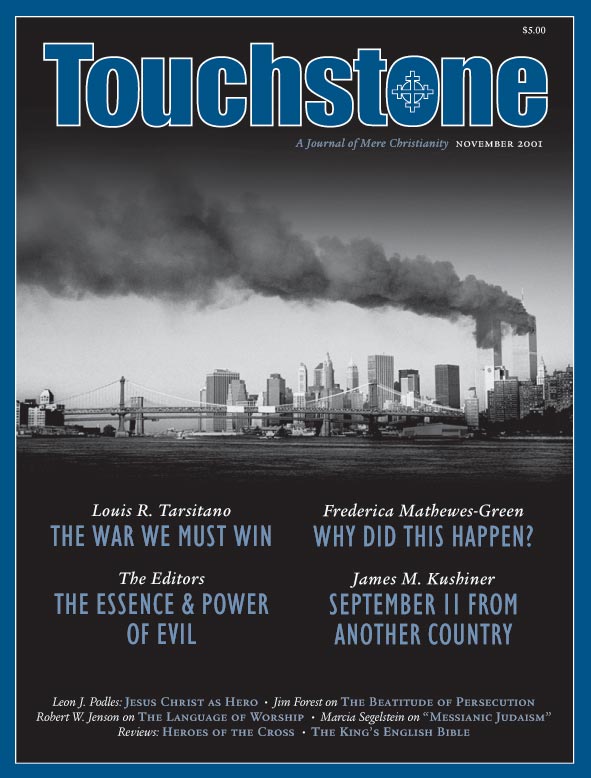
Necessary Justice
To do justice and judgment is more acceptable to the Lord than sacrifice.
—Proverbs 21:3
Justice is often listed as the first of the four cardinal virtues. It has been called the mother of all virtues by Lactantius and Leo XIII, but that title is also claimed for gratitude (Cicero), humility (Augustine and Cassian), charity (Jerome), prayer (Isaac the Syrian), discretion (Abba Moses and Benedict), obedience (Augustine—yes, again), sobriety (Origen), good will in the soul (Albert the Great), reverence (von Hildebrand), courage (Winston Churchill), patience (Hindu tradition), appreciation (Chinese tradition), jihad-patience-sacrifice (Islamic tradition), and frugality (inscription on the State National Bank Building in Houston, Texas).
Despite this disagreement over which is the greatest of the virtues, it is clear that justice holds civilized societies together. As Augustine said in City of God, “A republic cannot be administered without justice.” Nevertheless, justice is a very elusive thing. Justice is, in every country, more difficult to obtain if one is very poor and weak than if one is very rich and powerful. Presidents, kings, and rich young rulers can get away with scandalous things that peasants and paupers cannot. Hence, although it is our duty to live justly, we recognize that true justice for us will only be obtained in the Kingdom of Heaven.
THIS ARTICLE ONLY AVAILABLE TO SUBSCRIBERS.
FOR QUICK ACCESS:
Thomas S. Buchanan is the George W. Laird Professor of Mechanical Engineering and Biomedical Engineering at the University of Delaware. He has studied at UCSD, Northwestern University, and MIT, and has held visiting professorships at the University of Western Australia and the University of Aix-Marseille. He has served as department chairman, deputy dean, and institute director, president of the American Society of Biomechanics, and editor-in-chief of the Journal of Applied Biomechanics. He is on the Board of Trustees of Saint Katherine College, the editorial board of Touchstone, and the board of The Fellowship of St. James.
A Journal of Mere Christianity—Delivered to Your Door
- Essays on theology, culture, and the Church
- Contributors from across the Christian traditions

Six print issues (one year) of Touchstone, plus full online access and PDF downloads for only $39.95.

Get a one-year full-access subscription to the Touchstone online archives for only $19.95.
bulk subscriptions
Order Touchstone subscriptions in bulk and save $10 per sub! Each subscription includes 6 issues of Touchstone plus full online access to touchstonemag.com—including archives, videos, and pdf downloads of recent issues for only $29.95 each! Great for churches or study groups.
Transactions will be processed on a secure server.
more from the online archives
29.3—May/June 2016
A Deathbed Reflection on Catholic Social Teaching & Our Future Prospects by Karl D. Stephan
16.5—June 2003
on the Importance of Fathers to Churchgoing by Robbie Low
22.5—June 2009
C. S. Lewis on Civilization & the Natural Order by Timothy L. Hall
calling all readers
Please Donate
"There are magazines worth reading but few worth saving . . . Touchstone is just such a magazine."
—Alice von Hildebrand
"Here we do not concede one square millimeter of territory to falsehood, folly, contemporary sentimentality, or fashion. We speak the truth, and let God be our judge. . . . Touchstone is the one committedly Christian conservative journal."
—Anthony Esolen, Touchstone senior editor
