




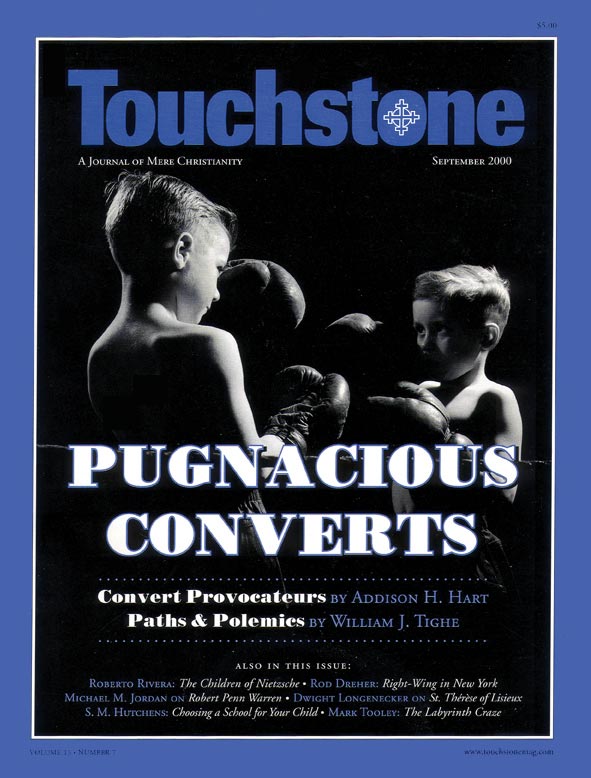
Tough Little Sister
Thérèse of Lisieux—A Saint for All Christians
by Dwight Longenecker
It was during a hitchhiking pilgrimage to Jerusalem that I met a saint. After four years as an Anglican curate in southeast England, I had three months free before taking up my next post. I decided to make a pilgrimage to Jerusalem, staying in monasteries and convents en route. I wanted a holiday, but I also wanted the chance to reflect on my faith and explore the historic heartland of Christendom.
The first leg of the journey was through the western French province of Normandy. After an overnight stay at the historic Abbey of Bec, I hitched a ride to the town of Lisieux. I knew Lisieux was the hometown of St. Thérèse, and planned to stop, not because I had any particular interest in the saint called the “Little Flower” but because, as a pilgrimage destination, there probably would be a religious hostel where I could spend the night.
I had been brought up in a fundamentalist home in Pennsylvania. My ancestors were Mennonites, Brethren, and Reformed Christians. It was during my time at Bob Jones University that I became interested in C. S. Lewis, T. S. Eliot, Anglicanism, and all things English. I’d felt the call to ministry, and when I had the chance to study at Oxford, it seemed too good an opportunity to miss. During training and after ordination into the Anglican ministry, my understanding of the Church moved in a more Catholic direction, although I considered myself firmly Anglican. Devotion to someone as thoroughly Roman Catholic as “St Thérèse of the Child Jesus” was not high on my list of priorities, to say the least.
With her simpering expression, clutching a bouquet of roses and a crucifix, Thérèse seemed one of the worst expressions of nineteenth-century Catholic kitsch. What stories I heard about her life didn’t help. She was “God’s little girl”—a kind of Catholic Emily Dickinson who fed Roman Catholics’ unfortunate taste for greeting card Christianity. I liked a robust faith and she represented the worst excesses of “meek and mild” Christianity—the kind that fosters doormats, not doorkeepers.
Nevertheless, I approached Lisieux with a certain detached curiosity. I found my way to the pilgrim’s hostel and was greeted by a cheerful and practical nun. She showed me to a simply furnished room where I took off my shoes, shrugged off my backpack and sat down to relax. After dinner that night I wandered through the town. Adjacent to the hostel was the Carmelite convent where the saint lived for just nine years before her death at the age of 24. On the hill on the edge of town was a huge basilica built in honor of the saint. This little girl was certainly important to the Catholics, and I resolved to keep an open mind and try to learn a bit more about her.
The next day I visited the sites associated with the saint and picked up a paperback biography. I was impressed by what I discovered. It is true that Thérèse is called the “Little Flower,” but if she is a flower, then she is a steel magnolia. Under that sentimental language and kitschy image I discovered the story of an amazing individual, a Christian soul who was tough as well as tender. If she clutched roses, those roses definitely had thorns. I was not won over to her completely, but my reading and exploration were enough to make me want to learn more.
A Complete Convert
Marie Françoise Thérèse Martin was born in Alençon in Normandy on January 2, 1873. Her father was a watchmaker, and her mother made lace to supplement the family income. In the summer of 1877 her mother died, and that autumn M. Martin moved Thérèse and her four older sisters to a small house called Les Buissonets in the nearby town of Lisieux. Thérèse was a sensitive and loving child, and the home was very devout, but conventionally middle class. She took part in a religion that was woven seamlessly into the tapestry of everyday life. Her Christian family was a sharing in the Holy Family, and God was everywhere present. Thérèse spoke of her early awareness of Christ by saying, “From the age of three I have never refused the good God anything.”
She was four and a half when her mother died and from that point on she went through ten years of religious scruples and nervous hypersensitivity. On Christmas Eve when she was fourteen she describes how she suddenly became aware of God’s healing and regained her spiritual strength. She considered this experience to have been her conversion. In his book, The Way of the Lamb, John Saward describes the conversion experience in terms of her childhood being reborn in a fresh way.
A Journal of Mere Christianity—Delivered to Your Door
- Essays on theology, culture, and the Church
- Contributors from across the Christian traditions
Subscribe (Print + Online) 
Six print issues (one year) of Touchstone, plus full online access and PDF downloads for only $39.95.
Subscribe (Online Only) 
Get a one-year full-access subscription to the Touchstone online archives for only $19.95.
bulk subscriptions
Order Touchstone subscriptions in bulk and save $10 per sub! Each subscription includes 6 issues of Touchstone plus full online access to touchstonemag.com—including archives, videos, and pdf downloads of recent issues for only $29.95 each! Great for churches or study groups.
Transactions will be processed on a secure server.
more from the online archives
27.3—May/June 2014
Facts versus Stereotypes About Love & Marriage in the Land of the Free by Allan C. Carlson
31.5—September/October 2018
The Secular State Without the Decalogue by James M. Kushiner
calling all readers
Please Donate
"There are magazines worth reading but few worth saving . . . Touchstone is just such a magazine."
—Alice von Hildebrand"Here we do not concede one square millimeter of territory to falsehood, folly, contemporary sentimentality, or fashion. We speak the truth, and let God be our judge. . . . Touchstone is the one committedly Christian conservative journal."
Support Touchstone
—Anthony Esolen, Touchstone senior editor
