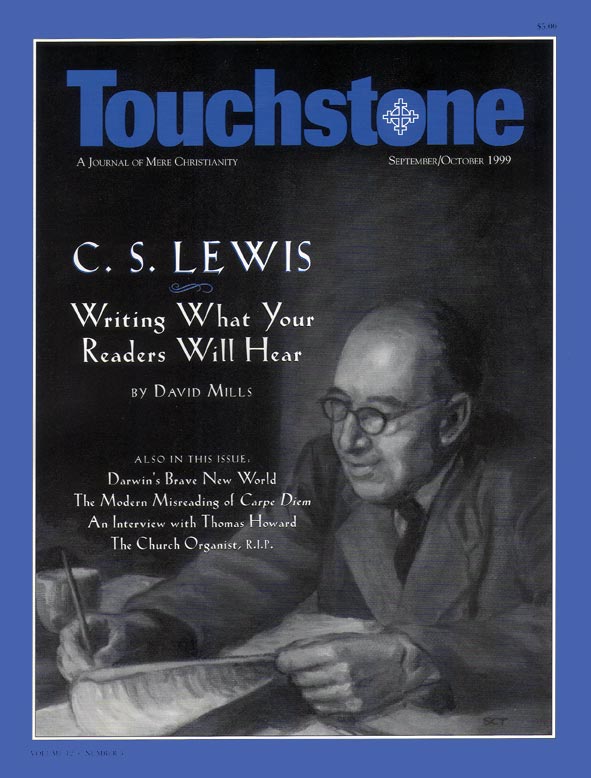
The Catholic Angler
An Interview with Thomas Howard
A longtime friend of Touchstone and himself a model of the “ecumenical orthodoxy” and “mere Christianity” we strive to represent, Professor Thomas Howard has brought many—Catholics as well as Evangelicals—to a deeper understanding of the treasures of the historic church through his writings and personal influence.
A graduate of Wheaton College and New York University, Professor Howard taught for many years at an Evangelical college until he became a Roman Catholic in 1985. From then on until his retirement he taught English at St. John’s Seminary College, the seminary of the archdiocese of Boston.
He has written several books, on both religious and literary subjects, beginning with Christ the Tiger, a sort of spiritual autobiography, in 1967. Since then he has written seven more books, including Evangelical Is Not Enough; Lead, Kindly Light, the story of his conversion to Catholicism; and most recently On Being Catholic. He has also written studies of the novels of Charles Williams and C. S. Lewis, notably The Achievement of C. S. Lewis and C. S. Lewis, Man of Letters. Ignatius Press, the publisher of On Being Catholic, also distributes a videotape series of 13 lectures by Professor Howard on “The Treasures of Catholicism.”
Professor Howard was interviewed by senior editors Patrick Henry Reardon and David Mills while at Trinity Episcopal School for Ministry to teach a weeklong course on the novels of C. S. Lewis. The interview has been edited for clarity and completeness, but the oral style has been retained.
Touchstone: One of the things C. S. Lewis is now notable for is his intellectual dissent from, in a way his assault on, feminism. I mean not the ordination of women as in his essay “Priestesses in the Church?” but the feminist ideology in general.
Thomas Howard: That’s one of those questions that has to be chased all the way through the corpus of Lewis’s works, because, obviously, feminism as such was not then a major or articulate force. He wrote the essay “Priestesses in the Church?” because the question had surfaced in a mild Anglican sort of way, but there was nothing very imminent about it.
Lewis presents a view of reality at a polar extreme from the frame of mind that ends up demanding ordination of women as presbyters. Obviously, he believes in hierarchy, but it’s not a hierarchy of power, which seems to be the feminist understanding. The whole discussion of priestesses in the last thirty years has run along sociological and political lines, with theology dragged in, when necessary, from the sidelines and various attempts made to rewrite the Bible to show that St. Paul said you should ordain women as presbyters.
In Lewis, you get a vision of things—of everything—in which the whole question of masculine and feminine is a subdivision of tremendous, prior considerations that he understands to characterize the universe. Lewis felt that those categories are of the very stuff of the universe, prior to male and female. Male is the way masculinity exhibits itself under biological species or terms, and female is the way femininity manifests itself under biological species.
For him, hierarchy is obviously the way the dance is choreographed, or the way the map of the universe is drawn. He points out in one place that in a hierarchy one has the duty of obedience to those above one in the hierarchy and the duty of magnanimity and stewardship and noblesse oblige to those below one. I seriously doubt that Lewis would use the words “above” and “below” with respect to masculine and feminine, because they don’t apply. They’re the terms of people who can only think of a dance in terms of power—which makes for a pretty poor dance.
The locus classicus for his view of gender is, I think, the scene toward the end of Perelandra when Ransom sees the two eldila: Perelandra, who is feminine, and Malacandra, who is masculine. The feminine eldil, Perelandra, participates in equal majesty, dignity, authority, and so on, with the masculine figure, Malacandra, but she has a receptiveness, a nurturing side. All these words have become buzzwords now, but they weren’t when Lewis wrote them in the 1940s.
James M. Kushiner is the Director of Publications for The Fellowship of St. James and the former Executive Editor of Touchstone.
A Journal of Mere Christianity—Delivered to Your Door
- Essays on theology, culture, and the Church
- Contributors from across the Christian traditions

Six print issues (one year) of Touchstone, plus full online access and PDF downloads for only $39.95.

Get a one-year full-access subscription to the Touchstone online archives for only $19.95.
bulk subscriptions
Order Touchstone subscriptions in bulk and save $10 per sub! Each subscription includes 6 issues of Touchstone plus full online access to touchstonemag.com—including archives, videos, and pdf downloads of recent issues for only $29.95 each! Great for churches or study groups.
Transactions will be processed on a secure server.
more from the online archives
calling all readers
Please Donate
"There are magazines worth reading but few worth saving . . . Touchstone is just such a magazine."
—Alice von Hildebrand
"Here we do not concede one square millimeter of territory to falsehood, folly, contemporary sentimentality, or fashion. We speak the truth, and let God be our judge. . . . Touchstone is the one committedly Christian conservative journal."
—Anthony Esolen, Touchstone senior editor