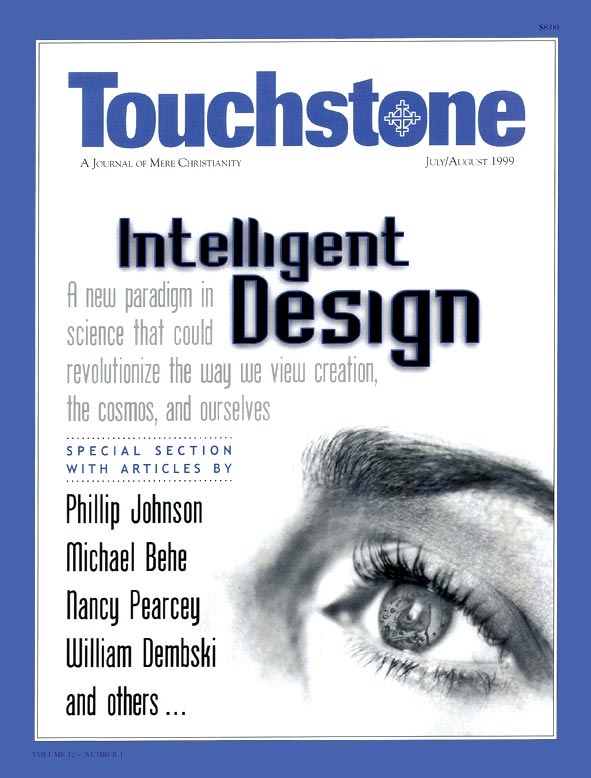
Darwin’s Breakdown by Michael Behe

Darwin’s Breakdown

Irreducible Complexity & Design at the Foundation of Life

by Michael Behe

The topic of evolution is both fascinating and vexing. Fascinating, because it involves questions of who we are, how we got here, and how we relate to the world around us. Vexing, because it provokes arguments and political battles. The battles are all the more frustrating when fought by polarized factions with preset agendas such as, on the one hand, defending a literal interpretation of the Bible, or, on the other, keeping any hint of transcendence out of the public schools.

Many people, discouraged by the bickering, are tempted to ignore the topic. For a Christian, this is a mistake. In his letter to the Pontifical Academy of Sciences several years ago ( L’Osservatore Romano, Oct. 30, 1996), Pope John Paul II wrote that evolution is “an essential subject which deeply interests the church, since revelation, for its part, contains teaching concerning the nature and origins of man.” An informed Christian, engaged with the world, should have a basic understanding of the facets of evolution that are of particular importance to the faith.

In his letter the pope made several statements that seemed on the surface to conflict. He acknowledged that evolution is “more than a hypothesis” and that “this theory has been progressively accepted by researchers, following a series of discoveries in various fields of knowledge.” He also noted, however, that “rather than the theory of evolution, we should speak of several theories of evolution.” In part the several theories have to do with “the different explanations advanced for the mechanism of evolution.” How can evolution be so well-supported that it is more than a hypothesis and yet there still be uncertainty about its mechanism?

The difficulty arises because the word evolution can be used in different senses, and equivocation can easily confuse people. In one sense evolution just means common descent—that living creatures are all related to a common ancestor. It is in this sense, I think, that the pope meant that evolution is well-supported. Common descent is a possible explanation for the similarities among species, and modern science has shown many similarities, especially at the molecular level, that were unknown to earlier scientists. Explaining similarities, however, is the easy part. You just have to say that some features remained the same. Explaining the many profound differences between organisms is the hard part.

In another sense evolution is sometimes used to mean Darwin’s particular theory. Darwin proposed the theory of natural selection to account for the differences between organisms. Darwin saw that there was variation in all species, and he reasoned that animals whose random variation gave them an edge in the struggle to survive would tend to leave more offspring than others. If the variations were inherited, then the characteristics of the species would change over time. In other words, Darwin proposed a mechanism to drive evolution. Although it clearly can explain relatively small changes, the sufficiency of Darwin’s mechanism to account for larger, more complex changes in organisms remains in question. Pope John Paul II apparently had in mind the doubts about Darwin’s mechanism when he referred to “several theories of evolution.”

The Professor and the Cardinal

Why do such arcana matter? To many Christians, the problem with Darwin’s theory is in the single word “random.” Ever since the theory was first proposed, persons antagonistic to the Church, including some prominent scientists, have aggressively asserted that the randomness is not merely epistemic; it is ontological. In other words, they claim that science sees no purpose in living things because there is no purpose, and therefore there is no God. For example, the Oxford zoologist Richard Dawkins has remarked (Science 1997, vol. 277, p. 892) that “The universe we observe has precisely the properties we should expect if there is at bottom no design, no purpose, no evil and no good, nothing but pointless indifference.” Clearly such assertions go well beyond the domain of science. Nonetheless, because science has considerable authority in our culture, scientists are accorded great respect even when they are dispensing bad philosophy.

Although in his letter the pope did not address the randomness assumed by Darwin’s mechanism, his close advisor, Cardinal Joseph Ratzinger, did discuss it in a little book entitled In the Beginning: A Catholic Understanding of the Story of Creation and the Fall (Eerdmans, 1986). There he wrote:

Let us go directly to the question of evolution and its mechanisms. Microbiology and biochemistry have brought revolutionary insights here. . . . [W]e must have the audacity to say that the great projects of the living creation are not the products of chance and error. . . . [They] point to a creating Reason and show us a creating Intelligence, and they do so more luminously and radiantly today than ever before (pp. 54–56).


A Journal of Mere Christianity—Delivered to Your Door

  • Essays on theology, culture, and the Church
  • Contributors from across the Christian traditions
Subscribe (Print + Online)

Six print issues (one year) of Touchstone, plus full online access and PDF downloads for only $39.95.

Subscribe (Online Only)

Get a one-year full-access subscription to the Touchstone online archives for only $19.95.


bulk subscriptions

Order Touchstone subscriptions in bulk and save $10 per sub! Each subscription includes 6 issues of Touchstone plus full online access to touchstonemag.com—including archives, videos, and pdf downloads of recent issues for only $29.95 each! Great for churches or study groups.

Transactions will be processed on a secure server.


more from the online archives
31.4—July/August 2018

The Names of the Christian

Labels & the Ecumenism of Discipleship by James M. Kushiner

30.5—Sept/Oct 2017

Passions' Republic

The Christian Cure for What Ails Modern Politics by David Bradshaw

21.6—July/August 2008

The European Disunion

Benedict XVI on the Crisis of Faith & Reason by Samuel Gregg

calling all readers

Please Donate

"There are magazines worth reading but few worth saving . . . Touchstone is just such a magazine."
—Alice von Hildebrand

"Here we do not concede one square millimeter of territory to falsehood, folly, contemporary sentimentality, or fashion. We speak the truth, and let God be our judge. . . . Touchstone is the one committedly Christian conservative journal."
—Anthony Esolen, Touchstone senior editor

Support Touchstone

00