




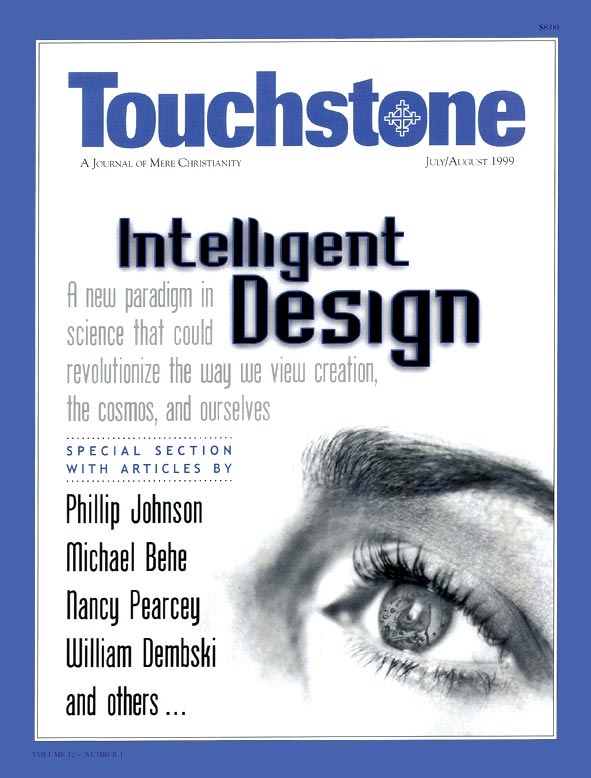
Feature
Design & the Discriminating Public
Gaining a Hearing from Ordinary People
by Nancy Pearcey
Evolution has enormous purchase on the public imagination, and it’s easy to understand why. Just peek into the average living room where toddlers everywhere are sitting wide-eyed before videos like The Land Before Time series. This series offers nothing less than an excursion into evolution. Colorful one-celled organisms arise in a blue-green primeval ocean, where they “change again and again,” until they evolve into the endearing little dinos of the stories. It is a delightful, fairy-tale introduction into naturalistic evolution for children, and once a child’s imagination is populated with bright, colorful images, it becomes ever more difficult for a parent to dislodge them and teach the child to think critically.
The Response to Imperial Darwinism
Despite the immense visibility of evolution in the culture, design is supplanting it for three reasons. First, there is a growing demand for help in answering the claims of Darwinism as it grows more pervasive and more intellectually imperialistic. Whereas a generation ago, parents could simply ignore the challenge of Darwinism, today’s parents cannot. Their children are getting a Darwinian message not only in the classroom but also in books and videos and other forms of entertainment. Today not only Christians but also theists of all stripes are being forced to respond to the naturalistic, mechanistic worldview implied by Darwinism in venues far from the science classroom.
We’re talking here about a sizeable portion of the American population. A 1991 Gallup poll found that 46 percent of Americans still believe human beings came directly from the hand of the Creator, while another 40 percent believe God guided the process of evolution. (Only 9 percent accept the strict account of evolution by completely natural forces.) Moreover, a 1996 survey by the National Science Foundation found that fewer than half of Americans believe that “humans developed from earlier species.” Clearly, there is a very large constituency in America eager for help in answering the imperialistic claims of Darwinism.
As Executive Editor for Chuck Colson’s daily radio program, “BreakPoint,” I have found that the number of listener call-ins increases dramatically whenever we deal with this topic on the air. The first time we ran a radio series on the subject, the number of calls tripled and quadrupled. When we ran the series again several months later, it broke call-in records again. We then ran a series popularizing Reason in the Balance by Berkeley law professor Phillip Johnson, and again the calls spiked astonishingly. Consistently, we find that our radio listeners feel a need to get a handle on questions of Darwinism and evolution.
This is not to suggest that people merely are interested in science popularizations, which are readily available. The reason they are so hungry for good material on evolution is that they sense that it is really about much more than science. The scientific establishment portrays dissenters from Darwinism as backwoods rubes seeking to inject religion into the science classroom. But what these dissenters rightly note is that religion is already in the classroom. Even ordinary folks who know little about the scientific details are uncomfortably aware that Darwinism bootlegs a philosophy of naturalism that is implacably opposed to any form of theism.
And the more honest Darwinists say so. Francisco Ayala of the University of California at Irvine says natural selection “exclude[s] God as the explanation accounting for the obvious design of organisms.” Tufts philosopher Daniel Dennett praises Darwinism as a “universal acid” that corrodes traditional spiritual and moral beliefs. And Oxford biologist Richard Dawkins says Darwin “made it possible to be an intellectually fulfilled atheist.”
Darwin himself made it clear that his theory had anti-religious implications. Indeed, it was devised precisely to eliminate the idea of design in living things. The function of natural selection is, after all, to sift out harmful variations and preserve only beneficial ones. But if we admit God into the process, Darwin argued, then God would ensure that only “the right variations occurred . . . and natural selection would be superfluous.” In other words, you can have God or natural selection, but not both. Alternatively, given natural selection, God would be redundant. As historian Jacques Barzun writes, the central elements in Darwin’s theory (i.e., random changes and the blind sifting of natural selection) were both proposed expressly to get rid of design and purpose in biology: “The sum total of the accidents of life acting up on the sum total of the accidents of variation . . . provided a completely mechanistic and material system” to explain the development of living things.
This atheistic message is easily picked up by kids in the classroom. A popular high-school textbook published by Prentice-Hall describes evolution as “random and undirected,” working “without either plan or purpose.” A textbook by Addison-Wesley says, “Darwin gave biology a sound scientific basis by attributing the diversity of life to natural causes rather than supernatural creation.” American state schools are supposed to be neutral with regard to religion, but these statements are clearly antagonistic to all theistic religions.
In the words of John Wiester, chairman of the Science Education Commission of the American Scientific Affiliation, “Darwinism is naturalistic philosophy masquerading as science.” And as a philosophy, its implications extend far beyond science. In a taped debate with Phillip Johnson, Cornell biologist William Provine outlines unflinchingly what Darwinism means for human values, flashing a list on an overhead projector: Consistent Darwinism implies “No life after death; No ultimate foundation for ethics; No ultimate meaning for life; No free will.” (The video is titled Darwinism: Science or Naturalistic Philosophy? and is available from Access Research Network.) The only reason people still believe in such things, Provine said, is that they haven’t realized the full implications of Darwinism.
Nancy Pearcey is a professor and scholar in residence at Houston Christian University. She is the author of several bestselling books, which have been translated into 19 languages. Her most recent book is The Toxic War on Masculinity: How Christianity Reconciles the Sexes, which grew out of her 2018 Touchstone conference talk.
A Journal of Mere Christianity—Delivered to Your Door
- Essays on theology, culture, and the Church
- Contributors from across the Christian traditions

Six print issues (one year) of Touchstone, plus full online access and PDF downloads for only $39.95.

Get a one-year full-access subscription to the Touchstone online archives for only $19.95.
bulk subscriptions
Order Touchstone subscriptions in bulk and save $10 per sub! Each subscription includes 6 issues of Touchstone plus full online access to touchstonemag.com—including archives, videos, and pdf downloads of recent issues for only $29.95 each! Great for churches or study groups.
Transactions will be processed on a secure server.
more from the online archives
14.1—January/February 2001
The Christian Heart of Fatherhood
The Place of Marriage, Authority & Service in the Recovery of Fatherhood by John M. Haas

31.2—March/April 2018
How Best to Face the Total War of the Anti-Culture by R. J. Snell

calling all readers
Please Donate
"There are magazines worth reading but few worth saving . . . Touchstone is just such a magazine."
—Alice von Hildebrand
"Here we do not concede one square millimeter of territory to falsehood, folly, contemporary sentimentality, or fashion. We speak the truth, and let God be our judge. . . . Touchstone is the one committedly Christian conservative journal."
—Anthony Esolen, Touchstone senior editor
