Feature
A Hope of Collapsing Churches
The Present Malaise & Future Hope of the Mainline Churches
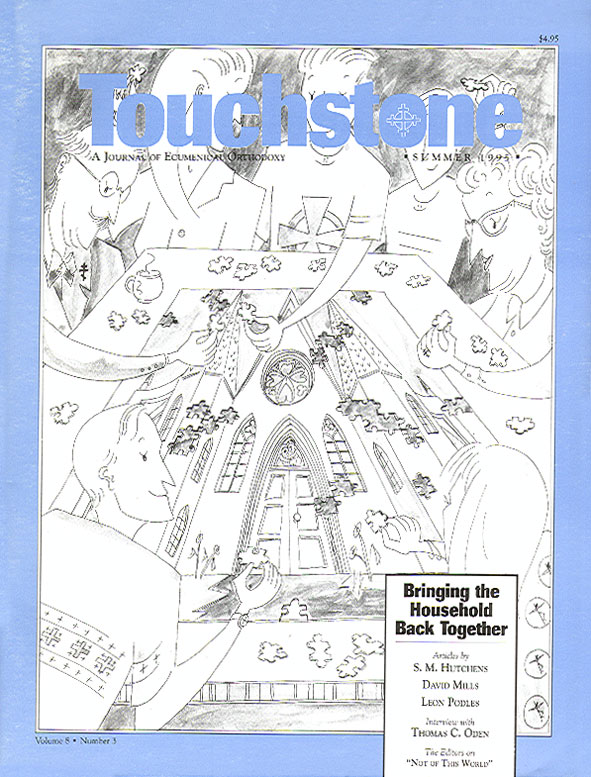
From a distance, the castle’s towers rise high above the countryside, its flags snapping in the wind. Its walls stand massive and secure, and the life inside continues much as it always has. And yet its foundation is cracking and sinking, the walls are beginning here and there to crumble, its flags are tattered, the roofs are full of holes, and many of the windows are broken.
Such, certainly, are the mainline churches. Such also is Rome, seen as a whole; that is, as including Hans Küng and Rosemary Radford Ruether as well as Pope John Paul II. Such will be Orthodoxy as well, when those churches have more fully been infected by modernity and the cultural ghetto that has so far protected them has finally turned into a suburb.
I will describe here only the mainline churches, because their decay is already so advanced and so easy to trace. Barring divine intervention on a scale not seen since the parting of the Red Sea, they will predictably and inevitably collapse, but in this inevitability lies the greatest hope for orthodox Christianity in the mainline churches.
This is (broadly speaking) a sociological judgment. A sociological rather than theological analysis of the churches will help us see our situation more clearly, and correctly discern the signs of the times. In particular, it should help us avoid the thoughtless identification of “the Church,” which shall not fail, with a particular institution or church, which certainly can, and in many cases seem very much to want to. This identification has kept many well-meaning Christians from responding effectively to apostasy by letting them convince themselves that they do not need to do anything but wait.1
Much of what follows is, in human terms, pessimistic. By hope I mean Christian rather than worldly hope, which is the desire that things will get better, or at least not get worse, with a minimum of fuss and bother and as little pain as possible. Christian hope is hope in Christ, who died a horrifying death on the Cross before he ascended into heaven. Hope, like heaven, is found only through the Cross, and may well mean that we are led where we would rather not go, along paths that seem to us to lead in the wrong direction.
I do not mean to deny God’s power to revive a church. The revival among Anglicans in East Africa, the papacy of John Paul II, and Orthodoxy’s new interest in evangelism all seem to be signs of a new work of the Holy Spirit among his people. But the process of decay and collapse I will describe is itself the result first of disregard for and then (inevitably) rebellion against the Lord of the Church, and I have no reason to think these will change in a way that leads to revival in the churches as they are now. Revival, I think, is much more likely to redistribute the members of the churches so that fellowship or communion and doctrinal unity are more clearly related than they are at this moment.
Unexamined Assumptions
What does a sociological analysis tell us about the present and future of the mainline churches? Institutions or groups are held together by shared beliefs and unexamined assumptions about the nature of things. People act the way they do because they have a set of ideas—unconsciously held but relatively coherent—that makes sense of everything around them, that tells them this is good and that is bad, that they ought to do this and not do that, that this is true and that false.
When most Americans assumed that marriages were to be lifelong, people worked harder at keeping them going because people (“good respectable people,” anyway) just didn’t get divorced. It was not done. As an old lady said to me, half-seriously, “Oh I never would have divorced my husband. But there were times I might have killed him.”
Then some people challenged the assumption by saying that to be “fulfilled” or “self-actualized” or “happy” was more important than to remain married. Suddenly it wasn’t obvious to almost everyone that marriage was better than divorce. The assumption gone, the divorce rate shot up. Eventually “good respectable people” were as likely to be divorced as anyone else.
David Mills has been editor of Touchstone and executive editor of First Things. He edits the opinion page of the Pittsburgh Post-Gazette.
A Journal of Mere Christianity—Delivered to Your Door
- Essays on theology, culture, and the Church
- Contributors from across the Christian traditions
Six print issues (one year) of Touchstone, plus full online access and PDF downloads for only $39.95.
Get a one-year full-access subscription to the Touchstone online archives for only $19.95.
bulk subscriptions
Order Touchstone subscriptions in bulk and save $10 per sub! Each subscription includes 6 issues of Touchstone plus full online access to touchstonemag.com—including archives, videos, and pdf downloads of recent issues for only $29.95 each! Great for churches or study groups.
Transactions will be processed on a secure server.
more from the online archives
calling all readers
Please Donate
"There are magazines worth reading but few worth saving . . . Touchstone is just such a magazine."
—Alice von Hildebrand
"Here we do not concede one square millimeter of territory to falsehood, folly, contemporary sentimentality, or fashion. We speak the truth, and let God be our judge. . . . Touchstone is the one committedly Christian conservative journal."
—Anthony Esolen, Touchstone senior editor