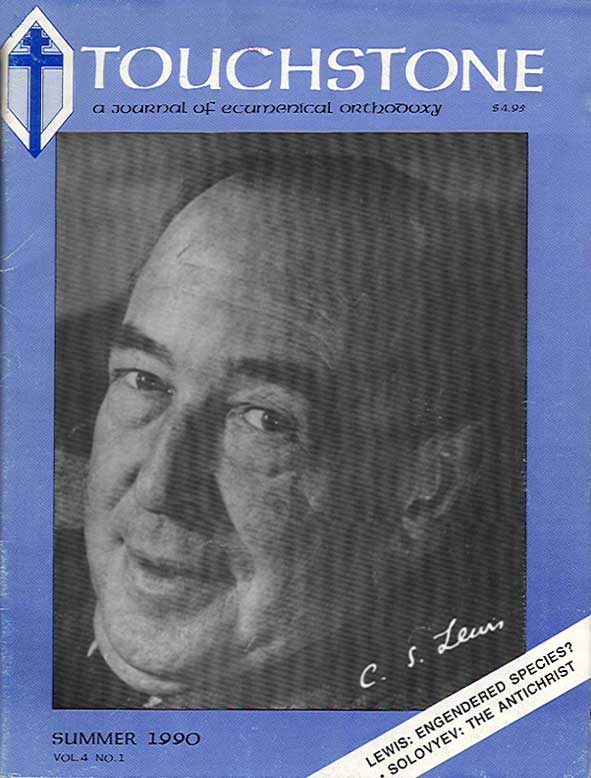
C. S. Lewis: A Biography
by A. N. Wilson
New York: W. W. Norton & Company, 1990.
334 pages, $22.50 (hardcover)
reviewed by Wayne Martindale
I confess. I was convinced I wouldn’t like Wilson’s book before I ever read it.
His preface appeared in the New York Times Book Review. In it, he accused various persons or camps in Lewis studies of creating portraits of Lewis after their own image. Wheaton College and the Wade Center (which is acknowledged to be the best collection of Lewis material in the world) were caricatured as places far removed from the real world, hence with an unreal view of Lewis. The Wade Center, Wilson suggests, is a shrine for the hero worship of a plaster-sainted Lewis, not a place which fosters serious scholarship. The implication in all this debunking is clear: Wilson will explode all of the rival myths and give us the real Lewis, which everyone else seems to have missed. In addition, before I got to the book itself, I read several reviews, some with enough ammunition to explode some of Wilson’s claims as a scholar and biographer—he has published about a dozen books, including an award-winning biography of Tolstoy.
To my surprise, almost dismay, I liked the book. It has considerable faults, to be sure, and more on that later. But first I want to give Wilson his due. He (at least in part) won me over. How? First, he did what Samuel Johnson says all good writers must do: write in such a way that the reader wants to read to the end. Like Lewis himself, Wilson is a skilled storyteller. He blends suspense and engaging characterization around centers of conflict, all with interesting detail and a readable style. Even here, the transitions are sometimes poor and the vocabulary occasionally pretentious, but it held me.
Second, his interpretation of Lewis as a character builds around a clearly articulated center. Despite the irony in Lewis’s hatred of Freudian criticism, Wilson’s portrait of Lewis as a man searching for the love and support of the mother who died when he was nine and of a man unwittingly taking on the “police court” style of his solicitor father, often has the ring of truth.
Third, the book maintains, along with its persistent psychological focus, a central interest in relationships. Wilson shows us Lewis in company, making his way through a world of real people, interesting people. The portraits of Tolkien and the literate friends of the Lewis circle known as the Inklings are especially engaging.
Fourth, Wilson brings to the task a wonderful knowledge of England, Oxford, and literature. There is no substitute for insider’s knowledge, especially in the highly stratified society of mid-century England and the unique subculture of Oxford University. Wilson is especially good in his assessment of Lewis’s contribution to the field of literary criticism as with Lewis’s volume in the Oxford History of English Literature, his Preface to Paradise Lost, and others—Lewis has ten titles in this genre. Lewis’s vast range of reading, his gift for clarity and capturing the reader’s interest are all given their just due in this group of books.
Finally, Wilson’s iconoclasm serves a useful purpose. He will not allow an idolatrous view of Lewis or Warnie (Lewis’s brother) or Joy (Lewis’s wife) to emerge. To some, Lewis is as good as sainted, and Wilson does give us Lewis, as one reviewer says, “warts and all.”
So, I changed my mind; after reading a borrowed copy to withhold my financial support from the enterprise, I have decided to buy it after all. But there are problems, and big ones. Enough problems that I worry about those people who buy Wilson’s book and know little else of Lewis.
Wilson’s is the most relentlessly and recklessly interpretive of all the biographies on Lewis. If this is often a source of its appeal, it is also a predictable source of controversy and, too often, gross speculation. Take Wilson’s Freudian approach. It works well enough attempting to dig to the bottom of Lewis’s mysterious relationship with Mrs. Janie “Minto” Moore, the mother of an army buddy, Paddy Moore, who was killed in the First World War. Lewis made an agreement with Paddy Moore that if Lewis were killed, Paddy would care for Lewis’s father. If Paddy were killed, Lewis would care for Paddy’s mother. There is a touch of nobility and a promise kept in all of this which Wilson passes by. Yet, given the fact of Lewis’s being thrown in with Mrs. Moore, there is nothing far-fetched about Lewis needing and seeking a mother substitute. It certainly seems clear that Lewis in some sense felt a need for the relationship.
Wayne Martindale is a professor of English at Wheaton College in Wheaton, Illinois.
A Journal of Mere Christianity—Delivered to Your Door
- Essays on theology, culture, and the Church
- Contributors from across the Christian traditions

Six print issues (one year) of Touchstone, plus full online access and PDF downloads for only $39.95.

Get a one-year full-access subscription to the Touchstone online archives for only $19.95.
bulk subscriptions
Order Touchstone subscriptions in bulk and save $10 per sub! Each subscription includes 6 issues of Touchstone plus full online access to touchstonemag.com—including archives, videos, and pdf downloads of recent issues for only $29.95 each! Great for churches or study groups.
Transactions will be processed on a secure server.
more on C. S. Lewis from the online archives

more from the online archives
calling all readers
Please Donate
"There are magazines worth reading but few worth saving . . . Touchstone is just such a magazine."
—Alice von Hildebrand
"Here we do not concede one square millimeter of territory to falsehood, folly, contemporary sentimentality, or fashion. We speak the truth, and let God be our judge. . . . Touchstone is the one committedly Christian conservative journal."
—Anthony Esolen, Touchstone senior editor