




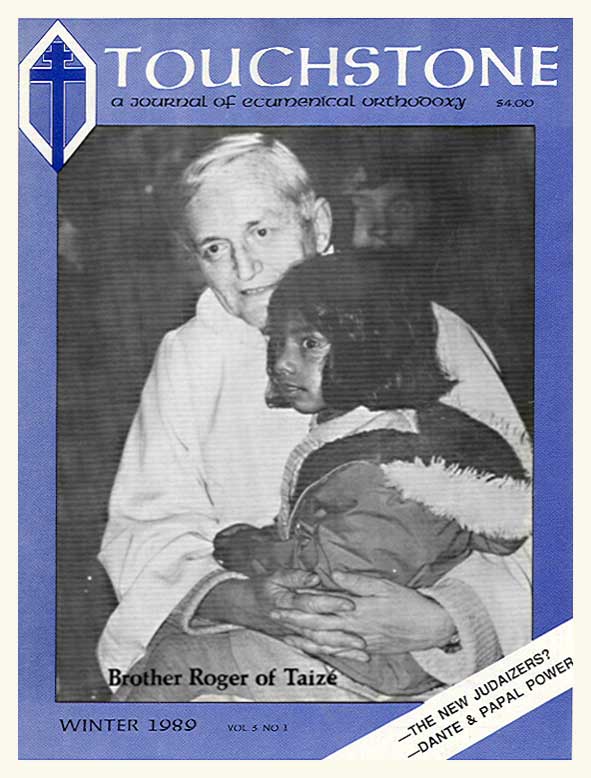
Dante’s Puzzle
The Riddle of Papal Power
by Steven Faulkner
The issue of papal authority has long been a particularly knotty controversy among the Christian churches. Indeed, it has troubled the Church since at least the late second century when Pope Victor saw fit to excommunicate the churches of Asia Minor over the question of the dating of Easter. At that time the old Asian bishop Polycrates, claiming apostolic precedent, boldly opposed him. In the intervening centuries the question of papal authority has never quite gone away. It is a key issue dividing Christian East from Christian West, and Protestant from Catholic. For some a powerful papacy is the very bastion of orthodoxy; others believe it to be a semi-heretical usurpation or a positively heretical tyranny. And now, as Pope John Paul II seeks dialogue with the Eastern Orthodox and the Protestants, this ancient question still confronts us. In certain ways, the time seems favorable for the advancement of understanding. But can we approach the issue with open minds and open hearts to reason together peaceably?
Nowadays, when the question does arise, it is too often posed in a historic vacuum. On a popular level, Christians dispute the issue with much ardor but little understanding of past events which led to present convictions. Thus we are commonly reduced to sniping at each other from well-entrenched positions across a chasm of deep bias. For my part, I find myself somewhere between trenches, in no-man’s-land, with allies on different sides, but taking fire from all sides, too. Yet, I do not even pretend to have a definitive solution. (That belongs to the Body of Christ and the wisdom of its divine Head.) I merely contend that we must not give up on serious dialogue and the search for more fruitful grounds of discussion. And so I raise this article as something of a white flag and call for a parley.
For my small contribution, I would put before you an allegory, an intriguing riddle from long ago, from the pen of the great Dante Alighieri. I believe Dante intended his allegory to raise this issue in the minds of his contemporaries and to strike a blow at a basic misunderstanding, which had led to terrible consequences in the thirteenth century Church. In our own day, perhaps Dante’s puzzle can intrigue us and defuse or circumvent our standard defenses long enough for us to view the problem afresh and think it over anew.
Dante Alighieri, of course, was one of the greatest poets and minds of all time. He was a man belonging to more than the medieval world which produced him and his own native Florence. And I see him as a man of deep faith and deeply devoted to the Church—though he detested the avarice which had infected it and was not even shy about inveighing against the greed of particular popes. Any reader of the The Divine Comedy can see that Dante readily attacked the impiety of certain popes. In the nineteenth canto of the Inferno, Dante’s pilgrim discovers a special hole in hell reserved especially for simoniacal popes. Nicholas III is there, awaiting his successors Boniface VIII and Clement V.
But it is one thing to denounce overt corruption in particular men, quite another to undermine the claimed powers of the papal office itself. Heretic hunting was a common sport and an Italian writer of the early fourteenth century needed to choose his words carefully. The papal party had strong allies in the Italian cities, and one such political faction had driven Dante from his beloved Florence. (I should note in this regard that Dante was not a naive child in the imperial/papal political struggles of his day: he was clearly a partisan convinced that the emperor and not the pope should wield ultimate political power.)
Now Dante gave his views on the papacy quite explicitly in the Monarchia, his work on world government, which is seldom read nowadays. Most modern readers confine themselves to the first part of Dante’s Divine Comedy, The Inferno. But we find Dante’s views revealed, or I should say concealed in a more intriguing way in a more popular work, the second part, The Purgatorio. For here the author invites the reader to solve a riddle, a riddle which he says is key to the understanding of an allegorical pageant in which it is set. Admittedly, this puzzle is not easy; no doubt it has stymied many Dante readers over the centuries. But may I suggest that Dante uses the riddle to veil his view on papal authority in such a way that he both attracted attention and avoided retribution. And the key to all lies in the riddle of a mysterious number or numbers, or letters, as you interpret it. What an intriguing way to spur thought on the papal office!
The Procession & the Puzzle
The allegory begins as Dante’s pilgrim finds himself in ancient Eden, walking along a beautiful stream. Suddenly “a burst of incandescence cuts the air.” The radiance increases and a gentle melody drifts through the brightening air. Seven golden candlesticks approach. Beneath their flowing bands of light, twenty-four elders clothed in white approach, chanting a song, followed by four winged creatures reminiscent of Ezekiel’s vision. These creatures surround a triumphal chariot drawn by a great griffin whose wings soar out of sight. Three ladies, one red, one green, and one white, dance near the chariot’s right wheel while four ladies robed in purple dance to the left. Behind the chariot walk seven men.
Then with a thunder burst and the shouts of a hundred angels, the lady Beatrice appears within the chariot. She reprimands Dante for straying from his early quest for salvation. In her eyes, Dante sees the griffin reflected “who is two natures in one single being.” Overawed by all of this, Dante follows the mystical procession until the griffin attaches the chariot to a great, barren tree that is identified as Adam’s tree. The tree immediately bursts into leaf and bloom. Beatrice descends from the chariot, while the rest of the procession departs.
Steven Faulkner teaches creative writing at Longwood University in southern Virginia. He is the author of Waterwalk: A Passage of Ghosts (2007) and Bitterroot: Echoes of Beauty and Loss (2016). Both books are memoirs of father-son journeys that followed the paths of missionary priests: Marquette (in Waterwalk) and De Smet (in Bitterroot).
A Journal of Mere Christianity—Delivered to Your Door
- Essays on theology, culture, and the Church
- Contributors from across the Christian traditions

Six print issues (one year) of Touchstone, plus full online access and PDF downloads for only $39.95.

Get a one-year full-access subscription to the Touchstone online archives for only $19.95.
bulk subscriptions
Order Touchstone subscriptions in bulk and save $10 per sub! Each subscription includes 6 issues of Touchstone plus full online access to touchstonemag.com—including archives, videos, and pdf downloads of recent issues for only $29.95 each! Great for churches or study groups.
Transactions will be processed on a secure server.
more on literature from the online archives

32.2—March/April 2019
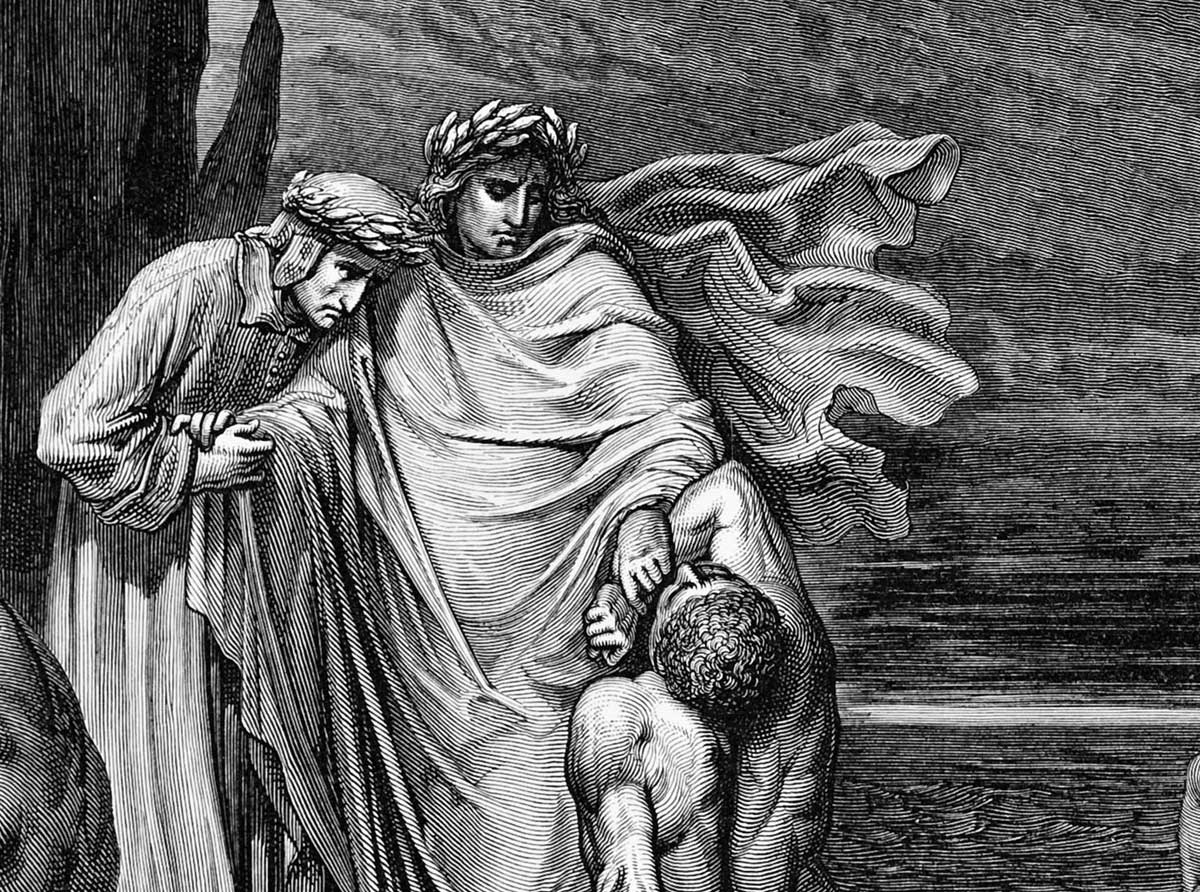
Misguided Mercy & Dante's Infernal Purgation by Joshua Hren

30.5—Sept/Oct 2017
on Costly Grace in Breece D'J Pancake's Flyover Country by Casey Chalk
more from the online archives
30.6—Nov/Dec 2017
Christ, Individualism & the Meaning of Cultural Diversity by Anthony Esolen

26.5—Sept/Oct 2013
The Perils of Pragmatism in Christian Attitudes Toward the Liberal Arts by Robin Phillips
calling all readers
Please Donate
"There are magazines worth reading but few worth saving . . . Touchstone is just such a magazine."
—Alice von Hildebrand
"Here we do not concede one square millimeter of territory to falsehood, folly, contemporary sentimentality, or fashion. We speak the truth, and let God be our judge. . . . Touchstone is the one committedly Christian conservative journal."
—Anthony Esolen, Touchstone senior editor
