View
Spirited Hearts
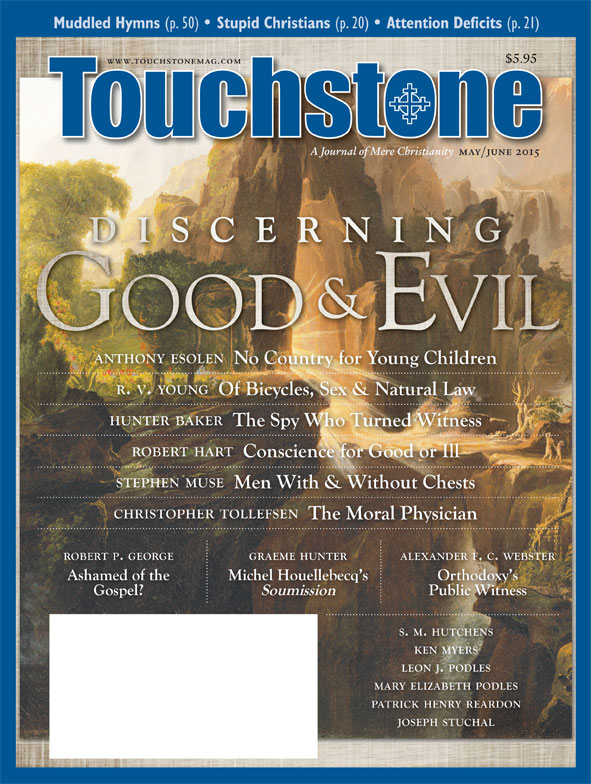
Stephen Muse on Why Men Without Chests Are Not Free & Do Not Love
William Blake once asked a companion what he saw when he looked at the sun. His friend replied, "I see a yellow orb, approximately such-and-such a shape and distance from the earth." Blake responded something like, "I see the Hosts of Heaven coming on chariots of fire proclaiming 'Holy, Holy, Holy, Art Thou O Lord!'" Did the two men see the same sun? Or were they just talking about it differently? And what does it really matter?
C. S Lewis, in The Abolition of Man, describes a textbook used to teach the ways of the King's English to British youth. He points out a subtle philosophical sleight-of-hand that the author hid behind the guise of teaching boys rhetoric. An example was given of the poet Samuel Taylor Coleridge, who was visiting a waterfall with two tourists. One called the waterfall "sublime" while the other said it was "pretty." Coleridge endorsed the first judgment and rejected the second with disgust. The textbook author used this incident to teach that when the one man said, "This is sublime," he only appeared to be making a remark about the waterfall. Actually, his remark was not about the waterfall at all, but only about his own emotions in response to it.
With this teaching, the author was inculcating in students an uncritical acceptance of a philosophical position regarding their capacity to discover what is true about themselves and the world. They were learning that one's own subjective experience is all one can know about reality. This utterly self-centered perspective is now a familiar, often unquestioned stance, that finds its way into catchy slogans that effectively end any depth of discussion by appealing to the politically correct psychobabble implicit in the social norms governing public discourse in America: Whatever I like and works for me is true and good for me, and whatever you like and works for you is true and good for you. (The corollary to this seems to be: Whatever I like and however I want to say it is true and good for me, and if you don't like it, so what!)
Do these kinds of kindergarten rules of engagement permit us to encounter one another co-creatively with any degree of passion and intelligence to discover a truth greater than our own personalities? Do they permit us to fully explore the depth and height and breadth of the blazing mystery that lies around and within us and includes all of us, and that set the poet William Blake's heart on fire?
False Freedom
There is a saying from the Talmud that declares, "We don't see the world as it is but as we are." Though that may sound a lot like the position of the author cited in Lewis's book, it is actually a much more subtle and useful observation. It suggests by implication that if we want to see the world as it is, we had better refine our own vision first; or, as Jesus said, "Take the log out of your own eye" and "Blessed are the pure in heart, for they shall see God." That's pretty good vision.
If human subjectivity is indeed the "highest value" and "measure of all things," it had better be illumined by God, who alone is able to actually know life as it is. Whatever our religious persuasion, we all suffer from a kind of monomeism instead of monotheism. This is the sickness of every addict, which must be cured by the first three of the "twelve steps" before any healing and transformation can begin: One—recognizing that putting all my hope in myself is hopeless. Two—recognizing that there is a God whose power and truth are greater than my own subjective self, and who can help me. Three—entering into relationship with that Other in order to become free of slavery to my addiction, which is rooted in placing my own desires and self-centered actions above the objective reality and truth of God and all other persons.
Unwillingness to move beyond one's own unredeemed subjectivity in order to encounter the other and the world on their own terms inevitably produces what Lewis calls "a man without a chest," that is, someone who is content to allow basic fallen instincts and imagination to overpower and co-opt reason because he has no discerning heart able to integrate instinct and rationality in the service of goodness, truth, and love. A "man without a chest" is someone who does not distinguish his desires from their effects on others, someone whose heart remains untrained, undisciplined, blind, weak, and ineffectual. In effect, he is a man who is not free and does not love.
What comes to fruition in the life of a man without a chest is not the humanity of God we see in Jesus Christ, but the inhumanity that Mark Twain remarked was more cruel than the fang and claw of any beast, which arises in every person who presumes to be the sole determiner of right and wrong, "knowing good and evil" on his own, apart from God and the community. This is Lucifer, the king of men without chests. And from Lucifer all manner of demons arise to captivate and further enslave.
Once a person confuses freedom with the tyranny of his untransfigured instincts and subjective emotions, he becomes like Gulliver venturing onto the island of the Lilliputians, who are able to tie him down and immobilize him with a thousand weightless strands. What seems like the ultimate "freedom to be myself" is an illusion that can only be maintained by disregarding the power and threat contained in each of those tiny strands of "I want." In reality, it is precisely the opposite of freedom. In his play Man and Superman, George Bernard Shaw offers a definition of hell as "having to do what you want." This leads to total depravity, and it happens a little bit at a time. Every instance in which conscience is ignored makes the spiritual heartbeat grow a little fainter.
Stephen Muse is a pastoral psychotherapist and deacon serving in the Greek Orthodox Church. His most recent books are When Hearts Become Flame and Being Bread (Orthodox Research Institute Press). The Peddler and the Disenchanted Mirror is currently in press with Parrisia Editions.
A Journal of Mere Christianity—Delivered to Your Door
- Essays on theology, culture, and the Church
- Contributors from across the Christian traditions

Six print issues (one year) of Touchstone, plus full online access and PDF downloads for only $39.95.

Get a one-year full-access subscription to the Touchstone online archives for only $19.95.
bulk subscriptions
Order Touchstone subscriptions in bulk and save $10 per sub! Each subscription includes 6 issues of Touchstone plus full online access to touchstonemag.com—including archives, videos, and pdf downloads of recent issues for only $29.95 each! Great for churches or study groups.
Transactions will be processed on a secure server.
more from the online archives

calling all readers
Please Donate
"There are magazines worth reading but few worth saving . . . Touchstone is just such a magazine."
—Alice von Hildebrand
"Here we do not concede one square millimeter of territory to falsehood, folly, contemporary sentimentality, or fashion. We speak the truth, and let God be our judge. . . . Touchstone is the one committedly Christian conservative journal."
—Anthony Esolen, Touchstone senior editor