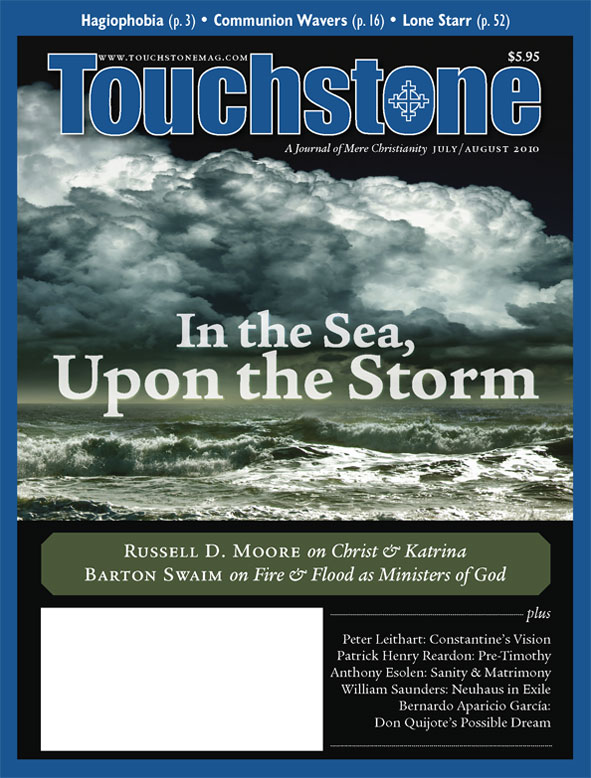
Christ & Katrina by Russell D. Moore
Christ & Katrina
Five Years Ago My Hometown Suffered an Apocalypse
by Russell D. Moore
I always feared seeing my hometown turn into Armageddon, and five years ago,
sure enough, that’s just what happened. As a small child, I would sit
in the pews of my church and imagine, as our pastor flipped through one apocalyptic
scenario after another in his prophecy charts, what our town—Biloxi,
Mississippi, on the coast of the Gulf of Mexico—would look like after
the seals of the Book of Revelation had been opened, after all hell broke loose
on the world as we knew it.
When I’d mention such things, the Southern Baptist adults around me
would try to comfort me with the details of our then-trendy 1970s pop-dispensationalist
eschatology: “Don’t worry about that, honey; the Rapture of the
church will have happened by then, and you won’t be here to see it.”
That really didn’t comfort me, though, as much as they thought it would.
Yes, my raptured soul would be safely sequestered in heaven, while tsunamis
and locusts and horse-riding specters ravaged our hometown, but it would still
be gone, washed away in a flow of blood and debris. I would be exiled from
it. And home would be taken away from me—forever.
I knew I wasn’t supposed to think that way. This world is not our home,
you know. We are citizens of heaven, resident aliens here for a vapor. But,
still, the idea of my little beachfront community buried beneath the collapse
of unbelieving civilization was hard to take, so I tried not to think about
it, focusing instead on the scenarios the preachers actually talked about:
the sudden evaporation of New York or Washington or Hollywood or Rome, all
those Babylons that, we were told, were exalting themselves against God, and
corrupting our values with prayerless schoolrooms and primetime soap operas
and heavy metal music and nuns (though with a half-Catholic family, I never
believed that last part).
I outgrew the dispensationalism (while holding onto the gospel underneath
it all), but I still lived to see my hometown face an apocalypse. And rather
than watching it all helplessly from a cloud in heaven, I had to watch it all,
even more helplessly, on CNN.
Divided by Camille
When I was growing up, hurricanes were like fall revival meetings: cyclical
as the seasons themselves, lots of buzz beforehand, but rarely amounting to
much at all. A few hurricanes hit, tearing up the yard, uprooting our climbing
trees, and leaving us without power or water for weeks at a time. It was kind
of an adventure. My little brother would literally jump around the yard in
excited anticipation. Some adventurous rakes would always plan hurricane parties
on the beach—while the older people shook their heads in disapproval.
Every time a hurricane came through, though, the generation before us would
start chattering about “Camille,” the big, devastating hurricane
that wiped out the Coast in 1969, two years before I was born. Our parents
and grandparents divided history into “before Camille” and “after
Camille.” To us, Camille was as distant as the Great Depression. One
explained why my grandmother canned so much food every year in her storage
shed, and the other explained why she cried whenever the weatherman announced
a hurricane watch.
I expected a normal, run-of-the-mill hurricane when my parents told me, in
August of 2005, that another one was forecast. “Dad, why don’t
y’all come up here with us, during the storm,” I offered, though
I knew in advance what his response would be. “Only wimps and Yankees
evacuate,” he said (which is an adequate answer, perhaps, for why my
ancestors lost the Civil War).
What I didn’t know was that the most horrible natural disaster in American
history was building strength somewhere out there in the Gulf. And my hometown
was her prey.
Like Babylon
Most of the news reports focused on the levees breaking in New Orleans, and
rightly so, since the engineering failure that devastated that great and indispensable
American city—and the political, social, cultural, and economic aftermath—is
an ongoing national crisis. But Katrina didn’t hit New Orleans—she
merely released her apocalyptic horsemen out into the Crescent City. She hit
the coastline of Mississippi, just over the Louisiana border, and afterwards,
nothing would ever be the same.
For a week I didn’t know if my parents and grandmother and other relatives
were alive or dead. I watched the images on television, pacing the floors as
I saw landmark after landmark wiped off the map. The mausoleums in some of
the graveyards are said to have opened, with coffins and bodies floating down
the streets.
But the round-the-clock cable networks didn’t prepare me for seeing
my post-Katrina hometown with my eyes for the first time. My boyhood prophecy
charts prepared me more.
After the National Guard allowed traffic into the disaster area, I drove
down Highway 90, along the Gulf, with my wife. I pulled the car over to cry,
and to vomit. Houses of family and friends: gone. Churches I’d heard
and preached the gospel in: gone. Most of the landmarks of my childhood, adolescence,
and young adulthood: gone. And thousands of my fellow Coastians (and New Orleanians):
devastated. The strewn brick and rotting fish and jagged trees all lay there
in the coastal sun like a decomposing corpse.
Some people said it looked like Hiroshima after the bombing. My thought instead,
conditioned by my fundamentalist background, was that it looked like Babylon
after the fall of the Beast. It was like the end of the world I used to worry
about, just a couple miles down the road from there. And, in some ways, it
was.
Little Apocalypses
Katrina reminded me that my home church was right about the apocalypse, even
if wrong about the details. Scripture continually speaks of the Day of the
Lord—that time in history when all the established order is shaken like
ripe figs from the tree (Nahum 3:12) by the judgment of Yahweh. And it speaks
of glimpses of that Day of the Lord coming repeatedly through history, as nations
war against nations and earthquakes and signs in the heavens rattle the dwellers
of earth. These are, Jesus tells us, “but the beginning of the birth
pains” (Matt. 24:8).
The use of apocalyptic language for the destruction of Katrina is tricky,
complicated by all the craziness that accompanies any disaster these days.
Of course, the hired-gun prophecy experts on Christian television were on hand
to embarrass the church, as usual, with pronouncements that this was God’s
judgment for some sin of the people there (usually the casino industry on the
Coast or, more typically, the hedonism, sexual and otherwise, of New Orleans).
And it wasn’t just the right-wing fringe. Robert F. Kennedy, Jr., sounded
like a mirror image of Pat Robertson when he suggested that the governor of
Mississippi’s opposition to a global climate-change treaty had something
to do with the disaster. Such is, of course, nonsense.
The Christian gospel refuses to flatten out the little apocalypses of history
into the same kind of “sheep and goats” clarity as the final Apocalypse.
Jesus refuses to blame the falling of the tower at Siloam on the personal sin
of those suffering there. But Jesus doesn’t avoid talking about ultimate
Apocalypse either. He rejects a personal sin-disaster correlation but then
says: “Unless you repent, you will all likewise perish” (Luke 13:4–5).
Unnatural Disasters
The apocalypses we experience now—whether in Katrina-struck America
or earthquake-devastated Haiti or tsunami-ravaged Asia—remind us that
this present order isn’t the way it’s supposed to be. The CNN meteorologists
can explain the hurricane only in terms of barometric pressure and water temperatures.
We know, however, that at its root this natural disaster isn’t natural
at all. It is creation crying out, “Adam, where are you?”
The Psalmist reminds us that God originally put all things under the feet
of Adam (Psalm 8:6). But the writer of Hebrews reminds us that we do not yet
see all things under the feet of humanity (Heb. 2:8), although we do see a
crucified and resurrected Jesus (Heb. 2:9). Whereas Jonah the sinner could
only still the storm by throwing himself into its midst, Jesus exercises dominion
over the winds and the waves with his voice. Mark testifies that the boat’s
occupants remarked: “Who then is this, that even wind and sea obey him?” (Mark
4:41).
The Apostle Paul likewise reminds us that the creation itself groans under
the reign of sin and death, waiting for its rightful rulers to assume their
thrones in the resurrection (Rom. 8:20–23). The storms and the waves
are one more reminder that the “already” has not yet been replaced
by the “not yet.”
The Scripture says that in our fallenness we intuitively want to deny even
the possibility of ultimate apocalyptic judgment—whether in reference
to the first watery apocalypse or the fire to come next time. In these last
days, the Apostle Peter tells us, scoffers will say: “Where is the promise
of his coming?” Unbelief will always point, he says, to the fact that “all
things are continuing as they were from the beginning of creation” (2
Peter 3:3–4). That’s why Jesus says the final cosmic Katrina will
come as “in the days of Noah”—unexpectedly in the midst of
feasting and working and marrying and giving in marriage (Matt. 24:36–55).
Baptismal Warning
The tragedy of a groaning cosmos right now isn’t because God is a capricious
king. It’s because he is allowing these chaotic upheavals to warn us
that the order we so want to hold onto isn’t stable, that the ruler of
this world is judged—and his kingdom will ultimately be shaken and replaced.
Because we know the end is coming, the Spirit prompts us to learn to groan
along with the cosmos (Rom. 8:22–23).
Perhaps the right kind of biblical apocalypticism was proclaimed less in
our prophecy charts than in our baptisteries. As Baptist Christians we believed
(and I still do) that baptism is immersion. But too often we seemed to forget
that this immersion was a sign of judgment, and of the sureness of death. Our
baptism proclaims that we are drowned beneath the watery curse of death, buried
with Christ, but also raised with him (Rom. 6:3–6). As the tribe of Noah
is brought safely through the waters and into a new creation, “baptism,
which corresponds to this, now saves you” (1 Peter 3:20).
The people of my hometown have seen, in a sense, a “baptism” of
their entire world, beneath the waters of a violent sea. They—and I—will
probably never hear the parable of the house built on the rock the same way
again. And they—and I—will probably find something all the more
sobering about the warning that Jesus will baptize this universe next not with
cleansing water, but with purifying fire (2 Peter 3:7).
Loss of Home
But Katrina also reminded me what was wrong with the Evangelical apocalypticism
of my boyhood.
We always seemed to love “home” too much to really believe it.
The culture around us revolted against Southern Evangelical eschatology with
songs like Hank Williams Junior’s “If Heaven Ain’t a Lot
Like Dixie (I Don’t Want to Go).” We’d respond by singing
of “Sweet Beulah Land,” that we were “kind of homesick for
a country, to which I’ve never been before.” But the heaven we
spoke of, and sang about, and imagined, looked an awful lot like Dixie, too.
We were rooted people, despite all our prophecy charts and gospel songs.
The grief I experienced after Katrina was nothing like that of those who
had stayed—including most of my family—relocated to FEMA trailers,
their homes a pile of rubble, their jobs “raptured” away with the
fleeing businesses. My pain was more psychic. Some would say it was the loss
of nostalgia. I’d see it more as the loss of home.
The worst part of my post-Katrina visit wasn’t the wreckage. The worst
part, for me, was that, driving down the most familiar piece of ground for
me on this earth, I didn’t know where I was.
Biloxi was always where I could return to, if only for a few days, and find
things always the same. Sure, things would change in a micro-evolutionary way:
a new pier built over here, a new dollar store on the corner over there.
But the beachfront mansion Beauvoir would always be there, right where Confederate
president Jefferson Davis had built it. Right there would be the magnolia trees
my brothers and I climbed through, pretending to be pirates. Right there would
be the Winn-Dixie grocery store where I’d worked my way though high school.
Right there, the mall where I first saw the bashful young girl who would later
be my wife. Right there, the seafood restaurant overlooking the beach where
we’d had our first date. And right there, at the end of that pier, the
spot where I first realized I wanted to ask her to marry me.
It’s all gone now. And it’s not coming back.
Loss of the Past
Not knowing where I was, on Highway 90, gave me a jarring sense of a loss
of the past. I feel it still. Five years later, most everything that can be
reconstructed has been. There are shiny new high schools and malls. But you
can’t rebuild a beachfront antebellum house or a hundred-year-old church.
Instead, Biloxi is now dotted with (even more) casinos, (even more) Waffle
Houses, and (even more) Wal-Marts and Best Buys.
I understand now what Elizabeth Spencer wrote, in another day, in her memoir Landscape
of the Heart:
If I could have one part of the world back the way it used to be, I would
not choose Dresden before the firebombing, Rome before Nero, or London before
the Blitz. I would not resurrect Babylon, Carthage, or San Francisco. Let
the Leaning Tower lean and the Hanging Gardens hang. I want the Mississippi
Gulf Coast back the way it was before Hurricane Camille, that wicked killer
which struck in August 1969.
Now Southerners are a nostalgic people, and this shows up in our literature,
from Thomas Wolfe to William Faulkner to Eudora Welty to Anne Rice. Mississippi
writer Willie Morris writes about an Ole Miss student who, after encountering
a cosmopolitan, Eastern prep school graduate at a party at Harvard, remarked: “For
the first time in my life, I understood that not all Americans are from somewhere.”
But, it seems to me, this isn’t just a Southern thing or a small-town
Midwestern thing. Rootedness is an essential aspect of human flourishing. It
reminds us that we are creatures; we are from somewhere.
A Rooted Messiah
As fallen image-bearers, we’re all drawn toward the primal sin of the “prince
of the power of the air” (Eph. 2:2). We want either to idolize our roots—to
make them ultimate (see, for instance, the satanic power of the Aryan myth
of the Nazis or the racial supremacist views of the Ku Klux Klan or the Black
Panther Party)—or to transcend our rootedness, to see ourselves as gods
who aren’t fashioned from any particular piece of ground.
In his novel Andy Catlett, Wendell Berry writes of the young Kentuckian
who wishes to get away from his upbringing, to create his own identity, and
to be as “ancestorless” as the first man. But the first man wasn’t “ancestorless.” He
was, the Bible says, the “son of God” (Luke 3:38). And he wasn’t
from nowhere. He was molded from the mud and given a home in a specifically
noted place, in the east and defined around the rivers Pishon, Gihon, Tigris,
and Euphrates (Gen. 3:10–14).
When God in Christ Jesus recapitulates the human story—and thereby
redeems the world—he does so with a “rooted” Messiah. Yes,
the Son of God transcends human time and space. He was with the Father and
the Spirit in love and glory “before the world was” (John 17:5).
But in his Incarnation, Jesus identifies himself with a tribe, with a genealogy,
with a hometown—even one that isn’t thrilled about his preaching
(Luke 4:24). He, Scripture tells us, “went and lived in a city called
Nazareth, that what was spoken by the prophets might be fulfilled: ‘He
shall be called a Nazarene’” (Matt. 2:23).
Some of Jesus’ contemporaries rejected him because of this rootedness: “But
we know where this man comes from, and when the Christ appears, no one will
know where he comes from” (John 7:27). They were quite mistaken. It is “the
Beast” who is from nowhere, “rising out of the sea” (Rev.
13:1), representing humanity in its origins-denying self-exaltation (Rev. 13:18).
Our Lord Jesus, on the other hand, is from “the land beyond the Jordan,
Galilee of the nations” (Is. 9:1). We know where this Man comes from.
Perhaps if we were less embarrassed by our rootedness, we might see something
glorious in it despite all the ways we have perverted it (and Mississippians,
as we know, have seen how love of roots can be drawn into the spirit of anti-Christ).
It seems to me that the Christian Platonism of C. S. Lewis is more resonant
with biblical eschatology than the Christian apocalypticism of C. I. Scofield.
Lewis would have been derided by the old dispensationalists as rejecting a “literal” view
of the end—one without an earthly millennial kingdom or a “future
for Israel.” But Lewis was no cosmopolitan. Yes, he craved heaven, for
the great “northernness” he could see in the vast sky above him,
but he tied that craving to a longing experienced first in nostalgia—for
the changing seasons, for the stories of childhood, for the experience of home.
In the last of his Narnia books, Lewis shows us his vision of the end. It
is not an escape from creation or a flight from the past. It is instead a more “real” Narnia,
of which the older Narnia was but a shadow. Life in this present Narnia comes
to a close, but it isn’t “over.” It is a preparation for
life in a new Narnia, in which the longings of home come to fruition, ever
expanding into eternity.
Redeemed & Restored
Five years after Katrina, my hometown has changed. There seems to be a roughness
there I never knew before. The confluence of coastal Cajuns, old southern families,
and Vietnamese immigrants, with Deep South manners and the rhythms of Mississippi,
made for a certain kind of sweetness. The co-existence of Roman Catholic Lenten
fish fries and Southern Baptist revival meetings furthered a sense of “mere
Christianity,” even as it often showed just how nominal and shallow both
could be. The Coast seems more rugged now, more grown-up in the most tragic
sense. The Coast (and with it, New Orleans) seems more like William Faulkner
than John Kennedy Toole these days. It’s my favorite place on earth,
but there’s a deep brokenness there.
As I am editing this article—written months before—my hometown
is bracing for another wave of crisis. An oil rig catastrophe in the Gulf of
Mexico, the greatest environmental disaster in American history, means an enormous
blob of crude petroleum gushing from the ocean’s floor now threatens
to cover the beaches and marshes of the Gulf Coast, smothering the sea-life
and birds and possibly making extinct the fishing, seafood, and tourism industries
that have created and sustained not just the economy but the culture itself.
As I write these words, I have no idea how badly this will turn out, but it
feels much worse than Katrina—a slow-motion Katrina with no eye of the
storm.
The people of my hometown have seen a little apocalypse. They’re not
the first, and they won’t be the last. But five years later, we should
all remember that “natural disasters,” ultimately, are neither
natural nor disastrous.
My hometown isn’t there anymore. But then again, it never really was.
The hope after Katrina is not for civil defense and architectural rebuilding.
It is for that little stretch of pine-dotted coastland, and with it the entire
created universe, to be redeemed and restored in Christ. There will come a
day when the curse is reversed, and the Gulf Coast, along with the entire cosmos,
fully reflects the glory of a resurrected Messiah. And John sees in his vision
that, on that day, “the sea was no more” (Rev. 21:1). He also sees
that, in the Holy City, “nothing unclean will ever enter it” (Rev.
21:27).
Jesus of Nazareth can bring down Babylons, yes, and Jerusalems too. But Jesus
can also drive evil spirits into the sea. He can turn back the sea itself with
a clearing of his throat. And even as he teaches us that those who follow him
must leave “houses and lands” (Mark 10:28–29), he promises
us that we’ll receive “a hundredfold” of such in him.
One day, we will all see the rubble of all of our places and people, our
principalities and our power. And we’ll grieve, as we should, for the
past worlds that have birthed us. But then, the gospel tells us, we’ll
see a new city, coming down out of heaven to resurrect a universe in which
the wrathful sea has finally been turned back.
“What is that?” one of us might ask.
“That’s the New Jerusalem,” we might hear a familiar Galilean
voice say. “Our hometown.”
Russell D. Moore is the author of Adopted for Life: The Priority of Adoption for Christian Families and Churches. He lives with his family in Louisville, Kentucky, where he serves as Dean of the School of Theology and Senior Vice-President for Academic Administration at The Southern Baptist Theological Seminary and as preaching pastor at Highview Baptist Church. He is a senior editor of Touchstone. |