




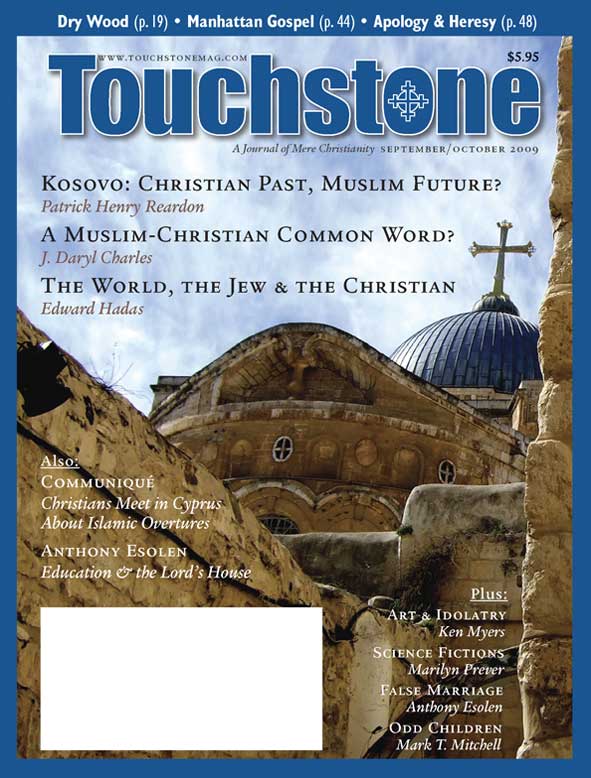
Art & Idolatry
In early July, from the corner of my vision, I caught glimpses of various efforts staged to memorialize the late Michael Jackson. Several friends commented to me during that week on the surreality of the intense displays of devotion. Among ourselves, we lamented the reverence accorded Jackson by the media, but we also had the disturbing sensation that it would have been a sacrilege to raise questions in public about the alleged magnitude of Jackson’s talent, let alone about the unseemliness of our culture’s adulation of a man with such a malformed life. During our conversations, I kept recalling observations from a number of books and articles I’d read about the idolatry and confusion evident in the culture of celebrity.
One book about the social history of modern art best helped clarify this odd moment. While the faithful were gathering to honor the death of the King of Pop (what a remarkably undemocratic moniker!), I happened to be rereading Jacques Barzun’s compact but powerful book, The Use and Abuse of Art (Princeton University Press, 1974), based on six lectures given in 1973 by the polymathic Barzun at Washington’s National Gallery of Art. In a chapter called “The Rise of Art as Religion,” Barzun observes:
Even now, despite the rebellion against high art, the present age as a whole assumes without question that man’s loftiest mode of expression is art. The models of human greatness are not the soldier, the statesman, the divine. They are occasionally the scientist and persistently, pre-eminently, the artist.
THIS ARTICLE ONLY AVAILABLE TO SUBSCRIBERS.
FOR QUICK ACCESS:
Ken Myers is the host and producer of the Mars Hill Audio Journal. Formerly an arts editor with National Public Radio, he also serves as music director at All Saints Anglican Church in Ivy, Virginia. He is a contributing editor for Touchstone.
subscription options
Order
Print/Online Subscription

Get six issues (one year) of Touchstone PLUS full online access including pdf downloads for only $39.95. That's only $3.34 per month!
Order
Online Only
Subscription

Get a one-year full-access subscription to the Touchstone online archives for only $19.95. That's only $1.66 per month!
bulk subscriptions
Order Touchstone subscriptions in bulk and save $10 per sub! Each subscription includes 6 issues of Touchstone plus full online access to touchstonemag.com—including archives, videos, and pdf downloads of recent issues for only $29.95 each! Great for churches or study groups.
Transactions will be processed on a secure server.
more from the online archives
32.5—September/October 2019
on the Inhuman Transformation of Transgenderism by Anthony Esolen

33.3—May/June 2020
on the Wisdom of the Good Doctor Edmund Pellegrino by Allen H. Roberts II
calling all readers
Please Donate
"There are magazines worth reading but few worth saving . . . Touchstone is just such a magazine."
—Alice von Hildebrand
"Here we do not concede one square millimeter of territory to falsehood, folly, contemporary sentimentality, or fashion. We speak the truth, and let God be our judge. . . . Touchstone is the one committedly Christian conservative journal."
—Anthony Esolen, Touchstone senior editor
