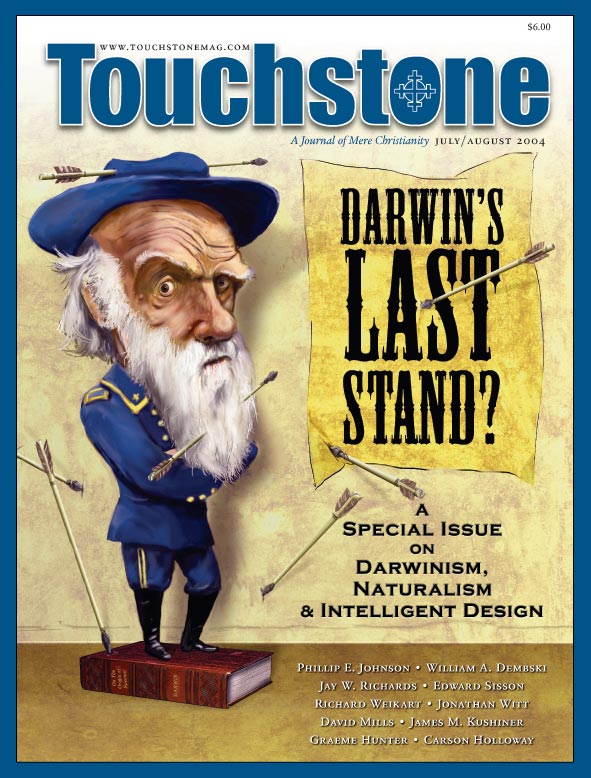
The Measure of Design by Jed Macosko + Paul A. Nelson + Phillip E. Johnson + William A. Dembski + Edward Sisson + Richard Weikart + Jonathan Witt
The Measure of Design
A Conversation About the Past, Present & Future of Darwinism &
Design
Jed Macosko, who received his doctorate from the University
of California at Berkeley for his work on influenza hemagglutinin and HIV RNA
and then received a two-year postdoctoral fellowship from the National Institutes
of Health, will begin teaching biophysics at Wake Forest University this August.
Paul A. Nelson has published articles in popular and scholarly
journals and contributed to the anthologies Mere Creation and Signs
of Intelligence. His forthcoming monograph, On Common Descent,
critically evaluates the theory of common descent, and is being edited for the
series Evolutionary Monographs, produced by the University of Chicago’s
Department of Ecology and Evolution. See the other writers’
articles in this issue for their biographies. The answers begin with those by
Phillip E. Johnson, as the leader of the movement, followed by the others in
alphabetical order.
Touchstone: Who are the “prophets” who anticipated
the intelligent design (ID) movement? (I mean people writing before Phillip
Johnson.) Did anyone influential listen to them?
Phillip E. Johnson: I would name, first, Dr. A. E.
Wilder-Smith, author of The Scientific Alternative to Neo-Darwinian Evolutionary
Theory, who pioneered the “origin of information” analysis
(see http://emporium.turnpike.net/C/cs/sa.htm),
and Dr. Michael Denton, author of Evolution: A Theory in Crisis. Both
these brilliant men were noticed to some degree, but prejudice prevented their
ever gaining a fair hearing.
William A. Dembski: I would add to Phil’s list
Michael Polanyi and Marcel Schützenberger. Like Wilder-Smith and Denton,
they were deeply critical of scientific materialism and the reductive approach
to biology that it fostered. They also had stellar reputations in the secular
intellectual world, so it was hard to dismiss them as cranks.
Paul Nelson: I’d list Charles Thaxton, Walter Bradley,
and Roger Olsen, who published The Mystery of Life’s Origin
in 1984, a book that anticipates many of the central concerns of the ID community.
If you ask Charlie Thaxton who he was reading, however, in the years
that led to Mystery, I think he’d mention people such as the
philosopher of science Michael Polanyi, mathematician and biologist Marcel Schützenberger,
and the theologian Francis Schaeffer. And A. E. Wilder-Smith, a polymath
who thought hard about exactly why Darwinism failed.
What do you say to people who say—in one way or another—it’s
just not plausible that mainstream science took such a wrong turn?
Johnson: Freud, Marx, and Darwin were all revered
as major scientific heroes throughout the twentieth century. Of the three, only
Darwin retains any scientific standing.
Nelson: Look at the history of science: plenty of wrong turns.
Taking and then discovering that one has taken a wrong turn is what science
is all about.
Edward Sisson: The history of science for the past 500 years
includes many such “wrong turns” by the mainstream science of the
day, including Ptolemy’s earth-centered universe (replaced by Copernicus’s
sun-centered theory), Galen’s theory of the four humors of the blood (replaced
by Harvey’s work on blood circulation), the theory that now-extinct land
animals crossed to different continents by means of now-submerged “land
bridges” (replaced by the theory of plate tectonics), and other now-rejected
theories as discussed in the landmark work by Thomas Kuhn, The Structure
of Scientific Revolutions. Thus, opponents of Darwinism are not, as this
kind of objection suggests, asserting something that has no precedent in the
history of science.
Darwinism has gained and maintained its position because it is a theory that
scientists very much want to be true, because it removes one of the main lines
of argument asserted by religious leaders: that there must be a God because
no natural force could explain the diversity of life. By removing that line
of argument, science enhances the authority of scientific leaders in competition
with religious leaders on matters of great public importance. That is what the
famous debate between T. H. Huxley and Bishop Wilberforce was all about:
who would be humiliated and who would control the podium.
Richard Weikart: As a Christian who specializes in European
intellectual history (especially the history of Darwinism), I consider many
intellectual movements of the past two centuries “wrong turns.”
For example, historicism, the idea that everything—nature, human society,
morality, and even God—is in constant flux, was an idea that dominated
nineteenth-century European thought. This was a reaction against traditional
Christian views of an unchanging God who created a stable world with immutable
moral laws. Historicism was already ascendant before Darwin published his theory,
and it obviously heavily influenced Darwinism. Another major intellectual current
in the nineteenth century, positivism, taught that all of reality could be explained
through science, and whatever could not be discovered through the scientific
method does not count as knowledge.
Science, especially historical science (such as Darwinism), was not immune
from these ideological influences. The positivist mentality effectively eliminated
from science any possibility of supernatural creative events in the past. Once
supernatural acts were ruled out of bounds (not by any scientific data, but
by philosophical presuppositions), then evolution became the only possible game
for explaining the origin of living organisms and humans, and anyone believing
in creative acts by a supernatural being was marginalized and branded unscientific.
By the way, mainstream religion took the same turn, and under the influence
of the same anti-supernatural bias, produced liberal Christianity.
Jonathan Witt: Given humankind’s penchant for institutionalized
stupidity, the more puzzling question is: How did even one group of mistake-prone
humans (Christian Europe) ever figure out how to thresh the wheat of scientific
truth from the chaff of inevitable error? History is replete with popular, persistent,
false “facts”: the supposed efficacy of child sacrifice, gods cavorting
on Mount Olympus, spring optimism at Wrigley Field.
Or consider an example from modern science: Astronomers from Newton’s
day well into the twentieth century assumed that the universe was eternal and
infinite. But then Edwin Hubble decided to regard this “fact” as
an open question and went on to show that the universe is finite and had a beginning.
The great thinker Aristotle assumed that a heavy object would fall faster than
a lighter one. It’s only a slight oversimplification to say that a bridge,
a pebble, and a stone could have disproved that easily enough. However, the
idea persisted for centuries until a Catholic named Galileo Galilei thought
something like this: “Aristotle’s position sounds right, but human
reason is fallen. I’ll consult the book of nature; I’ll test the
idea.” He discovered that weight had nothing to do with the matter.
Hubble and Galileo embodied the scientific method in motion. Darwinism, in
contrast, is just one of many missteps in the history of science. One question
remains: Will we guard the misstep or the method?
What do you say when someone accuses you of being a creationist
or using (i.e., misusing) science to advance an unscientific agenda?
Johnson: This appeal to prejudice is meant to distract attention
from the fact that Darwinism is founded upon naturalistic philosophy, rather
than upon unbiased empirical testing. I like to ask such accusers if natural
selection can be demonstrated to have the power to create new genetic information
or new complex organs. If not, then it is the Darwinists who are using science
to advance a philosophical agenda, the agenda of scientific materialism.
Dembski: With questions like this I always try to get back
on topic. The crucial issue always in this debate is whether material mechanisms
have the creative capacity to bring about biological complexity. This claim
cannot be a necessary truth, for otherwise we are talking metaphysics and not
science. And since it is not a necessary truth, the question is open for scientific
discussion, and design becomes once again a real possibility.
Jed Macosko: As I told the Christian
Networks Journal when they interviewed me about this, the ID position
is a minimalist position. It argues that the information we see in the biosphere
is too complicated to have arisen by chance plus natural selection, and that
something intelligent needed to bring all those complex systems into
existence. It is a scientific theory about how we see the world around us that
expects to be evaluated on scientific grounds.
Nelson: It’s funny—or sad—to see how “creation,”
one of the loveliest words in the English language, becomes a byword in science
when “-ist” is attached. “Creationists” are seen as
Bad Guys nowadays, so few people outside the young-earth creationism camp want
to use the label self-referentially. When critics say to me, “Hey, you’re
a creationist!”, I try to carry our discussion past what they intend as
an inquiry-stopping insult. Usually, with a little patience, one can do that—and
that works with the pejorative “anti-science,” too. Just let the
invective pass; get back to the evidence.
Sisson: No one has yet laid this accusation against me. Were
it to happen, I would respond that I am a non-churchgoer; that my religious
affiliation is mainline Episcopal; that I graduated from MIT with a bachelor
of science degree; and that I have never believed in young-earth creationism
or anything of the kind. I got interested in this issue by reading mathematical
analyses of Darwinism that demonstrate that under the rules of the mathematics
of statistics, evolution as posited by the Darwinian theory is impossible.
If someone were to say I am advancing an unscientific agenda, my response
would be: Mathematics is the foundation of science, and mathematics disproves
many of the most important Darwinian evolutionary claims. I am being scientific,
not unscientific, in rejecting Darwinism.
Weikart: If the charge is that I believe that God can and
has intervened in the past with miraculous creative acts, then I plead guilty.
The view that “science” excludes even the possibility that God could
have intervened in the past is not a scientific position, since this claim is
not based on any empirical data. It is instead a philosophical and religious
position. Those who defend such a view are being just as “unscientific”
as those they criticize. Science should be free to follow empirical data, even
if it doesn’t support the view that natural laws and chance are sufficient
to create all living organisms, including humans.
Why does Darwinism—using the term to include the later
versions of naturalism, like neo-Darwinism—appeal so strongly? In particular,
why does it appeal to so many people more than the Christian story, when it
(the Darwinian story) offers them a universe with no meaning, purpose, or end?
Johnson: Many people are glad to see God—and God’s
judgment—relegated to the never-never land of subjective belief. Even
devout Christians have been attracted to Darwinism because it seems to distance
God from natural evil. These Christians usually don’t realize that in
distancing God from the unpleasant aspects of reality, they are pushing him
out of reality altogether, and thus will end up with a godless world in which
there is no escape from nihilism. The depressing conclusion to the journey is
concealed from most people for a long time because they assume that our moral
traditions will somehow continue to direct human behavior even when their foundation
in God has been removed. As Nietzsche warned the Victorians, that assumption
is unrealistic.
Dembski: Two reasons: (1) It provides a materialistic creation
story that dispenses with any need for design or God (this is very convenient
for those who want to escape the demands of religion, morality, and conscience).
(2) The promise of getting design without a designer is incredibly seductive—it’s
the ultimate free lunch. No wonder Daniel Dennett, in Darwin’s Dangerous
Idea, credits Darwin with “the single best idea anyone has ever had.”
Getting design without a designer is a good trick indeed!
Nelson: If one looks at the population as a whole, I’m
not sure more people do prefer the Darwinian story. Polling data in the United
States, for instance, consistently show large majorities for creationism or
God-guided evolution. The scientific community, however, strongly prefers naturalistic
evolution. I think they do so because of how most scientists understand the
scientific enterprise. Design simply cannot be “science.” I think
that’s false, but it’s a deeply rooted preconception.
Sisson: I believe Darwinism is so appealing because it serves
human pride. It facilitates the belief that there is no supernatural intelligence
operating in our world. The absence of any such intelligence means that the
human mind is the most intelligent and creative force in the known universe.
Scientists, having mastered difficult masses of knowledge, and having proven
their reasoning and thinking abilities under rigorous and competitive conditions,
can fairly lay claim to being the most intelligent and creative among human
beings.
Anyone who has observed or read about the smug put-downs scientists inflict
on each other in debates, and who has observed the obsessive drive of scientists
to be the first to publish a discovery—thereby getting credit for having
the sharpest and fastest minds—knows that the drive for the feeling of
intellectual superiority is very strong in the scientific community. The net
effect of Darwinism is that it allows top-level scientists the satisfaction
of believing that nothing in the whole known universe is smarter than they are.
Weikart: Ironically, many Darwinian materialists, despite
their overt rejection of meaning or purpose in the cosmos, do in fact find meaning
in evolution. In the early twentieth century, many Darwinists embraced eugenics,
which was an attempt to help the human species improve and thus make further
evolutionary progress. Though many Darwinists have themselves pointed out that
progress is not really compatible with Darwinian theory, nonetheless, many—including
Darwin—continually refer to evolutionary progress.
Other Darwinists are more consistent and exult in the lack of meaning or purpose
in the cosmos. Stephen Jay Gould, for example, claimed that Darwinism shows
there isn’t any purpose in the universe, so we are free to construct our
own values. James Watson, the Nobel Prize-winning geneticist, tells us that
since everything has come about by chance, we should “play God”
(he actually uses that term) by genetic engineering of humans.
Witt: First, Darwinism grants its followers entrance into
the lists of the brave and unblinking, the übermenschen willing to confront
the frightening reality of annihilation and nothingness. Second, Darwinism is
also a handy belief nowadays if you want to get very far in the naturalism club
of elite academia. Third, for the philosophically inconsistent, Darwinism opens
the door to various forms of feel-good pantheism with its promise of spiritual
self-discovery. Whether that spiritual journey takes them into the desert or
into the arms of their neighbor’s spouse, well, that’s nobody’s
business but their own, for Darwinism slew the Lawgiver, leaving each free to
be his own little god.
What are the implications for morality of Darwinism and intelligent
design? What is their “cash value”?
Johnson: The fundamental issue is whether God is real or imaginary.
An imaginary God has no moral authority. Intelligent design is bitterly resisted
because it threatens to allow God to re-enter the realm of reality as the object
of public knowledge.
Dembski: Darwinism explains why we act morally and why we
have moral sentiments. It does so on the basis of historical conditioning by
our evolutionary past (how good such explanations are is another matter). What
it can’t explain is why we shouldn’t, upon conscious reflection,
rebel against that historical conditioning. Also, evolutionary ethics has a
real problem explaining genuine good. When you read that literature, Mother
Teresa’s life of self-sacrifice is always explained in terms of some underlying
self-interest. See E. O. Wilson, for instance.
Nelson: The philosopher Michael Ruse has argued that if we
take Darwinism “seriously,” we need to rethink the nature of moral
intuitions. Morality on this view is a set of powerful illusions built into
us by natural selection. Design takes a rather different approach. Maybe adultery
(for instance) is wrong, not because it may be selectively disadvantageous under
certain conditions, but because human beings were designed to function best
with one life-long, committed partner (of the opposite sex). In other words,
the designer knows what’s good for us—not natural selection, which,
as an utterly mindless process, wouldn’t care in the least if Homo
sapiens went extinct tomorrow.
Sisson: Darwinism, by undermining the necessity to believe
that any supernatural creative force must exist in our world, tends to diminish
faith in any god, and thus to diminish commitment to the moral rules pronounced
by those whose claim to authority derives from a god. To persons looking for
a way to enhance such authority, intelligent design gets only part-way there.
ID tends to increase the necessity to believe that there must be in fact some
kind of supernatural force operating in the world, but it does not provide criteria
for selecting any one current religion as the best explanation of what that
force is.
What would be lost if the ID movement and its works disappeared
tomorrow? To put it another way, is it merely a critique of Darwinism or does
it offer man something he needs to know?
Johnson: Intelligent design has the potential to become the
basis for a recognized scientific research program, but its main importance
is cultural, as changing society’s definition of knowledge, so that nature
is known to depend on something beyond nature.
Dembski: People’s intuitions will continue to lead
them to see the design in biology and the cosmos. But without intelligent design,
the scientific materialists will claim to have a theoretical justification for
dispensing with design in nature. Intelligent design provides a theoretical
justification for why design in nature is in fact indispensable.
Macosko: You start from where you are. We are saying that
Darwinism is not sufficient. More than half of the work of the ID community
is still directed to pointing out the problems with Darwinism. It has made some
mistakes in the past 150 years, and those mistakes have gone unnoticed for generations.
At the least, the ID movement is good for challenging Darwinism where it needs
to be challenged. But at best, it could be an entirely different and more fruitful
way of looking at science.
Nelson: It offers more, but demonstrating that is going to
be a long-term challenge. “Science in the Key of Design,” if you
will, is a melody that we’re going to have to teach others to hear and
play. First, of course, we have to master it ourselves!
Sisson: If the ID movement and its works disappeared, it
would bolster the current social trend towards the growing prestige of science
and scientists, as compared to the diminishing social prestige of religion and
religious leaders, because more members of the public would be more inclined
to believe that the only forces active in our world are forces within the bounds
of the laws of physics, i.e., that there are no supernatural forces. Thus, fewer
people would pay attention to religious leaders, who claim to have special insight
and understanding into the workings of supernatural forces, i.e., the mind of
God.
Witt: What would be lost if all the voices pointing out the
powerful evidence for intelligent design were silenced? The short answer is:
Western Civilization—that is, all those crucial ideas derived from belief
in a transcendent, rational lawgiver: natural law, the sanctity of life made
in the image of God, a rational cosmos accessible to rational inquiry, the objective
reality of good versus evil, absolute truth. All of these are lost if naturalism
is left to run the show, obstructing real faith in God by bracketing off scientific
evidence of design in nature, and historical evidence of divine revelation and
miracle.
“Those things aren’t science,” it says. “They’re
just irrational faith commitments.” The ID movement exposes naturalism’s
irrational game for the unscientific dogma it is.
What would be the effect if Darwinism
disappeared tomorrow? Has the philosophy produced any practical scientific results?
Has it impeded scientific progress? To put it another way, is it dangerous only
as a veiled form of religious advocacy or also as a scientific mistake?
Johnson: The importance of intelligent design in science
is made murky by the fact that biologists even now freely employ the concept
of design, saving themselves from charges of heresy by arbitrarily attributing
the design to natural selection.
Dembski: Natural selection acting on randomly varying replicators
is fruitful and certainly a factor in biology. It needs to be properly acknowledged.
On the other hand, the claim that this Darwinian mechanism can produce all of
biological complexity and diversity represents a huge leap unwarranted by any
evidence. The disappearance of such grand pretensions can only strengthen science.
Evolutionary biology these days is an exercise in credulity: a willingness to
believe just about anything so long as design is left out of the picture.
Nelson: I think the Darwinian view that organisms are cobbled-together
kludges—the “low” view of life, so to speak—was a scientific
blunder of the first order. Biology is having to unlearn “facts”
about putatively non-functional systems all the time, which might not have happened
if investigators had begun with the premise that what they were looking at was
the product of a subtle, exceedingly clever mind. What evolutionary theory has
discovered of genuine value—and there’s a lot of that—is important
and useful, of course (for example, population genetics). But all the true and
reliable stuff can be incorporated into a new science of design.
Sisson: If Darwinism and its related theories of “unintelligent
evolution” disappeared, it would tend to diminish the social prestige
of science and scientists, as compared to the social prestige of religion and
religious leaders. There would be no effect on the productivity of science,
because the theories have not produced and cannot produce practical results
in any field outside the field of evolution itself, which is not truly a scientific
field when you compare it to real scientific fields like physics. I don’t
know whether Darwinism has impeded other sciences, except that it has impeded
the study of design in nature, of course.
Where is the ID movement going in the next ten years? What new
issues will it be exploring, and what new challenges will it be offering Darwinism?
Dembski: In the next five years, molecular Darwinism—the
idea that Darwinian processes can produce complex molecular structures at the
subcellular level—will be dead. When that happens, evolutionary biology
will experience a crisis of confidence because evolutionary biology hinges on
the evolution of the right molecules. I therefore foresee a Taliban-style collapse
of Darwinism in the next ten years. Intelligent design will of course profit
greatly from this. For ID to win the day, however, will require talented new
researchers able to move this research program forward, showing how intelligent
design provides better insights into biological systems than the dying Darwinian
paradigm.
Nelson: Easily the biggest challenge facing the ID community
is to develop a full-fledged theory of biological design. We don’t have
such a theory right now, and that’s a real problem. Without a theory,
it’s very hard to know where to direct your research focus. Right now,
we’ve got a bag of powerful intuitions, and a handful of notions such
as “irreducible complexity” and “specified complexity”—but,
as yet, no general theory of biological design.
Name (1) the two books on the subject every Christian should
read, and (2) the five or so books every Christian interested in the subject
should read.
Johnson: Modesty forbids (grin).
Dembski: Two books: Darwin on Trial by Phillip
Johnson and The Design Revolution by me. Five books: Evolution:
A Theory in Crisis by Michael Denton, Darwin’s Black Box
by Michael Behe, The Privileged Planet by Guillermo Gonzalez
and Jay Richards, Icons of Evolution by Jonathan Wells, and Signs
of Intelligence, edited by me and James Kushiner.
Nelson: (1) Signs of Intelligence, edited by William
Dembski and James Kushiner. This is a volume that sprang from a Touchstone
special issue, and it’s a great introduction to the key questions. (2)
The Design Revolution by William Dembski. Good answers to the first
several waves of criticism of intelligent design. (3) Darwinism, Design,
and Public Education, edited by J. A. Campbell and S. C. Meyer.
A more in-depth treatment of the public-policy (education) questions, including
several chapters from critics of intelligent design. (4) The Mystery of
Life’s Origin by Charles Thaxton, Walter Bradley, and Roger Olsen.
An insightful classic. (5) Darwin on Trial by Phillip Johnson. Can
anything good come from Berkeley? Yes.
Sisson: Christians and non-Christians and, indeed, agnostics
and atheists should read the following books that establish the mathematical
impossibility of “unintelligent evolution,” such as Darwinism: Sir
Fred Hoyle’s Mathematics of Evolution, Dean Overman’s
A Case Against Accident and Self-Organization, and Lee Spetner’s
Not By Chance! They should also read The Design Revolution
by William Dembski, which deals with all the objections to intelligent design
and rebuts every one of them.
They should also read Maciej Giertych’s introduction to the book
Creation Rediscovered, published on the Internet (note: I have not read
the book, only Professor Giertych’s introduction). He demonstrates the
lack of observed data for unintelligent evolution in the field of population
genetics.
Is there anything else you think needs to be said?
Johnson: I have insisted that the ID movement should not
focus exclusively on scientific issues, to the exclusion of literature and the
arts, which are just as important as science or philosophy in forming a culture’s
understanding of what is real and important. I love Benjamin Disraeli’s
remark that utilitarianism in philosophy and unitarianism in religion suffer
from the same defect. They both neglect imagination, said Disraeli, and yet
imagination rules the world! In that spirit, I have recently founded a “Second
Wedge,” consisting of creative writers and other artistic people, because
it is illogical that literature and the arts should be dominated by materialist
ideas that lead to nihilism and despair. It is not only scientists who need
to be liberated from the straitjacket of materialism.
Dembski: In this debate, always keep your eye on what the
real issue is. This is not a Bible-versus-science debate. The real issue is
always about the nature of nature: Is nature a closed system of blind material
processes ruled by unbroken natural laws, so that any God or designer is merely
a lawgiver, or is nature fundamentally open to novel information from an intelligence?
Many religious traditions are now opening up to intelligent design because it
promises to give scientific expression to their deepest intuitions about the
intelligence and purposiveness that animate all levels of reality.
Nelson: We ain’t seen nothing yet.
Weikart: Darwinism is not an isolated issue that affects
science only. It has implications for our understanding of human nature, psychology,
anthropology, social thought, and morality, as well as religion. Darwin himself
discussed all these issues in The Descent of Man, and myriads of Darwinists
have expounded on the implications of Darwinism for other areas of human existence.
Darwinism was based on and perpetuates presuppositions that are essentially
antithetical to traditional supernaturalist understandings of Christianity,
and even though many Christians try to synthesize Christian doctrine and Darwinian
evolution, the incompatible elements ultimately ruin such a marriage. Not scientific
data, but anti-supernaturalist bias, produced the Darwinian revolution.
|