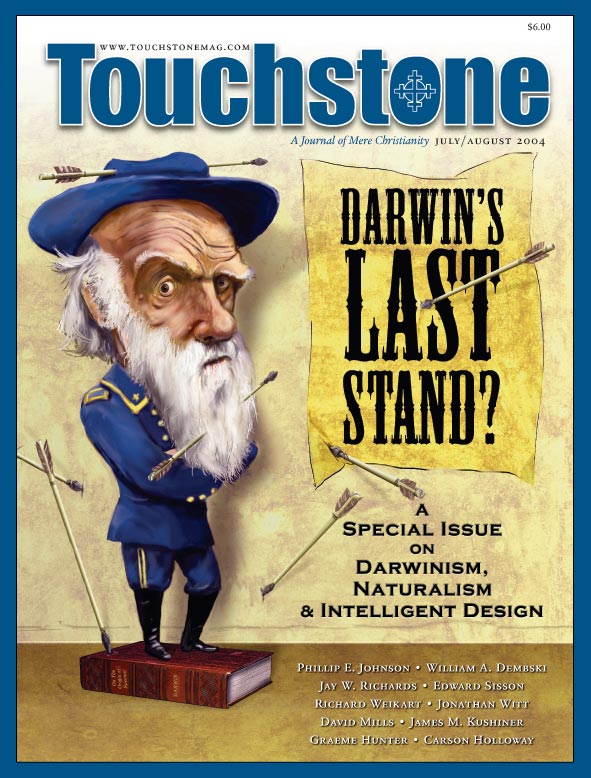
Winning by Design by William A. Dembski
Winning by Design
How ID Advocates Can Effectively Respond to the Growing Backlash
by William A. Dembski
It is to our advantage to discuss intelligent design (ID) and naturalistic
evolution on their merits, because the evidence and arguments are on our side.
For the same reason (though they wouldn’t put it that way), the other
side needs to delegitimate the debate by casting intelligent design as a pseudoscience
and characterizing its significance as purely political and religious, not scientific.
As a consequence, critics of intelligent design engage in all forms of character
assassination, ad hominem attacks, guilt by association, and demonization. My
favorite example is Marshal Berman’s article in the American Biology
Teacher (December 2003) titled “Intelligent Design Creationism: A
Threat to Society—Not Just Biology.” The epigraph to that article
is the well-known quote from Edmund Burke: “The only thing necessary for
the triumph of evil is for good men to do nothing.” (His use of “intelligent
design creationism” was by itself a way of trying to dismiss design theory
as subjective faith pretending to be objective science.) Intelligent design
is not just mistaken, but actually evil.
Sometimes the attacks are more subtle. Imagine if someone critical of Darwinian
evolutionary theory decided to publish a book titled Dogmatic Darwinian
Fundamentalists and Their Critics, got permission to republish articles
by prominent Darwinists without their knowledge, and then put their articles
in a collection of critical replies designed to make them look foolish. Evolutionists
would howl.
A few years ago, Robert Pennock published a collection of essays titled
Intelligent Design Creationism and Its Critics. When the book
appeared, I was surprised to learn that I had two essays in it. Without my knowledge,
Pennock had approached the publishers of those two essays and gotten their permission
to reprint them. It seemed to the average reader that I had given my permission
to have the essays appear in a book identifying (dismissing) my position as
a form of creationism and subjecting my essays to criticism I had no chance
to refute. There is no way I would have given my permission with that title—but
no one asked me.
And sometimes the attacks are not so much attacks as ways of bending the debate
in their favor by obscuring some of the basic issues. Michael Behe and I debated
Pennock and Kenneth Miller at the American Museum of Natural History in the
spring of 2002. The debate was initially titled “Blind Evolution or Intelligent
Design?” Yet when the debate actually took place, the organizers had quietly
dropped the word “blind” from the program bulletin and retitled
the debate simply “Evolution or Intelligent Design?”.
The original title was more accurate. Intelligent design is opposed to blind
evolution, not to evolution simpliciter, and by “evolution”
our critics mean a blind form of it—that is, a form of evolution occurring
entirely by undirected material mechanisms. But calling attention to the blindness,
or absence of teleology, in the evolutionary process is clearly not in their
interest.
For now, the evolutionists are sitting pretty. They hold the reigns of power
in the academy, they control federal research funds, and they have unlimited
access to the media. The reason intelligent design has become such a threat
to them is that it is giving the majority of Americans, who do not buy the atheistic
picture of evolution peddled in all the textbooks, the tools with which to effectively
challenge the evolutionists’ power structures. As a result, the evolutionists
have in effect adopted a zero-concession policy toward intelligent
design. Absolutely nothing is to be conceded to intelligent design and its proponents.
It is therefore futile to hope for concessions.
Engaging the Hard Core
Hard-core critics who have adopted this policy are still worth engaging, but
we need to control the terms of engagement. Whenever I engage them, the farthest
thing from my mind is to convert them, to win them over, to appeal to their
good will, to make my cause seem reasonable in their eyes. We need to set wishful
thinking firmly to one side.
The point is not to change our critics’ minds, but instead to clarify
our arguments, to address weaknesses in our own position, to identify areas
requiring further work and study, and, perhaps most significantly, to appeal
to the undecided middle that is watching this debate and trying to sort through
the issues. The proper answer to the critics’ zero-concession policy is
therefore a there-might-be-something-to-it-after-all policy.
Further, we ought to think of the attacks of our critics as opportunities
to advance our cause. We need to think of them as gifts. I have always been
fascinated with the Israelite conquest of the Promised Land. The pattern that
kept repeating itself was this: The Israelites would approach a fortified city.
Instead of entrenching themselves in their city and allowing their countryside
to be ravaged, the inhabitants of the city would come out for battle. Once they
went outside their positions of safety, the Israelites made short work of them.
That is the pattern I see in this debate. The proponents of evolution would
very much prefer to stay in their fortified positions. They do not want to dignify
us by devoting time and energy to refute us. They would prefer to ignore us.
They wish we would just go away. But the challenge to evolutionary dogma in
the schools and public square is real and threatens their monopoly. The unwashed
masses are not with them. The evolutionists cannot leave these crazy design
theorists unanswered. So out they come from their positions of safety to challenge
us. But in the very challenge, they open evolutionary theory to a scrutiny it
cannot withstand.
To understand how to defend ourselves in this debate, we need first to understand
the forms that the attacks take. The attacks take three forms, corresponding
to the three traditional aspects of rhetoric: logos, ethos, and pathos.
Logos refers to the reasoned case that is being advanced. Think of it as the
formal argument that can be written out on a sheet of paper. The identification
of presuppositions, the marshalling of evidence, and the drawing of inferences
all fall under logos. Ethos refers to the perceived character, integrity, and
accomplishment of the speaker and his subject. It inspires confidence and establishes
credibility in the eyes of the audience or destroys confidence and erodes credibility.
And, finally, pathos refers to the emotion or passion that the speaker is able
to elicit from the audience. He may be able to play on the audience’s
heartstrings and elicit sympathy or he may inspire anger or fear. Pathos is
especially important if he is trying to get the audience to take action.
Evolutionists use each of these to attack intelligent design. They attack
ID with respect to logos by claiming that science utterly fails to support it,
whether on evidential or theoretical grounds. They attack it with respect to
ethos by charging its proponents with being morally and intellectually deficient.
And finally, they attack it with respect to pathos by instilling the fear that
intelligent design means not just the end of science but the end of rational
discourse in a free and open society. Let us look at these attacks more closely,
and especially at ways to counter them.
Blanket Dismissal
Usually, in keeping with the no-concession policy, an attack relating to logos
starts with some blanket dismissal such as “Intelligent design offers
no testable hypotheses,” or “Intelligent design is just an argument
from ignorance,” or “Intelligent design is incoherent because of
the poor design evident in biological systems.” To counter these attacks,
we have to stay on topic. The first thing to do when confronted with such an
attack is to ask for elaboration of the objection so that it is clear what exactly
is under dispute.
Take one of the trio of objections that constitutes Kenneth Miller’s
standard attack on intelligent design. His main interest is in unseating Michael
Behe and his notion of irreducible complexity. Behe argues that systems exhibiting
irreducible complexity cannot be explained by Darwinian processes. Miller argues
that they can. Among the arguments Miller uses to make his case is that biological
structures that serve the same basic function but exist at various levels of
complexity (e.g., the eye in its many incarnations) prove that evolution is
an instrument for bringing about biological complexity.
The problem with the argument is that he is presupposing precisely the point
in question, namely, whether a materialistic form of evolution can bring about
biological complexity. Sample enough organisms, and you will find structures
in different states of complexity that perform the same basic function. But
arranging the similar structures and then drawing arrows marking supposed evolutionary
relationships does nothing to show whether these systems in fact evolved
by material mechanisms. The similarities may suggest evolutionary relationships,
but evolution is a process, and the evolutionary process connecting similar
structures needs to be made explicit before the similarity can legitimately
be ascribed to evolution. Miller’s analysis never gets that far. He gestures
to the similarities but never demonstrates how evolution accounts for them.
When defending intelligent design with respect to logos, I cannot overstress
the importance of staying on topic. This is a nasty debate. One of my colleagues,
who previously was involved with the abortion controversy and now works on the
public policy aspects of intelligent design, finds the level of hostility even
greater than in the abortion debate. It is therefore tempting to respond in
kind. Maintaining composure under pressure is especially effective for establishing
one’s credibility.
What does it mean to stay on topic? The central question that must always
be kept front and center in addressing ID’s critics is this: Why
might material mechanisms (such as Darwinian natural selection and random variation)
lack the creative capacity to bring about the full complexity and diversity
of living forms? The materialist scientist resists this question (and I
include here the scientist who is a religious believer but who thinks that science
must understand the natural world entirely in terms of material processes that
give no evidence of design). Indeed, from a materialist vantage point, what
else could be responsible for life’s complexity and diversity except material
mechanisms?
The materialist sees designing engineers as appearing only after evolution—a
materialistic form of it—has run its course. That’s why Daniel Hillis
remarks, “There are only two ways we know of to make extremely complicated
things, one is by engineering, and the other is evolution. And of the two, evolution
will make the more complex.” But whether a purely materialistic form of
evolution is able to perform amazing feats of design that would otherwise require
super-engineers to perform is precisely the point at issue.
What is more, unless we are able to press this point, the evolutionists will
win by default, having defined science as the study of material processes that,
by logical necessity, disqualify design and that, again by logical necessity,
ensure that some materialistic account of evolution must be true.
Peripheral Issues
Let us turn to attacks against intelligent design with respect to ethos. This
kind of attack tends to focus on peripheral issues, such as whether design theorists
have published their ideas in the right places, whether the scientific community
is accepting intelligent design in sufficient numbers to render it credible,
whether intelligent design is being unduly politicized, whether design theorists
are religiously motivated, and so on. Such questions are interesting, but they
do not address the validity of intelligent design as an intellectual and scientific
project, nor do they go to its truth or falsehood.
Nonetheless, such questions are important to people on the sidelines. We therefore
need to make certain that we are not misrepresented here.
Take the question of peer review. Intelligent design is a minority position
only now beginning to gain a hearing in the mainstream, peer-reviewed literature,
but our critics contend that it has no presence in that literature whatsoever.
For instance, Eugenie Scott at the National Center for Science Education claimed
that my book The Design Inference was not peer-reviewed. It had appeared
as part of a Cambridge University Press monograph series (Cambridge Studies
in Probability, Induction, and Decision Theory) with an academic editorial board
that included members of the National Academy of Sciences as well as one Nobel
laureate, and the manuscript had to be passed by three anonymous expert referees
before Cambridge University Press would publish it.
Similarly, at the Design and Its Critics conference (held at Concordia
University in the summer of 2000), Kenneth Miller claimed that Michael Behe’s
notion of “irreducible complexity” was nowhere to be found in the
mainstream, peer-reviewed biological literature. Yet, in fact, two mainstream
scientists had just a few months earlier published an article in the Journal
of Theoretical Biology on that very topic.
We do not need to respond to every misrepresentation that the other side makes.
It is enough to respond to those that trouble the undecided middle. And even
here, let us be careful not to become defensive. In line with our there-might-be-something-to-it-after-all
policy, it is usually enough to indicate that there is more to the story than
the other side lets on. John Angus Campbell puts it this way: A draw is a win.
The other side wants to obliterate intelligent design. Yet to persuade the
undecided middle, we just have to show that intelligent design has something
going for it. As much as possible, therefore, let us always return to the main
point at issue, which is that material mechanisms lack the creative capacity
to bring about the complexity and diversity of living forms and that the ID
movement is merely helping to elucidate this central issue in biology.
What Counts as Evidence
This raises an important point. We are accustomed to thinking that what it
means for data to count as evidence supporting a hypothesis is uncontroversial.
But, in fact, it can be highly controversial. What it means for something to
count as evidence is not itself decided by evidence. Rather, it depends on certain
cognitive predispositions, and these are heavily influenced by our views on
the ultimate nature of reality (metaphysics) and the scope of human knowing
(epistemology).
In particular, for the materialist, no facts of biology can count as evidence
for intelligent design, because no designer exists—which is a metaphysical,
not a scientific, assumption. Thus, when it is claimed that there are no articles
supporting intelligent design in the peer-reviewed journals, it is appropriate
to ask whether any data from biology could even in principle provide such evidence,
and if so, what these data might look like. If the answer is that no data could
even in principle provide support for intelligent design—as the evolutionist
will have to say—the conversation has moved from science to epistemology
and metaphysics.
In science, there are no raw data. Data are always collected in light of background
knowledge and assumptions. These condition the aspects of nature to which we
attend and from which we collect our data. Once collected, we interpret these
data. At one level of interpretation, we see facts. At a higher level of interpretation,
we see patterns connecting these facts. At still higher levels of interpretation,
we formulate hypotheses and theories to make sense of these patterns. It follows
that, as an inherently hermeneutical enterprise, science can never guarantee
consensus, especially at the higher levels of interpretation.
More and more, critics of intelligent design are outraged by what they call
“quote-mining.” They fault design theorists for going to the biological
literature to pull out quotes and ideas that support intelligent design. The
critics are outraged because they see the design theorists as shamelessly exploiting
the hard scientific work of others and interpreting it in ways that the scientists
who originally did the work would reject. We have nothing to be ashamed of here.
As Nobel laureate William Lawrence Bragg remarked, “The important thing
in science is not so much to obtain new facts as to discover new ways of thinking
about them.” Intelligent design is doing just that—discovering new
ways of thinking about and interpreting the well-established facts of science
that pertain to biological complexity and diversity.
I have stressed that we need to clear up misrepresentations of our work by
critics, and so we do. At the same time, we also need to clear up misrepresentations
of evolutionary theory. It is, for instance, completely unacceptable that, not
only do the famous Haeckel embryo drawings get recycled in edition after edition
of high-school biology textbooks, but so does the misconception responsible
for those drawings.
The mistaken idea they are used to prove is that similar structures in the
adults of different species result from similar developmental pathways in their
embryos, which is supposed to prove their common ancestry. It is a fact of embryology
that similar adult structures can arise via vastly different developmental pathways.
With such misrepresentations—especially when they appear in textbooks,
mislead our young people, and are supported by our tax dollars—we need
to hold the evolutionists’ feet to the fire.
Fear & Loathing
Finally, let us turn to attacks against intelligent design that appeal to
pathos. The strategy of the other side here is clear: Induce in the undecided
middle fear and loathing of intelligent design: fear that science and society
will be subverted, and loathing that intelligent design is just a tool for advancing
religious and political extremism. By contrast, to promote intelligent design
with regard to pathos, the most effective approach is to appeal to the undecided
middle’s sense of fairness and justice, especially its tendency to root
for the underdog and its predilection for freedom of expression.
In practice, to induce fear and loathing of intelligent design, the other
side invokes pejorative labels that are rich in negative associations. “Creationism”
is by far the preferred pejorative, though “anti-evolution,” “anti-science,”
“fundamentalism,” “right-wing extremism,” and “pseudoscience”
are great favorites as well. My advice is that, as far as possible, we resist
being labeled. To do this effectively, however, it is not enough simply to deny
a label. In fact, being too vocal and adamant about denying a label can be a
good way of attaching it more firmly.
Denial works best if we are explicitly asked to comment on a label and then
can explain why the label is wrong or misleading. Most reporters who interview
me ask me how intelligent design differs from creationism. That gives me a perfect
opening, and I can explain how intelligent design is not a religious doctrine
about where everything came from but rather a scientific investigation into
how patterns exhibited by finite arrangements of matter can signify intelligence.
If they assume that the two are the same, I take the chance to explain the difference.
However, the best way to resist being labeled is not by denying the labels
but by developing our own vocabulary and ideas that set the agenda for the debate
over biological origins. In this way, the other side is increasingly forced
to engage our ideas and cannot rely on dismissive labels to avoid the intellectual
work. Consider the following terms: (1) irreducible complexity; (2) specified
complexity; (3) design inference; (4) explanatory filter; and (5) empirical
detectability of design. The other side now spends an enormous amount of time
discussing these terms and the ideas underlying them. Insofar as the other side
engages us on our terms, it is in no position to label us.
Of course, the other side sees this, and therefore self-consciously makes
a point of labeling us and our program. Still, we do ourselves good by steering
the discussion as much as possible to matters of substance and not using labels
ourselves. Clarity and consistency in how we express our ideas are the best
antidote to labeling by the other side. Increasingly, the media are grasping
our ideas and expressing them not with tendentious labels but in our own words.
For instance, the media now consistently refer to “intelligent design”
and not to “creationism” or “intelligent design creationism.”
Not all labels, however, have the intended negative effect. There is no way
to give the labels “anti-science” or “pseudoscience”
a positive spin, but what about “anti-evolution”? The evolutionists
who are our main critics think evolution is the greatest concept ever conceived.
Daniel Dennett wrote: “If I were to give an award for the single best
idea anyone has ever had, I’d give it to Darwin, ahead of Newton and Einstein
and everyone else. In a single stroke, the idea of evolution by natural selection
unifies the realm of life, meaning, and purpose with the realm of space and
time, cause and effect, mechanism and physical law.”
For most of the population, however, the term “evolution” holds
no such positive associations. For most people, evolution is an implausible
and controversy-riven theory of biological origins, one that gives comfort to
atheists and undermines religious faith. When our opponents describe intelligent
design as a form of anti-evolutionism, they give it a positive advertisement
in some circles.
Even so, there is an important clarification to keep in mind here. Intelligent
design is anti-evolution not in the sense of rejecting all evolutionary change.
Indeed, some design theorists, like Michael Behe, accept the universal common
ancestry of all organisms. Rather, intelligent design is anti-evolution only
in the limited sense that it regards blind material forces as inadequate for
explaining all evolutionary change.
Radiated Confidence
In closing, therefore, I want to reflect on how we can avoid being intimidated
and maintain our composure in the face of evolutionist opposition. Two extremes
need to be avoided. On the one hand, we must refuse to allow evolutionists to
send us cowering into a corner. This depends on doing our homework so that we
know what we are talking about, and on going out and mixing it up with enough
evolutionists so that we know what we are up against.
On the other hand, we must refuse to allow evolutionists to make us angry
and lose our self-control, which usually leads us to denounce our opponents
in harsh and bitter words, and these never help our cause. Aggressiveness and
argumentativeness are almost always interpreted as defensiveness, and rightly
so. Victor Hugo put it this way: “Strong and bitter words indicate a weak
cause.”
I do a fair amount of public speaking and know from experience how it feels
to have a questioner get under my skin and the consequent urge to let him have
it. The simplest way I’ve found to resist that urge is simply to stay
on topic, answering the questioner’s actual questions, being courteous
throughout, and, as much as possible, attributing to the questioner sincere
motives. This has several advantages: (1) it prevents you from seeming defensive;
(2) it wins the respect of the audience (and they’re the ones we’re
trying to reach); and (3) it is usually the best way to slap some sense into
a recalcitrant questioner, whose aim is to distract you from your message; by
refusing to be distracted, you reinforce your message.
We, on the design side, are in an even better position than the evolutionists
to radiate confidence. Here’s why. The evolutionists are essentially in
a defensive posture. If they could demonstrate the power of material mechanisms
to generate biological complexity and diversity, we would not be having this
discussion, Phillip Johnson’s Darwin on Trial would never have
been written, and the intelligent design movement would not exist. But they
have nothing, and that despite possessing, as far as they are concerned, the
greatest scientific theory ever put forward.
“Winning by Design” is taken from his “Dealing with the
Backlash Against Intelligent Design,” which will appear in a festschrift
in honor of Phillip E. Johnson. See www.designinference.com for his writings.
William A. Dembski is Associate Research Professor in the Conceptual Foundations of Science at Baylor University and a senior fellow with the Discovery Institute?s Center for Science and Culture. He is the author of many books, including Intelligent Design (InterVarsity Press), No Free Lunch (Rowman & Littlefield), and The Design Revolution (InterVarsity Press); and the editor, with James Kushiner, of Signs of Intelligence (Brazos), a collection taken from the first Touchstone special issue on intelligent design. |