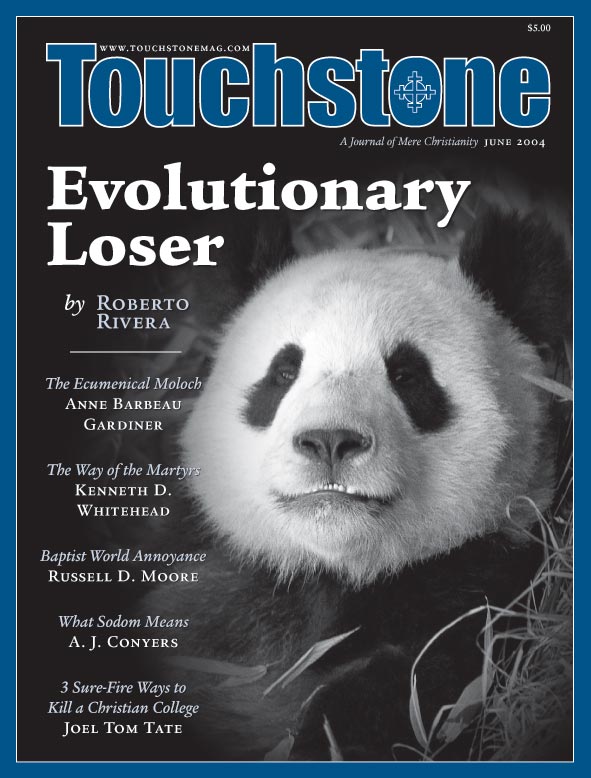
Of Pandas & Men by Roberto Rivera
Of Pandas & Men
Roberto Rivera on Darwinism & Why We Let
the Pandas Live
One hundred forty kilometers north of Chengdu in China’s Sichuan province
lies the Wolong Nature Preserve, a 200,000-hectare area that contains approximately
ten percent of the world’s giant pandas (Ailuropoda melanoleuca).
Wolong’s Giant Panda Research Center, which was the subject of a
recent Discovery HD Theater documentary, Panda Nursery, has made important
breakthroughs in the breeding and raising of the endangered species. Panda
Nursery documented the first six months in the lives of two giant panda
cubs. For the staff, especially the head of the breeding program, ensuring their
survival was a 24-hours-a-day-seven-days-a-week task. The head of the program
told viewers that he only saw his own two-year-old daughter two days a month.
Viewers learned everything they could possibly want to know about the creatures.
For starters, after some debate, biologists have concluded that giant pandas
are, in fact, bears, not, as previously thought, kin to raccoons. As for the
distinctive markings, the most popular theory is that these conspicuous markings
help the solitary creatures both avoid each other most of the year and spot
a potential mate during breeding season.
The Real Reason
I have my own theory about the markings: They make the creatures so cute that
people care about what happens to them. Because, let’s face it, evolutionarily
speaking, giant pandas are losers.
Unlike their ursine cousins who will eat almost anything, giant pandas—as
you probably know—basically eat one thing: bamboo stems and leaves. Okay,
two things. (No one is sure why. It’s not for lack of options. Their home
range supports other animals, such as the snow leopard, golden monkey, golden
langur, and musk deer, none of whom share the giant panda’s “dietary
restrictions.”) If that weren’t bad enough, bamboo ranks just ahead
of cardboard and Styrofoam on the nutritional scale. To complete the nutritional
trifecta, the giant panda is actually a carnivore with a carnivore’s digestive
system. So, at best, it’s capable of extracting only 20 percent of the
bamboo’s already meager nutritional value.
Then there’s the giant panda’s reproductive strategy. As one conservationist
website put it, giant pandas are “notoriously unenthusiastic about breeding.”
Anyone living in the Washington area is familiar with the difficulties the National
Zoo has had in breeding the animals: a mating season that seems to last 34 minutes,
males who are apparently clueless as to how females should be approached, and
other problems that make panda pregnancies relatively rare.
And when female pandas do get pregnant, their bamboo diet leads to a very
short gestational period and the smallest infants—as measured by their
weight relative to their mother’s, a 1,000 to 1 ratio—of all placental
mammals. If mom doesn’t accidentally roll over and crush the infant, there’s
still the problem of neglect. Half of all panda births are twins. Almost invariably,
the mother will choose one infant and completely neglect the other, resulting
in its death. That’s why the Wolong Center had to develop what it calls
“swap raising,” whereby the twins take turns being with their mother.
It’s as if the species is implementing the recommendations of some prehistoric
extinction consultant.
For those who take their Darwinism, as Thelonious Monk might have put it,
straight, no chaser, the logical response to the plight of the giant panda is
“tough.” Evolution is, if nothing else, unsentimental. It rewards
adaptability and punishes, in the medium-to-long term, overspecialization. If
your diet and habitat disappear—and that has happened countless times
in Earth’s history—then you do, too.
Pointing out that people have reduced the giant panda’s habitat only
begs the question, “Why should we care?” If man is, as the likes
of Richard Dawkins tell us, just the giant panda’s “fellow animal,”
our activity differs in degree, not in kind, and certainly not morally, from
what countless other species have done to countless other species throughout
history. The difference between modern man and the saber-toothed cats, who migrated
from North to South America and wiped out the indigenous marsupial and avian
predators several million years ago, is that we are a lot more efficient. While
I am happy to defer to Phillip Johnson on the specifics of Darwinism, I’m
fairly certain that being especially proficient at something is a positive in
Darwinist thinking.
I’ve read many books and watched many hours of PBS and Discovery Channel
programs on evolution, and the one thing that I haven’t heard is a hint
that a species felt, or should have felt, regret or remorse about out-competing
another species into extinction. Do you think that the American Bison feels
bad that it is, among late-Pleistocene mega-fauna like the Columbian Mammoth
and the giant ground sloth, the only survivor? Or that the first modern humans
to enter Europe felt regret about the eventual demise of the “indigenous
population,” a.k.a. the Neanderthals?
More to the point: I’ve never heard a modern paleontologist express
regret about such previous extinctions. As we’ve been told over and over,
extinction is natural.
Evolutionary Irony
Yet, no one finds anything noteworthy about the lengths to which humans are
prepared to go to save the giant panda and other endangered species. In Panda
Nursery, the willingness of the breeding program director to spend time
away from his own child to care for the panda’s was depicted as a sign
of his dedication.
What wasn’t noted was the irony that a member of the apex species would—forgive
the way I’m putting this—sacrifice the care of its own young to
care for the young of a species incapable of doing it on its own. Likewise,
in purely evolutionary terms, the mark of out-competing another species is that,
at the end of the day (pardon the cliché), you’re here and they’re
not. Yet humans are not only willing to surrender habitat—i.e., create
reserves—to help preserve another species, they’re convinced it’s
the right thing to do.
And it is. It’s just not the Darwinian thing to do. Oh yeah, biologists
treat biodiversity as an indispensable good of human existence, but it’s
nothing of the kind. There are probably indispensable species out there, but
apart from a few food plants, I’m hard-pressed to name any of them. (Contrary
to what you’ve heard, the rain forests aren’t the “lungs”
of the planet. As Bjorn Lomborg writes in The Skeptical Environmentalist:
Measuring the Real State of the World, if all the plants on the planet
died and decomposed, the process would consume less than one percent of the
atmosphere’s oxygen.)
If anything, animals are even less indispensable to human existence than plants.
As animal-rights activists never tire of telling us, we don’t need to
eat animals to survive; soy, legumes, and grains can provide the necessary protein.
We’ve technologically outgrown our need for animal labor, at least in
the industrial world. What’s true of chicks, ducks, geese, and other things
that scurry is especially true of the giant panda. If it and many other species
were gone tomorrow, the material impact on human existence would be
less than negligible; it would be nonexistent. Saving them from extinction has
nothing to do with self-interest.
What it has to do with is the qualities that cause humans, alone among the
millions of species on Earth, to ponder their obligations to other species.
As Leon Kass pointed out in The Beginning of Wisdom: Reading Genesis,
our capacity to ponder that question proves that we are not just another species.
Peter Singer, Matthew Scully, and, more recently, Jeffrey Moussaeiff, have all
written, with ample justification, against the cruel treatment of animals.
What often goes unmentioned in the debate about animal rights is that only
human beings could debate animal rights. Not just because of the uniqueness
of human language but because the arguments and appeals in such a debate only
resonate with humans. Pardon the rhetorical questions, but do lions care about
the suffering of the zebra? Do Orcas, which often toss their prey back and forth
like a beach ball before finally killing it, care about the feelings of seals?
Our relationship to the rest of creation is different, and we know this is
true even if we don’t believe in the biblical God. Even if we consider
Genesis to be a pious fairy tale, we still see ourselves as the protector of
other animals, especially those that are having a hard time surviving. That’s
as it should be. What’s not is insisting that man act as if he were special
while, at the same time, insisting that’s he’s not.
“Of Pandas & Men” is an expanded version of a column that
appeared on the Breakpoint
website.
Roberto Rivera is a Fellow at the Wilberforce Forum at Prison Fellowship. His work has appeared in Books & Culture, and he is also a regular contributor to the web magazine Boundless. He is a contributing editor for Touchstone. |