





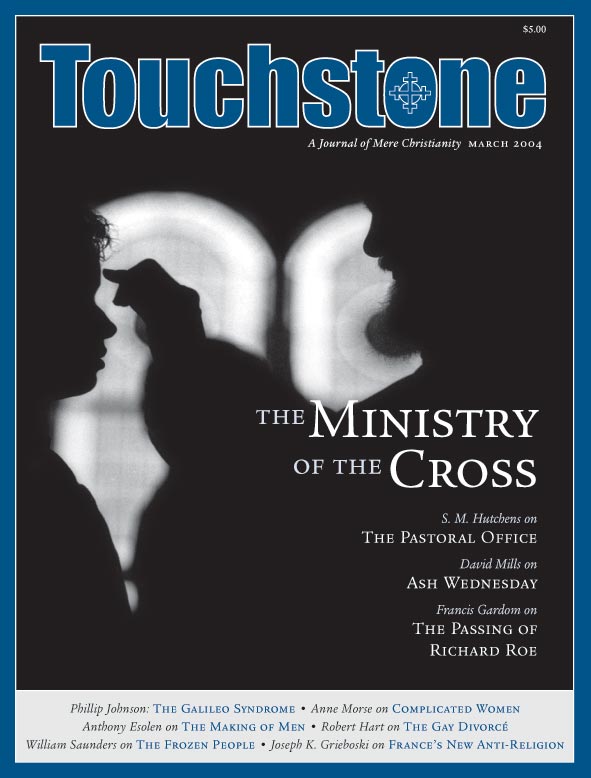
Hanging On
Most of us—the sort of people who produce and read Touchstone—feel no great confidence in the institutional and cultural future of Christianity in this country. Our Lord tells us that the gates of hell will not prevail against the Church, but at the moment the gates seem secure.
Christians in America seem to be either at rest in camps well outside the gates, their battering rams in disrepair, their tents replaced with luxury homes and their tanks with sports cars, or else urging new dialogues to erase the barriers that divide those who live outside the gates from those who live within, or else helping those who want to live in the infernal city pack their things and get their visas.
To be a secularist worried about Christianity is like this year’s Cy Young Award winner being scared to pitch to a former batting champion now in a nursing home. And yet worry they do.
We have every Christmas season the frenzied banishing of Christmas from the public square. All year round, television offers the fanatical Christian as a stock villain and the serious Christian as a reliable source of comedy. Misnamed groups like People for the American Way raise money by frightening their supporters with the threat of a Christian theocracy. Journalists writing after 9/11 kept raising the specter of “fundamentalism” in a way that implied that conservative Christians are nearly as dangerous as fanatical Muslims.
Every Knee Shall Bow
Worry they do—and they ought to worry. Not because Christians are strong (we are not) but because the Lord will come again in glory to judge the living and the dead, and his kingdom shall have no end. He is the one to whom, at the end of this world, every knee shall bow, whether they want to or not.
Some years ago, someone sold a bumper sticker saying, “If Jesus is the answer, what is the question?” It was supposed to be sarcastic and make Christians look stupid. The answer is, of course, “Whatever question you are asking.”
Several secular journals have recently run articles on Christianity’s appeal to Marxists. An article in In These Times began: “A specter has been haunting Marxism—the specter of Christianity. Routed politically by capitalist globalism, and hard-pressed to identify any really existing hope, some prominent Marxists have turned to Christianity for inspiration and revision.” The writer mentioned Terry Eagleton, one of the world’s Marxist stars, and the philosopher Slavoj Zizek, who is all the rage in some intellectual circles.
Zizek tells every Marxist to “go through the Christian experience.” He “affirms Christian orthodoxy against both New Age beliefs (exemplified in Buddhism) and the postmodern Judaism of Jacques Derrida.” He praises Chesterton in particular: “Chesterton’s conviction of ‘the thrilling romance of orthodoxy’ serves Zizek as a model for revolutionary ardor,” the writer noted.
Chesterton pointed out that paganism’s reminder of the death that awaits even the most pleasurable life leads to the deepest and most apolitical form of melancholy. But Christians, believing that creation is good and that life is eternal, know, as Zizek puts it, “an infinite joy beneath the deceptive surface of guilt and renunciation.” . . . Contemptuous of the fashionable and anemic suspicion of transcendent causes—incarnate in the calorie-counting hedonism of our “health-conscious” middle classes—Zizek asserts that real life consists in “the very excess of life: the awareness that there is something for which we are ready to risk our life.”
And so we find, in a leading advocate of one of history’s most insistently atheist philosophies, a desire for the Christian story. Zizek turns to Christianity because it answers, better than anything else, the questions he is asking. Where, he asks, is reasonable hope to be found? What can stand against the seductive promises of new-age Buddhism and postmodernism? What can rouse people from their hedonism and self-indulgence? Why should we sacrifice for others? What is the good life? How should we then live?
David Mills has been editor of Touchstone and executive editor of First Things. He edits the opinion page of the Pittsburgh Post-Gazette.
A Journal of Mere Christianity—Delivered to Your Door
- Essays on theology, culture, and the Church
- Contributors from across the Christian traditions

Six print issues (one year) of Touchstone, plus full online access and PDF downloads for only $39.95.

Get a one-year full-access subscription to the Touchstone online archives for only $19.95.
bulk subscriptions
Order Touchstone subscriptions in bulk and save $10 per sub! Each subscription includes 6 issues of Touchstone plus full online access to touchstonemag.com—including archives, videos, and pdf downloads of recent issues for only $29.95 each! Great for churches or study groups.
Transactions will be processed on a secure server.
more from the online archives
20.4—May 2007
A Short & Surprising History of Protestantism & Contraception by Allan C. Carlson

28.6—Nov/Dec 2015
on the Deepest Longings of the Restless & the Lonely by William Graddy
19.4—May 2006
The Culture War Is Between Religious Believers on Both Sides by Howard P. Kainz
calling all readers
Please Donate
"There are magazines worth reading but few worth saving . . . Touchstone is just such a magazine."
—Alice von Hildebrand
"Here we do not concede one square millimeter of territory to falsehood, folly, contemporary sentimentality, or fashion. We speak the truth, and let God be our judge. . . . Touchstone is the one committedly Christian conservative journal."
—Anthony Esolen, Touchstone senior editor
