The Shape of Evil & the Power of Hope by Eric R. Barr
The Shape of Evil & the Power of Hope
Fantasy Literature & the Dark Reality of Original Sin
by Eric R. Barr
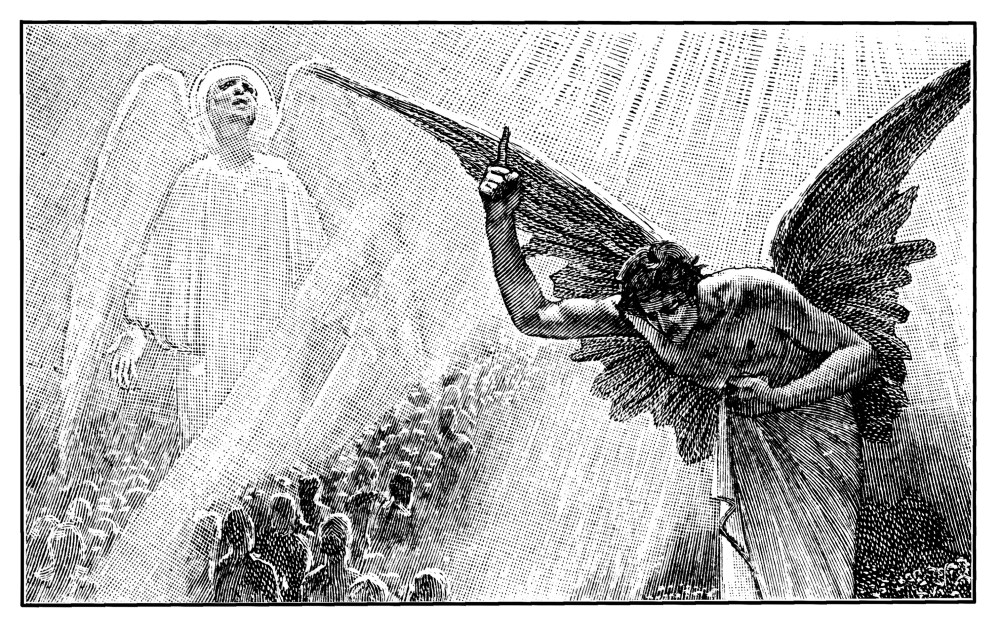
Picture in your mind Milton’s Satan lying prone on a vast sea of sulphurous
fire. He lifts his head and rises, described by Milton as “above the rest
/ in shape and gesture proudly eminent,” standing like a tower. Milton
continued:
his form had yet not lost
All her Original brightness, nor appear’d
Less than Arch-Angel ruin’d, and th’ excess
Of Glory obscur’d . . .
Dark’n’d so, yet shone
Above them all th’ Arch-Angel: but his face
Deep scars of Thunder had intrencht, and care
Sat on his faded cheek, but under Brows
Of dauntless courage, and considerate Pride
Waiting revenge: cruel his eye, but cast
Signs of remorse and passion to behold.1
Paint in your consciousness the shadowed figure of Melkor/Morgoth in J. R. R.
Tolkien’s Silmarillion, when Beren and Luthien “come to
the seat of Morgoth in his nethermost hall, that was upheld by horror, lit by
fire, and filled with weapons of death and torment.” He cuts a figure
of terror throughout the tale, “a dark Lord, tall and terrible,”
with his “great crown of iron” studded with the Silmarils, jewels
he placed there with his hands, which were “burned black by the touch
of those hallowed jewels, and black they remained ever after; nor was he ever
free from the pain of the burning, and the anger of the pain.”
When at last he is defeated, he is
thrust through the Door of Night beyond the Walls of the World, into the
Timeless Void; and a guard is set for ever on those walls. . . .
Yet the lies that Melkor, the mighty and accursed, Morgoth Bauglir, the Power
of Terror and of Hate, sowed in the hearts of Elves and Men are a seed that
does not die and cannot be destroyed; and ever and anon it sprouts anew, and
will bear dark fruit even unto the latest days.2
Hold in your heart the last image of Sauron, servant of Melkor, who rose to
be Lord of the Rings in the Third Age of the world. Hear Gandalf say,
“The realm of Sauron is ended! The Ring-bearer has fulfilled his Quest.”
And as the Captains gazed south to the Land of Mordor, it seemed to them that,
black against the pall of cloud, there rose a huge shape of shadow, impenetrable,
lightning-crowned, filling all the sky. Enormous it reared above the world,
and stretched out towards them a vast threatening hand, terrible but impotent:
for even as it leaned over them, a great wind took it, and it was all blown
away, and passed; and then a hush fell.
Look around this tiny corner of the cosmos we inhabit and answer truthfully:
What is the darkness that seeks to overwhelm anything good that humanity wishes
to do? Wars rage, enemies act on hate, the earth’s resources continue
to be depleted with frightening efficiency by our technology, while violence
in nature and humanity claims thousands of lives each year. With the passage
of every season, another species winks out of existence. And as much as we try
to escape death with creams, pills, diets, and exercise, there is always a new
disease around the corner, as well as the old ones, to deny life even to the
most hale and hearty among us.
A Sigh for Redemption
A good scientist would simply state that this is the ebb and flow of nature,
exacerbated and accelerated by the ingenuity of humanity. One of the great Scripture
scholars of the previous century, C. H. Dodd, thought that though the cataclysms
and natural, cyclic growth and decay of nature seem normal to the scientific
mind, “the poet cannot but feel deep pathos in this ‘thraldom to
decay’ in man and nature alike.”3 He asked whether this
cycle of pain and suffering has any meaning, and he believed that St. Paul gives
the answer.
The starting point is the spiritual life of human beings who sigh because
we are waiting. And as we sigh, nature sighs with us. Paul says that we long
for and sigh for the redemption of our bodies, and the universe is waiting for
our revelation as “‘the sons of God.’”4 You
might remember the biblical passage so crucial to understanding St. Paul:
For creation awaits with eager expectation the revelation of the children
of God; for creation was made subject to futility, not of its own accord but
because of the one who subjected it, in hope that creation itself would be
set free from slavery to corruption and share in the glorious freedom of the
children of God. We know that all creation is groaning in labor pains even
until now, and not only that, but . . . we also groan within
ourselves as we wait for adoption, the redemption of our bodies. For in hope
we were saved. (Romans 8:19–24)5
This passage points out a world and a humanity held under bondage to evil. The
hope that grows in human hearts because of Christ’s Resurrection is also
an eager expectation the cosmos experiences. This hope is traceable to the terrible
events in the past when rebellion against God led to disastrous consequences.
It is because of the close bonding between creation and humanity that the sin
of Adam and Eve (Gen. 3:17ff) led to creation’s being subject to futility.
And what is this futility? The Greek word that we translate as “futility”
really means “the disappointing emptiness of a promise unfulfilled.”6
Creation cannot fulfill its existence, cannot realize its goal. And the reason,
in the words of one New Testament scholar, is that “the material world . . .
shares man’s destiny, since it was created for him and is, as a result
of Adam’s sin, found at present in a violent state of frustration or corruption.”7
The Fall is more than a global war: “‘It was a war on all fronts,
terrestrial, celestial, infernal. Not only was man under oppression; nature
was in bondage also and the whole creation awaited deliverance.’”8
This deliverance has and will be given. First, the decisive blow to evil was
given on the Cross. Second, that action will come to full fruition on the Last
Day when the Christ shall come again.
Look at Luke’s Gospel, in which we see the ideas sweeping the early Christian
world, which St. Paul integrated into his theology. Luke’s Gospel is distinctive
because it shows the enormous compassion and forgiveness Christ showers upon
humanity in his public ministry. Unlike the other Gospels, which paint the Pharisees,
Sadducees, Zealots, Romans, and the mob as all culpable in the death of Christ,
Luke’s Gospel looks more benignly on them, not absolving them but looking
deeper at the root cause of all this evil.
Luke’s is the Star Wars Gospel: It shows there is truly a disturbance
in the Force. Humanity did not dream up the evils of sin, sickness, and death.
No! An enemy has crept into the cosmos and held us captive. Satan is abroad,
and he is the true enemy of Christ. That is why the Word of God comes to earth,
to do battle with the devil. It is spiritual warfare, pure and simple. Humanity
is held captive to the fallen angel who has come to corrupt the cosmos. Christ
holds out forgiveness to humanity and decisively defeats Satan.
Great Mythologies
Luke’s Gospel and the passage from Romans are crucial for understanding
the importance of Christian fantasy to modern religious experience. The Rebellion
in Heaven and the Fall of Humanity are the two great mythologies that lie behind
the genre of fantasy and the quest for the divine. So pervasive are these ancient
tales that they have defined for us what evil is and what our participation
in it has been. They explain why our hearts are filled with longing after the
passing away of Paradise, why evil still seems so powerful, and why we still
hope for the ultimate victory of good. Good fantasy incorporates these stories
because they are true, and have given humanity an insight into why the world
works as it does.
The strength and power of the genre of fantasy lie in its ability to convey
the fact of overwhelming loss inherent in the experience of life, to transmit
the belief that evil continues to pursue the remnant of good under siege, and
to demonstrate that hope still exists to turn back this tide of evil, freeing
humanity from the shadow of sin and death. What fantasy does is reiterate, in
the midst of strange worlds and peoples, that life is spiritual warfare and
our time on earth a test of how true we will be to our destiny.
The popular genre of fantasy likes to provide swashbuckling adventure, fantastic
creatures, and the use of magic for a public hungering for wonder. But the strength
of good fantasy lies precisely in its ability to frame the human condition as
under siege from the forces of evil. A sense of “what might have been”
had humanity not succumbed to this seduction of evil creates a feeling of loss.
The pursuit of what is left of goodness by evil creates dramatic tension.
Thus, the more effective examples of this genre (e.g.; Milton’s Paradise
Lost, Tolkien’s Lord of the Rings, C. S. Lewis’s
Space Trilogy) always show Original Sin, our complicity with evil, in all
its ugliness and power. It shows that the “happy ending” necessary
for true fantasy rests in the victory of the remnant of good over the overwhelming
force of evil, which the remnant of good cannot accomplish on its own, so powerful
is Original Sin. Much of contemporary fantasy, like J. K. Rowling’s
Harry Potter series, lacks a rooting in the Augustinian notion of Original
Sin and thus ultimately fails to satisfy the reader’s questions of “How
did we lose what we once had?” and “How will we ever recover what
we have lost?”
It is an axiom that fantasy, and the related genre of science fiction, have
far greater success in creating villains who are the source of evil in their
respective sub-created “worlds” than in creating heroes who are
the source of goodness in those same worlds. Far from being a weakness, this
is fantasy’s strength, at least for a Christian steeped in Augustinian
theology. The source of good is God, who is ultimately unknowable because he
is Supreme. The source of evil, however, is the will of a created rational being.
It is a rebellion against the supremacy of God. We know evil because, born of
our creatureliness, it is more familiar to us. Therefore, we do a better job
at imagining evil than imagining good.
We can gauge the relative effectiveness and last-ingness of a particular fantasy
by how it draws out and explains the problem of evil. The works of Milton, Tolkien,
and Lewis are Augustinian-based fantasies that reaffirm the experience of human
life, while much of modern fantasy, though often offering charming stories and
good reads, has less effect, for the good and evil presented have few roots
or analogies in the real world and so lack a reference point in the individual
reader’s life.
In the following, I assume familiarity with the story of The Hobbit and
The Lord of the Rings and of Lewis’s Space Trilogy.
Our Original Sin
The basic Christian anthropology, or view of man, is that humanity and nature
are good but fallen. St. Augustine crystallized this belief in his description
of Original Sin. He believed that we were created good, with original righteousness
and original perfection. In J. N. D. Kelly’s words, he believed
Adam “was immune from physical ills and had surpassing intellectual gifts;
he was in a state of justification, illumination and beatitude. Immortality
lay within his grasp if only he continued to feed upon the Tree of Life.”9
Yet Adam fell. Pride was the root cause, his desire to be apart from God, to
be his own master, to be godlike in his own right.
Though humanity sinned of its own free choice, we were tempted by one who fell
before us, namely, Satan. The serpent is Satan, the angel of light who fell
from grace because he sought to overstep his bounds and to be like the Most
High. Since Satan fell before humanity, we must realize that our turning away
from God is not due to sheer perversity—we are not inherently evil—nor
is this turning away a necessary concomitant of our human situation. We were
tempted and we fell. Our sin is our own but we did not have to sin.
This Original Sin, in which we are complicit with the powers of evil, has severely
wounded both us and creation. Every human being and all creation have suffered
since. Our inherent goodness is not compromised, but so wounded are we that,
no longer what we once were, we walk this world crippled and flawed, spiritually,
emotionally, physically. But we remember that once we were better than what
we are now. The great tales, epics and myths of our human race, particularly
in the West, emphasize this loss. In fact, most great epics seek to restore
what was lost. It is in the nature of the quest to renew the world.
The doctrine of Original Sin makes it clear that humanity will often be in league
with that ancient enemy, not only out of malice but also out of weakness. This
is a crucial choice because the source of evil rests not with the Creator, but
with each individual’s free will. We choose to be in league with a higher
created being who rebelled against the Lord. This archetypal myth keeps clear
in our minds that evil is not the equal to good, but a reaction against it.
It has no substance in and of itself except as rebellion.
Witness Satan in Milton’s Paradise Lost, who chooses to rebel and be damned
in a famous soliloquy that ends:
So farewell Hope, and with Hope farewell Fear,
Farewell Remorse: all Good to me is lost;
Evil be thou my Good; by thee at least
Divided Empire with Heav’n’s King I hold.10
This force of evil opposed to God is echoed in the works of the two greatest
modern proponents of the genre of fantasy: Lewis and Tolkien. Tolkien is the
most expansive of the two. “The Music of the Ainur,” the Creation
myth given in The Silmarillion, tells of the creation of the world
through song by Illuvatar—the name for God in Tolkien’s mythology—and
the powers of Heaven. Melkor/Morgoth strikes the discordant note and weaves
the dissonant melody almost from the beginning. As creative and beautiful as
this literary myth is, it is the exact same story as that found in Christian
tradition. Lewis liberally uses this tradition in his Chronicles of Narnia
and Space Trilogy.
By rooting their stories in the Christian Myth of the War in Heaven and the
Fall of Humanity, Milton, Lewis, and Tolkien give a power to their works that
resonates in the hearts of those who read them. This is what makes their stories
works of genius and other works of fantasy merely entertainment.
Dualistic Fantasy
Much of modern fantasy is simply dualistic—and thus boring. The forces
of light and darkness struggle against each other, but without grounding in
the reality of our human experience. Perhaps the most notable example of this
is J. K. Rowling’s Harry Potter novels. They are highly entertaining
with delightful characters and protagonists, but the worldview in these novels
is without depth. Lord Voldemort is evil, but why? And who taught him how to
be evil? Harry Potter is good, but why? Who has taught him goodness?
Evil simply exists, just as good exists. But without a deeper foundation, the
exercise of goodness and its battle with evil comes down only to a test of power
and wills, not a struggle to preserve truth and beauty.
We really do not know why Voldemort turned evil. In the first novel, Harry
Potter and the Sorcerer’s Stone, Professor Quirrel, who is busy trying
to kill Harry, pauses to explain, “Lord Voldemort showed me how wrong
I was. There is no good and evil, there is only power, and those too weak to
seize it.” That sounds like a good start; yet note how Professor Dumbledore
later explains to Harry that Voldemort failed to kill the lad when he was a
child because of Harry’s mother’s love: “To have been loved
so deeply, even though the person who loved us is gone, will give us some protection
forever.”11
Love not rooted in God is merely sentiment. Rowling just does not give a convincing
demonstration of good and evil. Her story is not rooted in ultimate truth. It
is noteworthy that with all the detail given to magic and its history, the Christmas
holidays at Hogwarts are celebrated without reference to the Christ in whose
honor the feast is celebrated.
Perhaps some will say that the Christian worldview is presupposed, but this
would be mere supposition. The morality in Harry Potter is conventional,
and because there is no religion behind it, no faith, magic becomes of high
concern. And magic is very deterministic: The one with the stronger magic wins.
Christian critics of this series may be reacting because of this characteristic.
Without a philosophical basis for good and evil, why choose one over the other?
What is good is what an individual chooses to be good, depending on the situation,
according to the moment.
Now, to Rowling’s credit, Harry and his friends succeed not so much because
of magic but because of character, and that is a good thing. In the end, some
vestige of a Christian moral view still perdures even if Rowling does not recognize
the source. But again, no God is involved, no overarching plan, no divinity.
And without God, how do we know what the good, the true, and the beautiful really
are?
Compare this with the story of the serpent’s temptation of Adam and Eve
in the garden. This story shows both our complicity with the powers of evil
to rebel against God and the infectious nature of sin. Sin brings with it consequences,
namely, suffering, sickness, and death. In fact, the whole first eleven chapters
of Genesis are an unending tale of the cycle of sin. Sin begets sin and all
that is beautiful begins to fade. The individual’s lifespan is shortened,
he is estranged from creation, and finally he is separated from others because
of envy, the lust for power, and pride. We are held in thrall to the powers
of evil.
Delivered to Woe
In Paradise Lost, Satan makes this point explicitly as he gazes in awe upon
Adam and Eve and plots their destruction:
Ah gentle pair, ye little think how nigh
Your change approaches, when all these delights
Will vanish and deliver ye to woe . . .
League with you I seek . . .
That I with you must dwell, or you with me
Henceforth; my dwelling haply may not please
Like this fair Paradise, your sense, yet such
Accept your Maker’s work; he gave it me,
Which I as freely give; Hell shall unfold,
To entertain you two, her widest Gates,
And send forth all her Kings; there will be room,
Not like these narrow limits, to receive
Your numerous offspring . . . 12
Tolkien replays this event in The Silmarillion as he tells of the
beauty of Middle-earth when the elves are awakened. In Tolkien’s mythology,
the elves stand for all that is beautiful, but they wed the powers of evil to
Middle-earth. Before, Melkor was only a raving, reckless force—evil to
be sure, but solitary. But he corrupts the elves through lies, rumors, and innuendo,
and gains their unwitting complicity in his plot to rule the world.
Mad with envy, he sows strife among the elves and plots the destruction of Valinor,
or Paradise, which he almost accomplishes. In that strife elf kills elf, and
it was this that caused the Valar (the world’s angelic rulers) to expel
many of the elves from Valinor, sending them to Middle-earth. And though the
elves realized that Melkor had used them and was their enemy, he was still loose
on the earth, until finally the Valar cast him into the Void.
Yet sin is infectious, and the servant of Melkor, Sauron, rose in power in
Middle-earth and, snaring the elves again in their pride, caused the Rings of
Power to be made. All the beauty they created begins to fade. He corrupts the
race of men, teaching them to lust for immortality. Men try to assail Valinor,
but the Valar crush them, withdraw this Paradise beyond the confines of the
world, sink the island of the Numenoreans, and cast the remnant to Middle-earth.
The tale in The Silmarillion is one of unrelenting sadness.
The loss of so much beauty is poignant, and what makes Tolkien’s fantasy
work is its echo of the reality humans face in this time, in this place. The
elves, who cannot die, must see everything they love pass away. Human beings,
to whom death is the gift of Illuvatar, resist their fate and pervert death
in such a way that it becomes a terror to be feared, rather than a blessing
to embrace.
As the elf-queen Galadriel speaks to the hobbit Frodo on his last night in
her enchanted land, Lothlorien, she muses on the terrible cost of his quest.
If he fails, doom and darkness will fall upon the world, but if he succeeds,
“then our power is diminished, and Lothlorien will fade, and the tides
of Time will sweep it away. We must depart into the West, or dwindle to a rustic
folk of dell and cave, slowly to forget and to be forgotten.” And for
men, “Death is their fate, the gift of Illuvatar, which as Time wears
even the Powers shall envy. But Melkor has cast his shadow upon it, and confounded
it with darkness, and brought forth evil out of good, and fear out of hope.”13
Strange as the races and lands of Middle-earth are, the concerns of the inhabitants
are exactly our concerns, and like them we struggle to preserve what beauty
there is.
Absurd Evil
Fantasy offers a crucial message about evil. Evil is absurd, banal, and uncreative.
Evil is a burden. Like a cancer, it seeks to get to the vital organs of humanity.
And like cancer, it often succeeds. The despair it brings comes from the hopelessness
it engenders. And as humanity focuses on this sickness, it becomes preoccupied
with it, and even in our worry over whether it will destroy us, our very worry
takes us to its lair of despair.
Tolkien demonstrated the inability of evil to be creative. It can only corrupt,
and its perversion of life reveals the utter depravity at its core. For Tolkien,
this type of destruction is personified in the raping of the landscape, whether
that be Saruman’s cutting down the trees of Isengard or Sauron’s
polluting the lands of Mordor with the machines of war and technology, or Melkor
in a past age twisting elves into the hideous parody that is the race of orcs.
In The Lord of the Rings, Sauron, as evil personified, pursues the
Fellowship. That unrelenting series of adventures and commerce with death, torture,
and war provides much of the action of the epic, but the true horror of evil
regains its personal touch when the hobbits arrive back at the Shire. Seemingly
defeated, evil still possesses malice. For no other reason than revenge, Saruman,
the disgraced head of the wizards, destroys much of the Shire. His ease at giving
up his lordship over the Shire is disconcerting, and his death at the hands
of his twisted servant Wormtongue is strangely unsatisfying.
Even the hobbits feel no victory at that moment, almost as if Tolkien was saying,
“In the pre-Christian world that I have created, the visible defeat of
evil is only an illusion. It never will give up till it is ultimately defeated.”
Sauron’s defeat doesn’t end evil in Middle-earth; what makes us
think Saruman’s death signals the defeat of those opposed to light? In
the midst of the very real victory of the forces of good, there is a haunting
feeling that we shall fight again another day. The horror of evil is that it
leaves nothing permanent except decay and destruction. It puts forth the lie
that death is inevitable and everlasting. One can understand how convincing
evil is. Creating nothing, it embraces nothingness.
In Paradise Lost, as Satan becomes less powerful, he becomes more
horrible. Noble and heroic at the beginning, a figure of some sympathy, by the
end of the poem he is a loathsome creature. C. S. Lewis, who was also an
excellent Milton scholar, compacts the series of degenerative steps taken by
Satan into a famous little sentence: “From hero to general, from general
to politician, from politician to secret service agent, and thence to a thing
that peers in at bedroom or bathroom windows, and thence to a toad, and finally
to a snake—such is the progress of Satan.”14 When Satan
wars in Heaven, “his stature reacht the Sky, and on his Crest / sat horror
Plum’d,”15 yet when he tempts Eve, he is described as “squat
like a toad, close at the ear of Eve.”16
In a lurid passage, “like a black mist creeping,” he searches
for the serpent, as yet an innocent animal, and enters its mouth, possessing
it, transforming it.17 As his true depravity is revealed and the immense
distance from God he has traveled is made known to the reader, we are yet struck
by his ability to beguile our First Parents and help them make the fateful decision
to walk away from their Creator. This degeneration of Satan and his ability
to cause harm is paralleled in Sauron, as his once fair form in The Silmarillion
is twisted into a black shadow at the end of The Lord of the Rings.
Hope Never Dies
Part of the reality of Original Sin is that it is also Original Despair. Humanity
believes that it cannot break the chains of evil that shackle it. We compromise
with evil in order to exist. We live our lives resigned to the evil we see around
us. The gospel message says this view is wrong. And that message is echoed in
the kind of fantasy written by Lewis and Tolkien.
In such fantasy, no compromise with evil is possible. In That Hideous
Strength, Jane and Mark Studdock discover this fact. Compromise means death
when it comes to dealing with evil. The servants of Sauron, whether they be
the powerful Ringwraiths or the hideous orcs or the southern allies, learn that
to dance with the devil is to die with him. And, of course, as the myriads of
fallen angels discovered, they may well reign in Hell, but it is still hell,
and in a poetic tour de force, Milton has them turn into hissing snakes at the
moment they think they have conquered, with the sibilant sounds of poetry testifying
to their degradation.
If we cannot compromise with evil, find a way to get along with it, what can
we do? Hope. Hope is the joy we feel when, facing impossible challenges and
apparently unstoppable evil, the hero and the forces of good triumph. The hope
in such fantasy is always a slim hope. It recognizes the power of evil and the
hold evil has even upon the heroes. The good faces grave obstacles, but should
the good triumph, the powers of evil are indeed vanquished.
The two chief characteristics of this hope are humility and mercy. This is important.
In Tolkien’s work especially, power and even wisdom take a back seat to
these two virtues.
First, humility. The battle against Sauron Aragorn leads is crucial, but not
final. He cannot be defeated by force. The final assault on Mordor by the Lords
of the West and their armies is merely a feint, a distraction to occupy the
Eye of Sauron. The real hope for victory (as the Lords of the West know) lies
elsewhere: in two hobbits who have no real chance of accomplishing their task.
Remember how they came to be there. When Frodo was first confronted with the
reality of the Ring, he said, “‘I wish it [its discovery and Sauron’s
search for it] need not have happened in my time.” Gandalf replies, “So
do I, and so do all who live to see such times. But that is not for them to
decide. All we have to decide is what to do with the time that is given us.”
When Frodo protests later, “I wish I had never seen the Ring! Why did
it come to me? Why was I chosen?”, Gandalf tells him, “Such questions
cannot be answered. You may be sure it was not for any merit that others do
not possess: not for power or wisdom, at any rate. But you have been chosen,
and you must therefore use such strength and heart and wits as you have.”
At the Council of Elrond, as the powerful and wise debate how to destroy the
ring, Frodo stands up and stuns them by saying, “I will take the Ring,
though I do not know the way.” He accepts the burden and danger, in a
humble submission of his will to what he recognizes as his calling.
Frodo’s growing humility becomes his greatest strength. It is how he is
able to pierce through the pride present among the rational creatures of Middle-earth,
many of whose leaders wish to use the Ring to defeat Sauron. In the awareness
of his own insignificance and yet aware that Providence (active even in this
pre-Christian world) has ordained that he must bear the burden of the Ring,
Frodo decides to use the time he has been given to try to destroy the Ring.
It is as if the hidden goodness still present in a fallen world is given an
opening when humility is present.
And with humility comes mercy. Words that Frodo once scoffed at when spoken
by Gandalf come back to him when he is confronted face-to-face by Gollum:
“What a pity Bilbo did not stab the vile creature, when he had a chance!”
“Pity? It was Pity that stayed his hand. Pity, and Mercy: not to strike
without need.”
“I do not feel any pity for Gollum. He deserves death.”
“Deserves death! I daresay he does. Many that live deserve death.
And some die that deserve life. Can you give that to them? Then be not too
eager to deal out death in the name of justice, fearing for your own safety.
Even the wise cannot see all ends.”
Gandalf believed that Gollum had some part to play in Middle-earth’s story
and that Bilbo’s original sparing of the creature would have great consequences.
With equal mercy, Frodo decides to spare Gollum and allow him to travel with
himself and Sam. Frodo’s reaffirmation of Bilbo’s decision assures
the success of his journey. Some say that he failed in his mission because in
the end he could not cast the Ring into the fires of Mt. Doom; it took the crazed
and demented Gollum to do that. On the surface, it would appear so. In many
ways, Frodo was a failure.
The Door to Hope
But it was this decision to spare Gollum that makes Frodo the true hero of the
tale. And because Sam possesses the same humility and decency, and even apologizes
to Gollum for mistaking his caress of Frodo for an attack, he shares the hero
role. The hobbits’ unsophisticated nature, their small stature, their
ordinariness seem poised to make them easy victims for Sauron and his agents.
But humility and mercy open in them the inherent goodness unstained by the prideful
actions of Middle-earth’s first dwellers. And with that open door comes
hope.
Just before entering Mordor, the travelers come to the Crossroads, where a final
decision has to be made. Three ways run away from Mordor, the fourth leads into
Mordor and certain death. Knowing which way he has to take, Frodo notices a
statue of a forgotten king of Gondor. It had been vandalized by the servants
of Sauron; knocked down and its head severed from its body. Then the setting
sun escapes the pall of cloud from Mordor and sends its light into that clearing.
Suddenly, caught by the level beams, Frodo saw the old king’s head:
it was lying rolled away by the roadside. “Look Sam!” he cried,
startled into speech. “Look! The king has got a crown again!”
A trailing plant with flowers like small white stars had bound itself across
the brows as if in reverence for the fallen king, and in the crevices of his
stony hair yellow stonecrop gleamed. “They cannot conquer for ever!”
said Frodo.
Near the end of the journey, as they crawl across the blasted waste of Mordor,
always at risk of discovery by Gollum and by Sauron’s agents, they stop
and Sam gets Frodo to go to sleep. Wanting to stay awake and guard his master—for
discovery would mean that Sauron would conquer the world—he looks to the
heavens:
There, peeping among the cloud-wrack above a dark tor high up in the mountains,
Sam saw a white star twinkle for a while. The beauty of it smote his heart,
as he looked up out of the forsaken land, and hope returned to him. For like
a shaft, clear and cold, the thought pierced him that in the end the Shadow
was only a small and passing thing: there was light and high beauty for ever
beyond its reach. . . . Now, for a moment, his own fate, and
even his master’s, ceased to trouble him. He crawled back into the brambles
and laid himself by Frodo’s side, and putting away all fear he cast
himself into a deep untroubled sleep.
At the end of the journey, Frodo is overcome by the power of the Ring. When,
with the ring’s destruction, he becomes himself again, he realizes the
mystery of humility and mercy as he says to Sam,
“But do you remember Gandalf’s words: Even Gollum may have
something yet to do? But for him, Sam, I could not have destroyed the
Ring. The Quest would have been in vain, even at the bitter end. So let us
forgive him! For the quest is achieved, and now all is over. I am glad you
are here with me. Here at the end of all things, Sam.”
They have emptied themselves, offered a true kenosis, and in their
spending their lives as a ransom or offering for all Middle-earth, they bring
salvation to the land. In these suffering servants is heard the far-off cry
of evangelium: good news beyond the ability of the world to provide.
Something greater than even the wise foretold has occurred. Hope prevails.
This is how humanity must fight evil, because human power is not sufficient,
as Tolkien explained. In a letter to a reader, he wrote of Frodo: “He
(and the Cause) were saved—by Mercy—by the supreme value and efficacy
of Pity and forgiveness of injury. . . . No, Frodo ‘failed’ . . .
[O]ne must face the fact: the power of Evil in the world is not finally resistible
by incarnate creatures, however ‘good’.” In another letter,
he wrote, “the salvation of the world and Frodo’s own ‘salvation’
is achieved by his previous pity and forgiveness of injury. . . .
By a situation created by his ‘forgiveness’, he was saved himself,
and relieved of his burden. He was very justly accorded the highest honors.”18
The hero who fails but succeeds—only with great risk does a novelist
attempt such a thing. Risky it may be, but it is very Christian. On the Cross,
Christ defeats evil through mercy and utter humility. In The Lord of the
Rings, Frodo’s whole quest redeems his world (from the threat of
Sauron and for a time) because he also showed mercy and humility.
There is a poignancy in the ultimate failure or weakness of created creatures
to overcome evil. In both Tolkien and Milton, where the action occurs before
the Christ Event, strength and, most importantly, hope are found only in that
very weakness. Milton ends his epic noting that, having heard the Archangel
Michael speak of events to come and promises foretold, Adam and Eve do not leave
Eden in despair:
In either hand the hast’ning Angel caught
Our ling’ring parents, and to th’ Eastern Gate
Led them direct . . .
Some natural tears they dropp’d, but wip’d them soon:
The World was all before them, where to choose
Their place of rest, and Providence thir guide;
they hand in hand with wand’ring steps and slow,
through Eden took thir solitary way.19
A Realistic Hope
Following the gospel, Christian fantasy sees the tension of spiritual warfare
as understood in an Augustinian sense (i.e., of how evil and Original Sin work
together to fight goodness) and recognizes that we need humility and mercy to
combat evil and have a realistic hope for redemption. It answers the questions
we asked at the beginning: “How did we lose what we once had?” and
“How will we ever recover what we have lost?” Thus it is able to
help transform a human person by showing in its own mode what the gospel tells
us about ourselves and the fallen world we live in.
This distinguishes Christian fantasies like those of Milton, Lewis, and Tolkien
from both ancient myths and other modern fantasy literature. The mistake of
many of the ancients was to posit two equal forces, light and darkness, good
and evil, and make the protagonist of the myth represent one or the other as
if either was equally valid. The error of many modern fantasy novelists is to
fail to answer the question of why evil even exists and to give any plausible
idea of how to resist and defeat it. Neither have any reason to value humility
and mercy. Neither can see any hope for redemption other than in power and force.
Let me close with a few suggestions to explain why the gospel in our history
and reality and Christian fantasy in the created worlds of their authors succeed.
I think they succeed because they stress several truths that other forms of
religion and fantasy do not.
• There is no dualism. Good and evil are not equally powerful opposites.
While there is a supreme good or God, there is no supreme evil.
• Evil is nothing in itself. It is a verb, not a noun; a reaction or rebellion
against good. It only exists by attempting to define itself in opposition to
good.
• The created world is complicit with evil. In some way, shape, or form,
we have accommodated ourselves to the rebellion. That exposure has tainted us,
damaged us, infected us. Original Sin is the dark tendency we have to rebel
against God.
• Yet this state of sinfulness has not utterly destroyed our original
goodness. Incapable of shaking off this taint of sin, we are yet able to reach
for the beauty we have lost.
• We reach for that innocence through humility and mercy. It is the only
way we can resist the overarching might of evil, which seems overwhelming and
impossible to defeat.
• The offspring of humility and mercy is hope. Hope is humanity’s
Excalibur—the sword we use to persevere in the darkness.
The beauty of good fantasy is that it accurately portrays the reality of our
world: besieged by evil, beset with sin, beguiled by temptation, yet possessing
a hope that will see creation through its trials to salvation. Behind all of
this is the Christ Event. As the chief Story, it gives life to the literary
creations of men and women who know that any tale worth telling truly must include
the fact of our battle against the dark reality of Original Sin and the malicious
evil that refuses to surrender.
It is a cosmic war, but one in which we already know the outcome. That knowledge
is our hope, our light in the darkness.
Notes:
1. Paradise Lost, in Complete Poetry and Selected Prose of John
Milton, ed. Merrit Y. Hughes (Odyssey Press, 1957).
2. The Silmarillion, ed. Christopher Tolkien (Houghton Mifflin Co.,
1977), pp. 73, 81, 180, 254–255.
3. The Epistle of Paul to the Romans (Harper and Row, 1932), p. 133.
4. Ibid., pp. 133–134.
5. The New American Bible with Revised New Testament.
6. William Sanday and Arthur C. Headlam, A Critical and Exegetical
Commentary on the Epistle to the Romans, 4th ed. (T. and T. Clark, 1900),
p. 208.
7. David Stanley, Christ’s Resurrection in Pauline Soteriology (Pontifical
Biblical Institute, 1981), p. 194.
8. W. David Stacey, “God’s Purpose in Creation—Romans viii,
22–23,” Expository Times 69 (1957–1958), p. 179.
9. Early Christian Doctrines (Harper & Row, 1978), p. 362.
10. Paradise Lost (PL), Book IV, 107–111.
11. Harry Potter and the Sorcerer’s Stone (Scholastic, Inc.,
1997), pp. 291, 299.
12. PL, Book IV, 366–368, 375–385.
13. The Silmarillion, p. 42.
14. A Preface to Paradise Lost (Oxford University Press, 1974), p.
99.
15. PL, Book IV, 988–999.
16. PL, Book IV, 800.
17. PL, Book IX, 181–191.
18. The Letters of J. R. R. Tolkien, ed. Humphrey Carpenter (Houghton
Mifflin Co., 1981), pp. 251–252, 234.
19. PL, Book XII, 637–639, 645–649.
Monsignor Eric R. Barr, M.A., S.T.L., is Vicar for Clergy
and Religious of the Diocese of Rockford in western Illinois. “The Shape
of Evil & the Power of Hope” was given at the conference on “Christianity
and the Creative Imagination” sponsored by Touchstone and the
International Institute for Culture in Bavaria
in July 2002.
|