
Seeing Thro’ the Eye by Ian Hunter
Seeing Thro’ the Eye
The Prophetic Legacy of Malcolm Muggeridge
by Ian Hunter
No lines were more often quoted by Malcolm Muggeridge than this stanza from
William Blake’s Songs of Innocence: “This life’s
dim windows of the soul / Distort the Heavens from Pole to Pole / And lead you
to believe a lie / When you see with, not thro’ the eye.” Seeing
thro’ the eye was a particular gift of his, combined, fortunately, with
compelling readability and a willingness to opine on almost any issue at almost
any time.
Muggeridge spoke prophetically about many important events of the twentieth
century. Prophecy is not so much a matter of predicting the future—though
Muggeridge predicted some events with uncanny prescience—as seeing clearly
truths others do not or refuse to see. If he was sometimes mocked and seldom
heeded—well, that is the fate of prophets, as Jeremiah found out when
he got himself chucked down a well. Prophets unsettle our preconceptions and
disturb our complacency.
My purpose here is to call attention to what, in baseball parlance, might be
called Muggeridge’s “box score,” in the no doubt vain hope
that a man so often proved right might be accorded greater attention. I should
make clear that Muggeridge himself did not claim to be a prophet. When others
applied that label to him, he demurred: “I am no prophet, no, nor prophet’s
son,” he said, adapting Amos. “I was a journalist and the Lord took
me as I sat at my typewriter.” Yet even as a journalist, he saw through
the eye what so many others, of greater fame and status, could not see because
they saw only with the eye.
Gandhi’s Writer
In 1925, at the tender age of 22, Muggeridge took his first job, teaching English
literature at Union Christian College in Alwaye, southern India. When he was
not mocking the college faculty (“Mr. Dryasdust, B.A., B.L., author of
notes on this, and notes on that and notes on every possible thing except on
life. . . .”) or the students (“The Indian undergraduate
is a strange being. He imagines that to be impressive, he must be pompous.”),
he was stirring up nationalist sentiment against the colonial administration
of the British Raj.
This was particularly evident after Mahatma Gandhi, at that time relatively
unknown, paid a visit to the college in March 1925. Muggeridge thereafter corresponded
with Gandhi, who published his letters in his newspaper, Young India,
thereby earning the distinction of being Muggeridge’s first publisher.
These letters pressed two themes: (a) the impossibility of changing society
without first changing men’s hearts; and (b) the artificiality and fragility
of a colonial set-up that appeared to most people impregnable. The latter was
an early application of his conviction about the futility of trying to live
by the will as opposed to the imagination; this theme he derived from his friend
Hugh Kingsmill, and it was one to which he returned almost as often as he spoke
of seeing through the eye.
To the discerning eye, both themes are evident in a passage, first published
in the Calcutta Guardian in 1926, where Malcolm is describing a retarded
boy who drove geese, a boy whom he regularly saw on his nightly walk along the
Parur Road. It demonstrates how consistent Muggeridge’s writing “style”
(a term he detested and never used) remained through his life:
He carries no stick to assist him in keeping order amongst them, but only
a large leaf, which he waves slowly to and fro; and one might easily imagine
that his speech was nothing but the noise of the wind through this, so like
is it to the sound of a forest when, in the evening, a light wind blows. With
this he keeps his charges as a compact, disciplined company, not stupidly
military in their orderliness, yet not by any means a rabble; rather they
remind one of a band of pilgrims, or of workers working voluntarily together.
They seem to be not so much numbered and uniformed as to make a harmony of
which he is the conductor: not so much to march in step as to dance with perfect
understanding of each other’s movements.
One day he saw another boy driving the geese, “a bouncing, bumptious
fellow, who carried a switch like a sergeant-major, and who shouted at the geese
as sahibs shout when they want something.” Predictably, the geese
ran around squawking, some getting lost and others run over. He will not draw
a moral from the contrast (“a thankless task”), but writes instead
that he envies the first boy.
I feel that he has found the secret of happiness in that he has done one
useful thing which he can do superlatively well, and that he is content to
go on doing from day to day until he dies. When his soul leaves the poor,
puny body, with its gapingly vacant face, I believe it will be found to be
a rare and beautiful soul, pleasing to its maker. Sometimes I wonder about
him—whether he will marry; whether he prays or has any kind of religion;
whether he ever wonders about the meaning of things. All this is doubtful;
what is certain is that he can drive the geese efficiently; and to do that
is quite as worthy of praise as to write a book or bleat a lecture or drone
a sermon or do any of the things we wretched intelligentsia preen ourselves
on.
A Daring Prophet
Muggeridge returned to England, where he wrote leaders (editorials) for the
Manchester Guardian, the leading newspaper of progressive opinion of
its day and the height of achievement for the young, idealistic socialist that
he then was. After a teaching stint at the Egyptian University in Cairo, his
first stage play, Three Flats, opened at the Prince of Wales theatre
on February 15, 1931. Its frankness about sex offended some critics—and
even some members of his own family—but the play’s theme, namely,
the destructive effect of high-rise living on individuals and families, would
later become fodder for urban planners and sociologists. Again, Muggeridge was
ahead of his time.
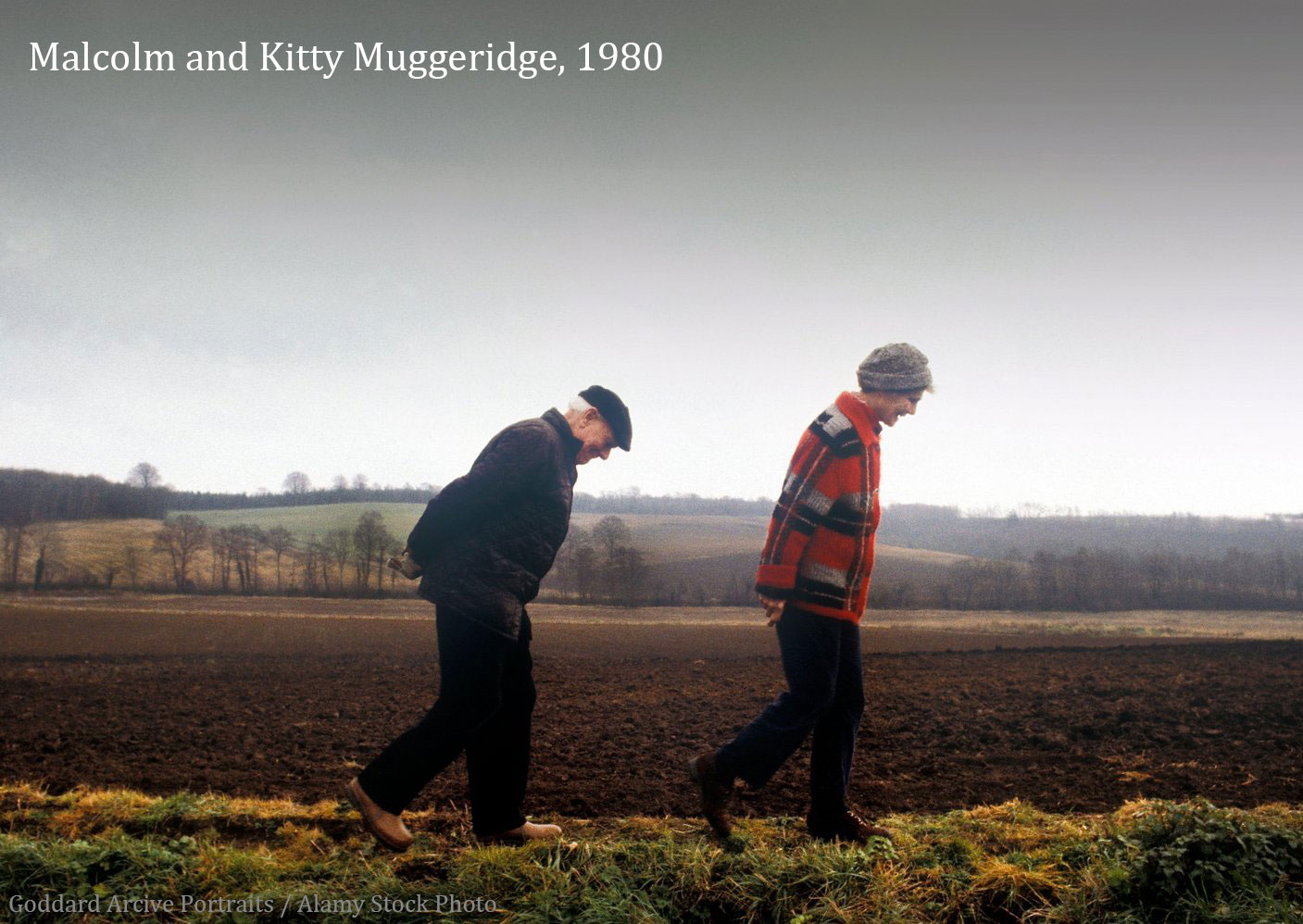
In 1932, Malcolm and his new wife, Kitty, left for the Soviet Union, where
Malcolm was to serve as a correspondent for the Guardian and the Christian
Science Monitor. It is arguable that the next 15 months gave rise to Muggeridge’s
most prophetic journalism. Early in 1933, he did a daring thing: He had his
Russian interpreter buy him a railway ticket to Ukraine and the North Caucasus.
What he saw on that extended rail trip he would not forget; years later, he
wrote that it “remained in my mind as a nightmare memory.”
He saw the richest wheat lands of Europe turned into a wilderness. He saw famine
“planned and deliberate; not due to any natural catastrophe like failure
of rain or cyclone or flooding. An administrative famine brought about by the
forced collectivization of agriculture . . . abandoned villages,
the absence of livestock, neglected fields: everywhere, famished, frightened
people.”
In a German settlement, a little oasis of prosperity in the collectivized wilderness,
he saw peasants kneeling down in the snow, weeping, and asking the settlers
for bread. In his diary he made this vow: “Whatever else I may do or think
in the future, I must never pretend that I haven’t seen this. Ideas will
come and go; but this is more than an idea. It is peasants kneeling down in
the snow and asking for bread. Something that I have seen and understood.”
And he saw an embryonic outline of what we now know (thanks to the courageous
witness of Alexander Solzhenitsyn) as the Gulag Archipelago. At a railway station
one gray, early morning, he saw a line of kulaks, or supposedly rich
peasants, “with their hands tied behind them being herded into cattle
trucks at gunpoint . . . all so silent and mysterious and horrible
in the half light, like some macabre ballet.”
In a series of articles for the Guardian, Muggeridge wrote of what
he had seen. In February he described the famine as “a state of war, a
military occupation.”
[T]he grain collection has been carried out with such thoroughness and brutality
that the peasants are now quite without bread. Thousands of them have been
exiled; in certain cases whole villages have been sent north for forced labour . . .
The fields are neglected, and full of weeds; no cattle are to be seen anywhere,
and few horses; only the military and the G.P.U. [the secret police] are well-fed,
and the rest of the population obviously starving, obviously terrorized.
The next month he wrote a three-part series tracing how the “Dictatorship
of the Proletariat” had become the Dictatorship of Joseph Stalin and then
how the Dictatorship of Stalin became the “Dictatorship of the General
Idea.” He concluded: “If the General Idea is fulfilled it can only
be by bringing into existence a slave state.”
Denunciation
Such reporting produced a chorus of denunciation. The policy of the British
government, and the inclination of the chattering classes, was wholehearted
support for what was then called “the Soviet experiment.” (The Guardian
itself spiked some of his articles and rewrote others.) Muggeridge was denounced
as a liar—even “an hysterical liar”—by such eminent
personages as the Very Reverend Hewlett Johnson, dean of Canterbury, who had
from his pulpit praised Stalin’s “steady purpose and kindly generosity,”
and by Harold Laski, legal scholar and Labour party guru, who assured all who
would listen that the Soviet economy was a model of efficiency and equality
and that the show trials of the Old Bolsheviks were models of judicial fairness.
George Bernard Shaw, who had just returned from a visit to Russia, also contradicted
Muggeridge’s accounts of famine by describing granaries full to overflowing,
attended by apple-cheeked granary maids. Even Malcolm’s aunt by marriage,
the Fabian Socialist star Beatrice Webb, joined the chorus, repudiating his
assertion that forced labor existed in the Soviet Union; when pressed in private
conversation, she did acknowledge, almost wistfully, Malcolm noted, that “in
Russia, people do disappear.”
Muggeridge’s reporting was contradicted preeminently by Walter Duranty,
Moscow correspondent for the New York Times, a man whom Muggeridge
later called “the greatest liar I have ever met”—a reporter
who nonetheless was awarded a Pulitzer prize for his reporting on the Soviet
Union. If vindication was a long time coming, it came in 1990, when Susan Taylor,
in her biography of Duranty, Stalin’s Apologist, wrote that but
for Muggeridge’s “stubborn chronicle of the event, the effects of
the crime upon those who suffered might well have remained as hidden from scrutiny
as its perpetrators intended. Little thanks he has received for it over the
years, although there is a growing number who realize what a singular act of
honesty and courage his reportage constituted.” Alas, by the time Susan
Taylor wrote that, Muggeridge was dead.
In 1933, the Guardian sacked him, and he went to Switzerland, where
he poured out his anger in a polemical novel, Winter in Moscow, which,
for the next four decades, circulated in samizdhat through the Russian
literary underground. It was his Russian experience that first prompted a reevaluation
of Christianity. As Muggeridge put it four decades later: “My disillusionment
with the notion of a predestined progress towards a kingdom of heaven on earth
led me inexorably back to the kingdom not of this world proclaimed in the Christian
revelation.”
Writing in 1937, in the journal Time and Tide, Muggeridge made an
astonishing prophecy: At a date when Alexander Solzhenitsyn was a teenager,
and most other dissident Soviet writers had not yet been born, he wrote: “Perhaps
a new literature will come to pass in Russia, as once it did in the darkest
days of Tsarist repression. If so, it will be a literature of revolt and so
anathema to the Soviet establishment. Perhaps it is being scribbled even now
in concentration camps and other dark corners. . . . Not even
Dialectical Materialism, not even that, can put out the light of genius.”
He made a similarly prophetic comment in 1978. I happened to be staying with
him when a Roman conclave chose Karol Wojtyla to become pope. “It is the
end of the Soviet Union,” he said to me. “They will not be able
to withstand the moral authority of a pope from the eastern Communist bloc.”
Another prophecy that he did not live to see fully vindicated.
The Thirties
For a brief period in 1933, Muggeridge worked on a study of labor cooperatives
under the auspices of the League of Nations in Geneva. That he entertained few
illusions about the efficacy of the League is evidenced by this concluding stanza
of a poem he wrote:
The place was set, the nations met,
They were a League of Nations;
But a League that seems, except in dreams,
To be little but orations.
When, in due course, the defunct League was replaced by the United Nations,
Muggeridge was similarly dismissive; he called its New York headquarters “that
huge symmetrical glass tombstone, whose occupants specialize in throwing stones.”
Incidentally, it was when Muggeridge was at the League of Nations that he
met (at the Café Bavaria, his favorite Geneva haunt) a free-lance journalist
with the ineffable name of P. Beaumont-Wadsworth. Once, in the fading light
of an autumn afternoon, this worthy delivered himself—casually, apropos
of nothing in particular—of a line that Muggeridge afterwards insisted
could serve as the twentieth century’s epitaph. P. Beaumont-Wadsworth
looked up from his glass, and said: “You know, I sometimes wonder if I’m
licking the right boots.”
In 1935, his Russian articles having rendered him unemployable in the British
press, Muggeridge returned to India, this time as assistant editor on the Calcutta
Statesman. He returned to England in the late thirties, where he collaborated
with his friend Hugh Kingsmill on two volumes of newspaper parodies: Brave
Old World (1936) and Next Year’s News (1937).
Both of these books fell victim to the satirist’s nemesis, namely, that
world events were far more bizarre than anything he could invent. Just by being
themselves, Muggeridge complained, public figures snatched the bread from the
satirist’s mouth. In Next Year’s News Muggeridge and Kingsmill
envisaged a non-aggression pact signed between Hitler and Stalin—three
years before Stalin and von Ribbentrop met secretly in Moscow to conclude the
Nazi-Soviet Non-Aggression Pact.
Throughout the late 1930s Muggeridge wrote frequently of the inevitably of a
world war. After Neville Chamberlain made two obsequious trips to meet Hitler
in Germany, Muggeridge wrote that “England has surrendered to coercion . . .
because of cowardice and unenlightened self-interest.” War, he declared,
would come sooner rather than later, because of the policy of appeasement.
After Chamberlain’s third and final trip, at the moment when Chamberlain
was waving about his piece of paper and being lauded for having secured “peace
in our time,” Muggeridge responded with an open letter to the British
Government. “No words exist to express my scorn,” he wrote, and
then, typically, went on to find just the right words. “I ask myself whether
if you had been asked to kneel down . . . and with your face
in the dust sing the Horst Wessel song, you would have raised any objection?
I do not think you would have . . . although, of course, you
would have preferred someone to act as your proxy.”
The War Years
The Second World War was underway by the time Muggeridge put the finishing
touches to his The Thirties, a social history of a decade that began,
he wrote, in the hope of progress without tears and concluded in the reality
of tears without progress. This book (published in the United States as The
Sun Never Sets) was his most successful book to date. It would remain continuously
in print for three decades; when it was reissued in 1967, reviewer Philip Toynbee
called it “a strange visionary portrait . . . the deep,
penetrating boom of a prophet in full flight.”
One particular sentence from The Thirties that lodged itself in my
mind is this one: “There is no obstinacy like that of a sheep asked to
move from its last corner of pasture, of a guest asked to go when a drink is
still in the bottle, of a woman asked to remove one remaining garment, or a
politician to forego one remaining principle.”
Muggeridge wrote little during the war years, partly because his activities
as a spy—he worked for MI6, the English equivalent of the CIA, as did
his friend Graham Greene—required total secrecy, partly because his spirits
were low. Even his diary (which he called The Diary of a Sad Man) received
sporadic attention. He wrote to Kitty in 1942: “Much of the time I spend
wishing I was dead, wondering why I am doing what I have to do, putting up my
own faint struggle with the tedium of time.”
After the war, Muggeridge edited an English version of the secret diaries
and wartime papers of Count Galeazzo Ciano, Mussolini’s son-in-law. The
papers had been smuggled out of death cell 27 in the Verona jail just prior
to Ciano’s execution in 1944. “What Ciano achieved,” Muggeridge
wrote, “was to provide the world with one more record, incomparable in
its naiveté, of how futile a pursuit is power, and how certainly those
who pursue it become enmeshed in their own deceits and stratagems.”
In 1946, Muggeridge came to America as Washington correspondent for the
Daily Telegraph. “Americans,” he wrote back to Kitty, “are
the most terrible bores the world holds; they only really want to talk about
themselves and that’s a soon exhausted subject.” Even his routine
American journalism contains prescient nuggets, and surely his succinct description
of Secretary of State John Foster Dulles has not been bettered: “Dull,
duller, dulles.”
When the US air force carried out its hydrogen bomb test on the island of Bikini,
Muggeridge described the whole operation to Kitty as “inimitable”:
“The airplane that carried it was called Dave’s Dream and a pin-up
girl was painted on the bomb before it was dropped. Apparently scarcely any
damage was done at all. A flock of goats left on the island appeared unperturbed
afterwards.” Later, Muggeridge learned that the pin-up girl on the bomb
was Rita Hayworth, and that she had wept on learning of this honor.
When the Bikini goats, together with a handful of Bikini rats, were brought
back to the United States for observation, Muggeridge went along to see them,
and concluded his account for Kitty’s delectation: “They were all
receiving blood transfusions and vitamins in air-conditioned pens. A press handout
answering criticism of humane societies that it was cruel to submit animals
to atomic explosions contained the delightful phrase: ‘They have not died
in vain’. I suggested that there be a tomb erected to the unknown pig
on which visiting statesmen might lay a handful of acorns.”
A Minefield
Back in England, Muggeridge was promoted to deputy editor at The Daily
Telegraph; then, in 1953, the first editor of Punch from outside
the magazine’s staff in that venerable British magazine’s long history.
He quickly transformed the staid old lady of the doctor’s waiting room
into a fiercely satirical journal, “a minefield over which the eminent
must tread at their peril.” An article from his first year, “How
to Be a Successful British Diplomat,” illustrated Punch’s
new bite:
(1) When an international agreement is unilaterally denounced, insure that
any formal protests you are instructed to make are as hesitant and equivocal
as possible; (2) Remember that nowadays the glittering prizes are given for
feats of demolition, not of construction. . . . Every diplomat
carries a peerage in his knapsack, provided only that he keeps retreating;
(3) Do not allow seeming setbacks to lower your spirits. Rather, they should
be made the occasion for displaying even more complacency and self-satisfaction
than before; (4) In politics, incline to the left. If you can combine this
with ample private means . . . so much the better; (5) No opportunity
should be missed of taking a sly dig at Americans and their policies. Indeed
potential allies everywhere should be treated as somewhat ludicrous if not
downright despicable.
In February 1954 a Punch cartoon depicting a paralytic Prime Minister
Winston Churchill touched off a terrific row, as the British public had not
yet been informed that Churchill had suffered a stroke. The ensuing hue and
cry very nearly cost Muggeridge his job; when, at the crest of the storm, he
took a swipe at Foreign Minister Anthony Eden (“Better a Churchill senile
than an Eden in full possession of his faculties, such as they are”),
he gave fresh offense to both camps.
But nothing in Muggeridge’s controversial journalistic career rivaled
his “Royal Soap Opera,” which appeared in the Saturday Evening
Post on October 19, 1957. The theme was that materialist societies like
ours are especially prone to hero-worship; having largely ceased to believe
in God, they pay increasing obeisance to a queen or royal family, making of
a symbol (“no bad thing in itself”) a kind of substitute or ersatz
religion.
The Queen happened to be touring America when the article appeared (it had
been written nearly two years before), and the British press smelled blood.
Muggeridge’s article was described as treasonous, ruthless, shocking,
patronizing, and gruesome, to quote only a few epithets. He received death threats
and his home was vandalized. As he walked along the seafront in Brighton, a
passer-by spat in his face. He was banned from the BBC, and his newspaper column
was dropped.
We who have lived to watch the authority of the monarchy reduced to a ribald
joke—soap opera indeed—can but marvel at Muggeridge’s prescience
and courage. If even he could not have imagined someone quite like Princess
Di, he could nevertheless say, paraphrasing Kipling, “I saw the sunset
ere most men saw the dawn.”
The Street-Walker
In the 1960s and 1970s Muggeridge operated as a sort of freelance world correspondent;
as he put it, he had taken up the hazards of street-walking in preference to
the security, such as it was, of being an inmate of a licensed house. He wrote
for papers and magazines in the United Kingdom, the United States, Canada, Australia,
and elsewhere. His television programs were broadcast throughout the English-speaking
world. Even to summarize his utterances in this hectic period is to shortchange
his prophetic gifts. Nevertheless, here, without comment, are a few delicious
Muggeridgisms:
• “Pleasure is but a mirage of happiness—a false vision of
shade and refreshment seen across parched sand. Where, then, does happiness
lie? In forgetfulness, not indulgence, of the self. In escape from sensual appetites,
not in their satisfaction. We live in a dark, self-enclosed prison which is
all we see or know if our glance is fixed ever downwards. To lift it upwards,
become aware of the wide, luminous universe outside—this alone is happiness.”
(1965)
• “You can leave two computers in a room by themselves without the
slightest anxiety.” (1969)
• “The twentieth century’s version of Descartes’ famous
dictum is, ‘I screw, therefore I am.’” (1969)
• “Man is a fugitive from reality who must somehow be persuaded
to confront his own imperfection and despair.” (1976)
• “The most highly educated society in Western Europe elected Hitler
and the highest density of Universities per acre and per person is to be found
in California. Need I say more?” (1978)
• “There is no such thing as darkness; only a failure to see.”
(1979)
• “A key to our present discontents is simply that the burden
of being free has come to seem too heavy to be borne, and that, consciously
or unconsciously, willfully or under duress, the prevailing disposition is to
lay it down. In a famous scene in Dostoevsky’s novel The Brothers
Karamazov, the Chief Inquisitor turns away the returned Christ because
he brings with him the dreaded gift of freedom. Governments, as it seems to
me, whatever their ideology, are going to show themselves of a like mind with
the Grand Inquisitor.” (1978)
After the South African Christian Barnard performed the world’s first
heart transplant surgery in December 1967, Muggeridge asked him (on a BBC television
program with the risible title, “Dr. Barnard Faces His Critics”)
whether such experimental surgery was first performed in South Africa because
facilities there so outpaced the rest of the medical world, or because the vile
doctrine of apartheid had so devalued human life that it had conditioned Dr.
Barnard and people like him to regard human beings as spare parts for medical
experimentation. It was a shrewd question, albeit it caused consternation all
around. Dr. Barnard’s soi disant “critics” on the BBC panel
immediately distanced themselves from Muggeridge’s question, urging Barnard
not to dignify it with an answer—which he didn’t.
To Do with Eternity
This episode marked the beginning of Muggeridge’s emergence as a relentless
opponent of medical hubris: in abortion, euthanasia, genetic engineering, etc.
Two decades before the existence of a worldwide black market in human organs
was admitted to, Muggeridge had not only predicted its emergence but had also
detailed the economies of its operation and just how it would work.
When Pope Paul VI issued his controversial encyclical Humanae Vitae
in 1968, Muggeridge wrote a supportive letter to The Times: “May
I be permitted, as a non-Roman Catholic and only dubious Christian, to pay a
tribute to the Pope’s noble statement on birth control. . . .
I do not doubt that in the history books, when our squalid moral decline is
recounted, with the final breakdown in law and order that must follow (for without
a moral order, there can be no order) the Pope’s courageous and just,
though I fear in the event largely ineffectual, stand will be accorded the respect
and admiration it deserves.”
Four years after he wrote those words, Muggeridge was received into the Roman
Catholic Church. This event, in the ordinary course private, generated headlines
in the British press. In The Times, Muggeridge wrote:
It might seem rather absurd for someone like myself well into his 80th year
to be seeking admission to a particular church—in my case, the Roman
Catholic church. Like taking out a life insurance policy when one’s
life is almost at an end. Yet since membership of a church is to do with eternity
rather than time, years are scarcely a consideration. After all, babies are
baptized before they can understand the significance of baptism, so why should
not octogenarians be received into a church shortly before leaving it in a
coffin?
On what might broadly be called “life” issues, there are too many
examples of Muggeridge’s prophetic insight to quote even a representative
sample; I content myself with this one comment (from The Observer in
1966), admittedly in Muggeridge’s hyperbolic mode, but daily, it seems
to me, coming to pass: “By the time men are finally delivered from disease
and decay—all pasteurized, their genes counted and rearranged, fitted
with new replaceable plastic organs, able to eat, copulate, and perform other
physical functions innocuously and hygienically as and when desired—they
will all be mad, and the world one huge psychiatric ward.”
Death was a topic about which Malcolm frequently thought and wrote. At the age
of 76, he wrote this: “Like a prisoner awaiting his release, like a schoolboy
when the end of term is near, like a migrant bird ready to fly south. . . .
I long to be gone. Extricating myself from the flesh I have too long inhabited,
hearing the key turn in the lock of time so that the great doors of eternity
swing open, disengaging my tired mind from its interminable conundrums, and
my tired ego from its wearisome insistencies. Such is the prospect of death.”
An Apt Epitaph
Alas, Malcolm’s death was not to be the easeful passage from time to eternity
that he had hoped for; his mind disintegrated, he grew suspicious and quarrelsome,
at the last he was confined to a nursing home. He died on November 14, 1990,
at the age of 87. He was buried in the village cemetery at Whatlington in Sussex,
and on his gravestone the epitaph is “Valiant for Truth.” It is
an apt inscription, for, though at the end his mind may have been troubled,
this contemporary prophet had earned the right to echo the words of Bunyan’s
Mr. Valiant-for-Truth:
“Though with great difficulty I am got hither, yet now I do not repent
me of all the trouble I have been at to arrive at where I am. My sword I give
to him that shall succeed me in my pilgrimage, and my courage and skill to
him that can get it. My marks and scars I carry with me, to be a witness for
me, that I have fought his battles who will now be my rewarder.” . . .
And so he passed over, and all the trumpets sounded for him on the other
side.
Ian Hunter is Professor Emeritus in the Faculty of Law at the University of Western Ontario. He is the author of biographies of Robert Burns, Hesketh Pearson, and Malcolm Muggeridge. |