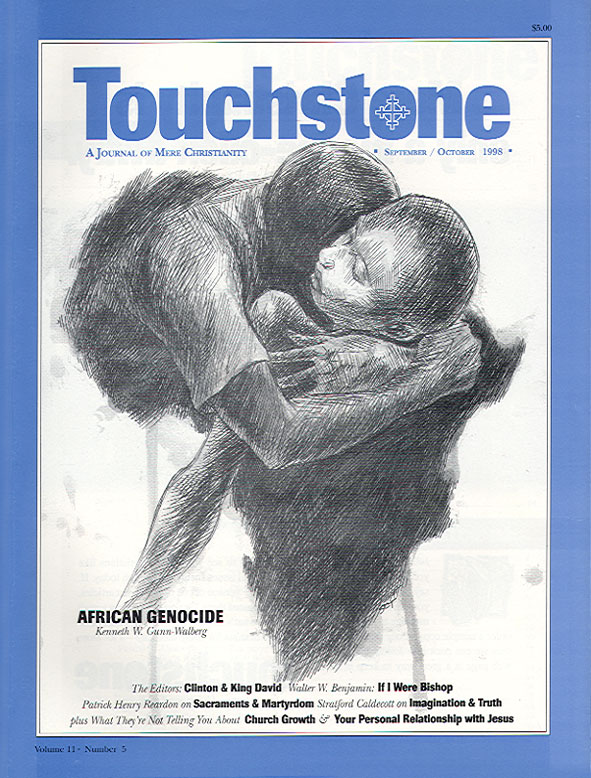
Anatomy of a Genocide by Kenneth W. Gunn-Walberg

Anatomy of a Genocide

The Crown, the Church, Ethnicity, & the State in the Rwandan Crisis

by Kenneth W. Gunn-Walberg

How many women, men, and children were killed in Rwanda in the weeks following April 6, 1994? Three quarters of a million, a million, perhaps as few as half a million? What of those mutilated, men minus hands or legs, children bearing marks of the machete, women raped, maimed, and tortured? Why did it happen?

Rwanda is a small country with a population of roughly eight million people. When European explorers seeking the source of the Nile entered Rwanda in the second half of the nineteenth century, they encountered three groups of people with distinct roles. The state was embodied by the king, known as the Mwami, whose symbol was a sacred drum or kalinga. The minority, but dominant element, was that of the Tutsi, who raised cattle. The majority was that of the Hutu, predominantly agricultural, and the Twa, a sparse pygmoid people.

Societies are given life by myths, and in Rwanda myths have a special importance. One particularly salient myth is:

At the beginning of time, the first king of Rwanda came down from heaven. His name was Kigwa and he was to have three sons—Ga-Twa, Ga-Hutu, and Ga-Tutsi. He asked each to care overnight for a gourd filled with milk.

Ga-Twa became thirsty and drank the milk.

Ga-Hutu fell asleep and knocked the gourd over, spilling the milk.

Ga-Tutsi guarded the milk faithfully and was yet attentive when in the morning Kigwa came back.

Thus everyone’s social status was determined: Ga-Tutsi would be Kigwa’s successor. He and his people would own cattle and be excused from manual labor. Only if they worked for Ga-Tutsi would Ga-Hutu and his people be allowed cattle. Ga-Twa and his people would be allowed no cattle and would be outcasts.

For hundreds of years such was the social reality, and the two major groups lived an interdependent existence under the Mwami, who was considered above ethnicity. Both the Hutu and the Tutsi scorned the Twa as an insignificant but troublesome minority. In contrast, the present-day Mwami, His Majesty, King Kigeli V, believes there is but one people, the people of Rwanda. While they are predominantly Catholic and Christian, Kigeli believes that liberty for others, including his Islamic supporters, must be secured in the future.


A Journal of Mere Christianity—Delivered to Your Door

  • Essays on theology, culture, and the Church
  • Contributors from across the Christian traditions
Subscribe (Print + Online)

Six print issues (one year) of Touchstone, plus full online access and PDF downloads for only $39.95.

Subscribe (Online Only)

Get a one-year full-access subscription to the Touchstone online archives for only $19.95.


bulk subscriptions

Order Touchstone subscriptions in bulk and save $10 per sub! Each subscription includes 6 issues of Touchstone plus full online access to touchstonemag.com—including archives, videos, and pdf downloads of recent issues for only $29.95 each! Great for churches or study groups.

Transactions will be processed on a secure server.


more from the online archives
19.8—October 2006

The Best Fears of Our Lives

on the Good Father’s Quiet Desperation by Russell D. Moore

31.6—November/December 2018

Virtue Gone Mad

Victimhood Culture Scapegoats Its Very Source by Michael P. Foley

11.6—November/December 1998

Rediscovering Advent

by Thomas S. Buchanan

calling all readers

Please Donate

"There are magazines worth reading but few worth saving . . . Touchstone is just such a magazine."
—Alice von Hildebrand

"Here we do not concede one square millimeter of territory to falsehood, folly, contemporary sentimentality, or fashion. We speak the truth, and let God be our judge. . . . Touchstone is the one committedly Christian conservative journal."
—Anthony Esolen, Touchstone senior editor

Support Touchstone

00