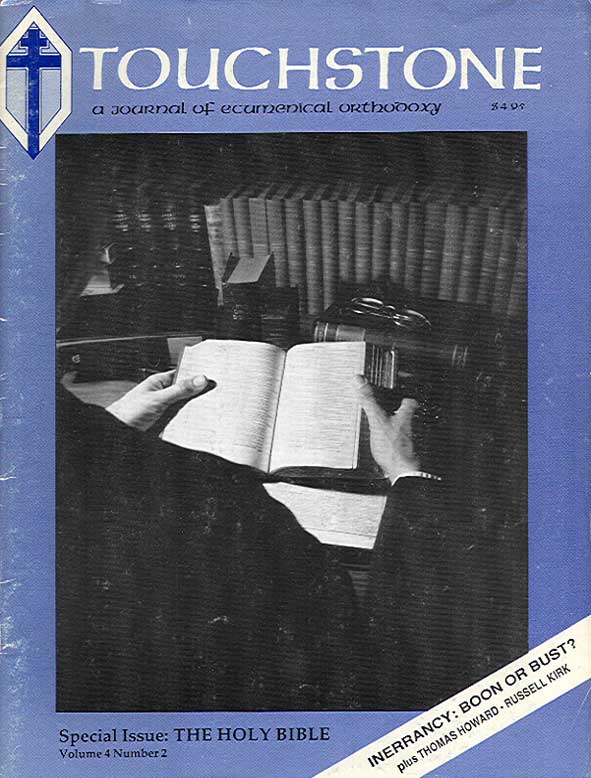
The Rarity of the God-Fearing Man by Russell Kirk

The Rarity of the God-Fearing Man

by Russell Kirk

A Michigan farmer, some years ago, climbed to the roof of his silo, and there he painted, in great red letters that the Deity could see, “The fear of the Lord is the beginning of wisdom.” These words are on that roof yet. When in his cups, which was often enough, that farmer thrashed his daughter to fill her with a holy terror.

In his way, I suppose, the drunken brute did fear God. Surviving the thrashings, his daughter grew to be a woman; and though she did not much fancy her father’s company, she lived as decent a life as most. Her upbringing, bad though it was, may have been better than the formative years of the average American child nowadays, “permissively” reared. To the permitted brat with the permissive parents, few appetites are denied, and he grows up ignorant of the norms of human existence. Never learning in childhood that certain things exist which we ought to fear, he slides into physical maturity, bored, flabby in character, and moved by irrational impulses toward violence and defiance, the consequence of a profound disorder in personality.

Without a knowledge of fear, we cannot know order in personality or society. Fear forms an ineluctable part of the human condition. Fear lacking, hope and aspiration fail. To demand for mankind “freedom from fear,” as politically attainable, was a silly piece of demagogic sophistry. If, per impossibile, fear were wiped altogether out of our lives, we would be desperately bored, yearning for old or new terrors; vegetating, we would cease to be human beings. A child’s fearful joy in stories of goblins, witches, and ghosts is a natural yearning after the challenge of the dreadful: raw head and bloody bones, in one form or another, the imagination demands. From the great instinct to survive, to struggle, to triumph, comes the urge to contend with fear.

And there are things which rightfully we ought to fear, if we are to enjoy any dignity as men. When, in an age of smugness and softness, fear has been pushed temporarily into the dark corners of personality and society, then soon the gods of the copybook headings with fire and slaughter return. To fear to commit evil, and to hate what is abominable, is the mark of manliness. “They will never love where they ought to love,” Burke says, “who do not hate where they ought to hate.” It may be added that they will never dare when they ought to dare, who do not fear when they ought to fear.

Time was when there lay too heavy upon man that fear of the Lord which is the beginning of wisdom. Soul-searching can sink into morbidity, and truly conscience can make cowards of us all. Scotland in the seventeenth century, for instance, tormented itself into a kind of spiritual hypochondria by an incessant melancholy fawning upon the Lord’s favor. But no such age is ours.

Forgetting that there exists such a state as salutary dread, modern man has become spiritually foolhardy. His bravado, I suspect, will stand the test no better than ancient Pistol’s. He who admits no fear of God is really a post-Christian man; for at the heart of Judaism and Christianity lies a holy dread. And a good many people, outwardly and perhaps inwardly religious—for religio implies the cult, the common worship, the binding together, rather than the relationship between the Almighty and lonely man—today deny the reality of reverential fear, and thus are post-Christian without confessing it.

Christianity always was a scandal; and I rather think I began to fear God because I discovered that terror to be so unconventional, impractical, and off-color in our era. (Men are moved in divers ways, and belief actually will follow action.) Before I began to think much on the spiritual diseases of our century, I revolted against the disgusting smugness of modern America—particularly the complacency of professors and clergymen, the flabby clerisy of a sensate time. Once I found myself in a circle of scholars who were discussing solemnly the conditions necessary for arriving at scientific truth. Chiefly from a perverse impulse to shock this Academy of Lagado, perhaps, I muttered, “We have to begin with the dogma that the fear of God is the beginning of wisdom.”

I succeeded in scandalizing. Some gentlemen and scholars took this for indecent levity; others, unable to convince themselves that anyone could mean this literally, groped for the presumptive allegorical or symbolical meaning behind my words. But two or three churchgoers in the gathering were not displeased. These were given to passing the collection plate and to looking upon the church as a means to social reform; incense, vestments, and the liturgy have their aesthetic charms, even among doctors of philosophy. Faintly pleased, yes, these latter professors, to hear the echo of fife and drum ecclesiastic; but also embarrassed at such radicalism. “Oh no,” they murmured, “not the fear of God. You mean the love of God, don’t you?”

For them the word of Scripture was no warrant, their Anglo-Catholicism not withstanding. With Henry Ward Beecher, they were eager to declare that God is Love—though hardly a love which passes all understanding. Theirs was a thoroughly permissive God the Father, properly instructed by Freud. Looking upon their mild and diffident faces, I wondered how much trust I might put in such love as they knew. Their meekness was not that of Moses. Meek before Jehovah, Moses had no fear of Pharaoh; but these doctors of the schools, much at ease in Zion, were timid in the presence of a traffic policeman. Although convinced that God is too indulgent to punish much of anything, they were given to trembling before Caesar. Christian love is the willingness to sacrifice oneself; yet I would not have counted upon these gentlemen to adventure anything of consequence for my sake, nor even for those with greater claims upon them. I doubted whether the Lord would adventure much on their behalf: the vessels for dishonor are not necessarily the sots of Skid Row. If, for instance, there should come a moment in which these particular churchgoers should be confronted with the squalid oligarchs of our time, the gauleiters and the commissars—why, I would look for precious little sacrifice from them. Theirs was a light love. Gauleiters and commissars? Why, their fellowship and charity were not proof against a dean or a divisional head.

“Me supreme Wisdom and primal Love sustain”: this is the legend above the gate of the Inferno. The great grim Love which makes Hell a part of the nature of things, my colleagues could not apprehend. And, lacking knowledge of that Love, at once compassionate and retributive, their sort may bring us presently to a terrestrial hell, which is the absence of God from the affairs of men—with certain unattractive personal and social consequences.


A Journal of Mere Christianity—Delivered to Your Door

  • Essays on theology, culture, and the Church
  • Contributors from across the Christian traditions
Subscribe (Print + Online)

Six print issues (one year) of Touchstone, plus full online access and PDF downloads for only $39.95.

Subscribe (Online Only)

Get a one-year full-access subscription to the Touchstone online archives for only $19.95.


bulk subscriptions

Order Touchstone subscriptions in bulk and save $10 per sub! Each subscription includes 6 issues of Touchstone plus full online access to touchstonemag.com—including archives, videos, and pdf downloads of recent issues for only $29.95 each! Great for churches or study groups.

Transactions will be processed on a secure server.


more from the online archives

30.4—July/Aug 2017

Soul Comforter

on Emily Dickinson & the Source of Our Hope by Josh Mayo

22.5—June 2009

A Law for All Seasons

C. S. Lewis on Civilization & the Natural Order by Timothy L. Hall

17.4—May 2004

Supremely Modern Liberals

The Unhappy & Abusive Marriage of Liberalism & Modernism by James Hitchcock

calling all readers

Please Donate

"There are magazines worth reading but few worth saving . . . Touchstone is just such a magazine."
—Alice von Hildebrand

"Here we do not concede one square millimeter of territory to falsehood, folly, contemporary sentimentality, or fashion. We speak the truth, and let God be our judge. . . . Touchstone is the one committedly Christian conservative journal."
—Anthony Esolen, Touchstone senior editor

Support Touchstone

00