




Piety, Place & Gratitude
Where Our Affections & Civilization Are Cultivated
Home is where one starts from. (T. S. Eliot)
A society that despises itself will die. A civilization that reviles itself cannot endure. Thus, any account of cultural survival must begin with love. And love is necessarily anchored to the particular. We must love that which is ours. Love begins at home.
Edmund Burke hints at this when he notes that our loves are formed in the “little platoons.” The home, the parish, the neighborhood—these are the places where our affections are cultivated. The local, the particular, and the placed provide an orientation for subsequent loves. We begin with the particular and move outward toward the universal, but even with that, we never leave the particular behind. Ironically, even those who reject their patrimony and all that it represents shape their lives around that rejection. We are forever haunted by the idea of home.
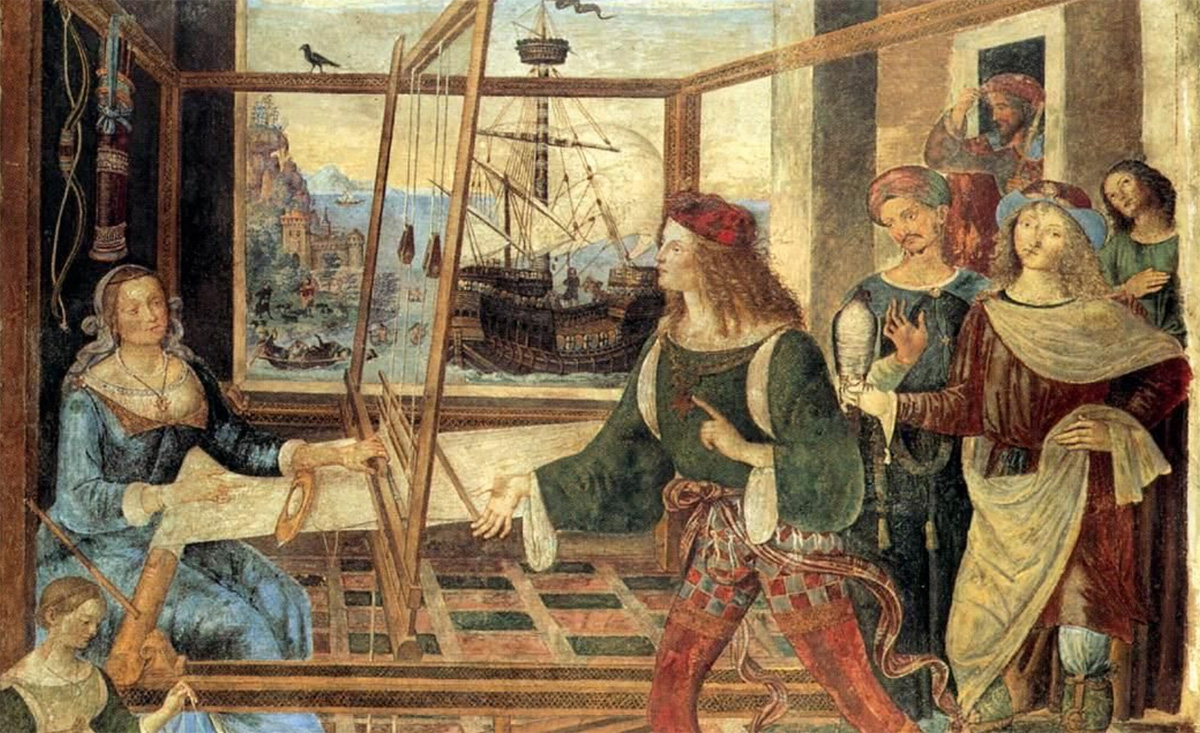
The notion of home is deeply rooted in our cultural consciousness. Consider some of our foundational texts. The Odyssey of Homer is an epic poem of homecoming. The titular hero, Odysseus, has been at war for ten long years and longs for home. After an array of adventures and distractions, he finally returns, only to find his home ravaged by those who desire both his wife and his kingdom. The integrity of the household is restored through a bloody purgation, and his return is ultimately realized in the nuptial embrace in the marriage bed that is literally and symbolically the center of the home. The love of home, and all that it represents, is the magnetic force that motivates the entire epic.
The Bible is permeated with the notion of home both lost and restored. The overarching architecture of the Bible is characterized by an initial at-homeness in Eden, followed by an expulsion that initiates a process culminating in return. Paradise, Canaan, the new heavens and new earth are all conceived as a sort of return to an original state of peace and belonging. There are, at the same time, smaller cycles that depict the same pattern: expulsion from Egypt, wandering in the desert, and finally a homecoming in the promised land. The exile to Babylon and return to Judah follows the same trajectory.
The English philosopher Roger Scruton argued that a proper view of politics and society must begin with oikophilia, a love of home. He writes that “human beings, in their settled condition, are animated by oikophilia.” But while oikophilia is the starting place for a healthy society, Scruton argues that modern liberal societies are increasingly characterized by oikophobia, which, in practice, manifests itself as a “culture of repudiation” rather than a “culture of affirmation,” which is the practical result of oikophilia. Burke’s insight into the contours of the French Revolution provides a pithy critique of the citizen and the society characterized by oikophobia and its attendant culture of repudiation: “You began ill, because you began by despising everything that belonged to you.” A healthy culture cannot be grounded on a rejection of all that has been inherited from the past. Affirmation, even if only selective, critical, and partial, is necessary.
I want to suggest that by digging into the notion of oikophilia, we can locate two key propositions and two imperatives that, together, present an account of cultural life that provides the only intelligible course of health and ultimately of survival.
Proposition 1: Place Matters
The novelist Flannery O’Connor sagely noted that “someplace is better than anyplace.” In her book The Need for Roots, French writer Simone Weil notes that “to be rooted is perhaps the most important and least recognized need of the human soul.” She continues: “A human being has roots by virtue of his real, active and natural participation in the life of a community which preserves in living shape certain particular treasures of the past and certain particular expectations for the future.” If this is the case, then a society characterized in large part by its mobility, a society that seems to take a perverse satisfaction in its own deracination, would be ill-equipped to provide one of the central human needs.
Writing of mid-twentieth-century France, but sounding as if she were writing for twenty-first-century Americans, Weil describes “a culture very strongly directed towards and influenced by technical science, very strongly tinged with pragmatism, extremely broken up by specialization, entirely deprived both of contact with this world and, at the same time, of any window opening to the world beyond.” This suggests that humans have a need for physical or geographical roots in a particular place embodying particular traditions, stories, habits, and practices. But humans equally require roots in a transcendent world, a world of spirit, a world of moral truth. In short, the uprootedness of many today is both geographic and spiritual. The two are related.
Indeed, it is no exaggeration to suggest that our society suffers from what we might call the problem of place. We hear of an epidemic of loneliness. Young people are suffering from unprecedented levels of depression and anxiety, and many are acting out in destructive and violent ways, while others wither in despondent apathy. It is no coincidence that restless mobility increasingly characterizes our lives.
We have created a world where places are increasingly pseudo-places. Shopping malls, airports, and the fast-food drive-thru are places that enhance and validate our restless mobility rather than provide a haven of peace and rest. People—especially the young—spend hours “online” (which is no place) “surfing” or “scrolling,” which is a pretty good description of a life of constant motion, constant seeking, never settling, never satisfied.
We have created a world in which it is easier to leave than to stay put. A world where, even when we are physically present, we are induced to be mentally absent. How many times a day do we check our phones? Why is it so difficult to maintain sustained attention? Our restlessness seems to be carried along by a combination of boredom and anxiety, and we do well to consider the cost of this restless inattention. And lest we are tempted to lay all the blame on our recently acquired technologies, consider Tocqueville’s assessment of a society dedicated to equality of conditions above all else: “The habit of inattention must be considered the greatest vice of the democratic mind.”
Related to this habitual inattention is the persistent fear of commitment that manifests itself in practical terms by a desire to keep one’s options open. To commit to living in one place is to say no to living in all other places. To commit to a particular church is to say no to all other churches. To commit to marry one person is to say no to the possibility of marrying anyone else. Ultimately, a reticence to commit—which is rooted in a habit of inattention that untethers the imagination from any specific place or person—reveals a profound oikophobia that disdains the implied claims on our freedom that true commitment necessarily requires.
The American writer Wendell Berry argues that a meaningful community must include the idea of rootedness. “By community, I mean the commonwealth and common interests, commonly understood, of people living together in a place and wishing to continue to do so. To put it another way, community is a locally understood interdependence of local people, local culture, local economy, and local nature.”
Berry argues that the decline of flourishing communities is the result of an excessive individualism that places rights ahead of responsibilities and economic gain ahead of meaningful and durable relationships—relationships with neighbors, with local customs and practices, with the land itself. As he puts it:
If the word community is to mean or amount to anything, it must refer to a place (in its natural integrity) and its people. It must refer to a placed people. . . . The modern industrial urban centers are “pluralistic” because they are full of refugees from destroyed communities, destroyed community economies, disintegrated local cultures, and ruined local ecosystems.
Ultimately, according to Berry, “a plurality of communities would require not egalitarianism and tolerance but knowledge, an understanding of the necessity of local differences, and respect. Respect, I think, always implies imagination—the ability to see one another, across our inevitable differences, as living souls.” For Berry, community requires commitment to a particular place and the people, culture, economy, and ecology of that place. At the same time, this localism requires that people recognize other persons, whether members of one’s community or not, as possessing inherent dignity.
Berry’s teacher, the novelist and essayist Wallace Stegner, wrote extensively about the American West and the various kinds of men and women who settled it. He describes two distinct personality types: boomers and stickers. Boomers are always on the lookout for the fast buck, for the next big thing. They insist on keeping their options open. They sit loosely, always ready to light out for the latest gold rush or land rush that promises wealth, excitement, and success. Boomers are transients who never fully commit to a place, for they are convinced that there is always some other place that is superior, one that will finally satisfy the restless longing that agitates their minds. In a real sense, a boomer can be a boomer even if he never gets the gumption to move, for failing to commit to a place and to see oneself as a part of its ongoing story characterizes the mind of the boomer.
Stickers, in contrast, stick. To be sure, the American West—and America as a whole for that matter—was settled by people who left their homes and went out seeking a new place. Some were motivated by a desire for land; some sought religious freedom; some were on the run from the law. Nevertheless, from among this variegated band, many chose to settle down, build homes, raise kids and crops, start businesses, and plan for the future. In imagining themselves in their places for the long haul, they learned to think in longer terms than the boomers. Rather than attempting to extract quick profits, stickers think of passing on a legacy of care to their children and grandchildren. According to Stegner, a recognizable indigenous culture emerged in the West, and this was “the product not of the boomers but of the stickers, not of those who pillage and run but of those who settle, and love the life they have made and the place they have made it in.”
Imperative 1: Human Scale
If place matters, we must learn to think and act in terms of human scale. Human scale is a largely forgotten concept that involves thinking specifically in terms of the scale of goods suitable to human flourishing. In 1973, the British economist E. F. Schumacher published a book with a suggestive title: Small Is Beautiful. The subtitle expressed the connection between scale and human beings: A Study of Economics As If People Mattered. In short, the economy, like the Sabbath, is made for man, not vice versa. Of course, speaking in terms of human scale requires us to ask basic questions pertaining to human nature: What is a human being? What are humans for? Are there goods that humans ought to pursue, and is there a specifically human shape and scale to those goods?
In the middle of the twentieth century, the German economist Wilhelm Röpke wrote of what he termed “the cult of the colossal.” His description of this phenomenon includes various ways in which our world has become enamored of size and as a consequence forgotten the matter of human scale:
The cult of the colossal means kowtowing before the merely “big”—which is thus adequately legitimized as the better and more valuable—it is the cult of power and unity, the predilection for the superlative in all spheres of cultural life. . . . To this style of the time correspond, in equal degree . . . imperialism, socialism, mammoth industries, monopolism, statism, monumental architecture, technical dynamism, mass armies, the concentration of government powers, giant cities, etc.
Today we might be tempted to add such entities as Google, Facebook, BlackRock, the World Economic Forum, and McDonald’s.
When we reject the notion of human scale, we reject the notion of limits. Yet without an acknowledgement of limits, we lack a proper context within which we can organize our lives both individually and corporately. In our restless world, where our attention anxiously flits to and fro, the notion of limits is seen as a constraint on personal freedom, an externally imposed confinement to a place, whether geographic, moral, or psychic.
Once the notion of limits is jettisoned as undesirable, the default toward the colossal is quite natural, for scale and limits are inseparable, and when we recoil from limits, we implicitly recoil from any conception of human scale. Thus, in an age characterized by a hatred of limits, advertisers insist that we can have it all, politicians spend money as if no amount of debt is too much, transhumanists promise that immortality is just a few years away, and globalists insist that national borders place unjust limits on freedom of mobility. Concepts such as self-control, asceticism, mortality, localism, and federalism all come to be regarded with repugnance.
We can think of the issue of scale in terms of the objects of our love. Recall that Burke insisted that our affections are cultivated in the “little platoons” of family, parish, neighborhood, and local community. Our loves grow in these contexts and remain anchored there even if we subsequently learn to love something larger, like our country. If they are not firmly anchored in the concrete reality of particular human-scale realities, our loves become mere abstractions, counting for little except perhaps the psychological satisfaction we get from claiming them as our own.
Dostoevsky makes this point in his novel The Brothers Karamazov, when a character proudly declares that he loves humanity but hates his stinking neighbor. Humanity is an abstraction that is simply beyond the range of an individual’s capacity to love. The concrete reality of the neighbor is proper to our capacities and more than sufficient for our aspirations. Christ makes the same point when he declares that “God so loved the world” yet commands his followers to love their neighbors. The scale of the neighbor is proper to our humanity. Seeking to bypass the anchoring stability of the neighbor, the particular, and the placed in favor of humanity, the universal, and the abstract is to relinquish the possibility of truly loving.
Proposition 2: Gratitude Is Essential
If we are creatures who owe debts to others, both living and dead, we must consider the nature of those obligations both individually and corporately. We must consider what a disposition of gratitude would mean for building and sustaining a culture, organizing ourselves socially, and conducting our politics. Yet we tend to be an ungrateful lot. As early as 1930, the Spanish philosopher José Ortega y Gasset observed that modern men and women are, among other things, characterized by “radical ingratitude.”
In the first instance, gratitude is a disposition toward the world that reminds us that we are not alone. We are not solitary creatures owing nothing to anyone. Rather, gratitude points to our dependence. It points to our contingency. When our thoughts are characterized by gratitude, they are outward looking. Gratitude breaks us out of the cocoon of self-satisfaction and self-concern that is a constant temptation and impels us to think about the ways our lives are related to others. Gratitude is quintessentially relational.
It is little wonder that Nietzsche regarded gratitude as a terrible burden. As he put it, “The man who gives a great gift encounters no gratitude; for the recipient, simply by accepting it, already has too much of a burden.” If, as Nietzsche suggested, the will to power is the central motive force of human existence, then gratitude would indeed be a burden, for it highlights the relative powerlessness of the recipient even as it points out the relative power of the benefactor. In short, gratitude highlights our dependence, not our independence, and to the extent that all people have been on the receiving end of beneficence, all people have a duty to be grateful.
In Paradise Lost, John Milton vividly depicts the fall of Satan from his heavenly position of honor. Satan admits that serving God was not at all onerous and that rebellion was not justified on that score. But presaging Nietzsche’s comment about gratitude two centuries later, this fallen angel acknowledges the burden:
The debt immense of endless gratitude,
So burthensome, still paying, still to owe;
Forgetful what from him I still received,
And understood not that a grateful mind
By owing owes not, but still pays, at once
Indebted and discharged; what burden then?
Because the debt he owed to God was greater than he was willing to bear, Satan sought to overthrow God and thereby expunge the debt. But even this cosmic rebel acknowledges that a grateful mind relieves the burden of gratitude though the debt remains.
One obvious object of gratitude is our parents. While God is the ultimate giver of life, in a more proximate sense, we owe our lives to our parents. Assuming our parents raised us, we owe them a debt of gratitude for providing us with food and shelter and educating us to know right from wrong. The Latin word pietas, from which we get our word “piety,” has a variety of meanings including a sense of duty, devotion, kindness, tenderness, and loyalty to the gods, to one’s parents, and to one’s country.
When a son acts dutifully toward his father, he is demonstrating pietas. Gratitude is tied up with this duty, for if the outward act is performed without the inward disposition of love and gratitude, it is not one of pietas. Pietas consists of proper action born of proper motivation. In the classical world, as in some contexts today, pietas for one’s father was tied inextricably to pietas toward the gods, for knowledge and devotion to the gods is acquired directly from one’s father. We honor the gods because we honor our father and he honors the gods. Thus, we can see a generational transmission of pietas that extends from son to father and ultimately to God.
This multigenerational duty that includes both one’s father and his gods is no better illustrated than in the character of Aeneas, the legendary founder of Rome and the subject of Virgil’s epic The Aeneid. Aeneas was, of course, a Trojan warrior who fought to defend his city against the invading Greek army. After ten long years of war, the Trojans fell for a ruse in the form of a horse, and Troy was sacked by the Greek army. As the city goes up in flames, Aeneas first attempts to marshal the Trojan soldiers, but he soon realizes there is no hope of victory. His mother, the goddess Venus, appears to him and encourages him to leave the fight and flee the city with his wife, son, and father. Yet despite the impending disaster, Anchises, the father of Aeneas, refuses to leave.
Aeneas, for his part, refuses even to consider leaving his father in the doomed city. He declares that if his father stays to be slaughtered by the Greeks, he will remain as well. Aeneas prepares to return to the hopeless fray and at least die a warrior’s death if escape is not an option. His wife begs him not to go. She holds up their young son, Iulus, to remind him of what will soon be lost. In the midst of this confusion, the gods send a sign. A tongue of flame appears on the young boy’s head. This moves the old man. He knows this is a portent. He lifts his eyes to heaven and asks Jupiter for another sign to confirm that this flame really is divine. Immediately, with a crack of thunder, a star falls from the sky and disappears into the darkness of the mountain beyond the city. That is enough. Anchises is now ready to go. The gods, despite the destruction of Troy, appear to have a plan for Aeneas and his little band.
But the old man is feeble. He cannot walk quickly, let alone run. Aeneas realizes what must be done:
“Then come, dear father. Arms around my neck:
I’ll take you on my shoulders, no great weight.
Whatever happens, both will face one danger,
Find one safety. . . .
Father, carry our hearthgods, our Penatës.
It would be wrong for me to handle them—
Just come from such hard fighting, bloody work—
Until I wash myself in running water.”When I had said this, over my breadth of shoulder
And bent neck, I spread out a lion skin
For tawny cloak and stooped to take his weight.
Then little Iulus put his hand in mine
And came with shorter steps beside his father.
Here we see a profound example of pietas. Aeneas flees the burning city with his father on his back and his young son at his side. He willingly shoulders the burden of his father, for that is what duty demands. His pietas does not allow him to touch the household gods, so the old man carries them. Thus, Aeneas bears the burden of his father and their gods. He is both literally and figuratively bearing the weight of the past as a good son must. His gratitude, as displayed in his pietas, makes any other option unthinkable. He will not leave his father or the gods of his father. But Aeneas is a father himself. He has duties not only to the past and to heaven but to the future as well. Thus, he takes little Iulus by the hand, and together they leave the city. Aeneas, the man of pietas, does his duty, and in the process teaches Iulus, through the example of his actions, how to be a man.
This, of course, leads us to the obvious question: Do we as a society see the world through the lens of gratitude, or do we suffer from the astigmatism of ingratitude? If our society is characterized to some extent by the disposition of ingratitude, what are the effects? Might it be possible to trace lines of ingratitude through many of the social and political problems that vex us? Again, Burke’s words are instructive: “You began ill, because you began by despising everything that belonged to you.” In other words, the Jacobin insanity was rooted in the pathology of ingratitude, which is merely another way of speaking of oikophobia.
Gratitude gives birth to acts marked by responsibility, for in expressing our gratitude, we acknowledge our dependence, which, if we are honest, is ongoing. To be grateful, in short, is to be humble. Ingratitude, on the other hand, is a manifestation of hubris. It is a pride that dooms us to a false conception of the world and therefore renders wisdom impotent and judgment faulty. To recover a better vantage point requires, on this account, a recovery of that sense of gratitude by which we acknowledge, through our dispositions and actions, the giftedness of the lives we live and the world we inhabit.
Imperative 2: Stewardship
Stewardship is the outward manifestation of our gratitude directed at particular places, persons, goods, and realities. Stewardship entails three vital components: grateful reception, loving care, and faithful transmission. This tripartite process is evident in, for example, the transmission of a family heirloom across successive generations. The same principle is also seen in St. Paul’s account of the transmission of the gospel: “For I delivered unto you first of all that which I also received.”
What would be the motive for participating in this process of reception, care, and transmission? Gratitude. For gratitude necessarily manifests itself as a sense of responsibility to the past and to the future. Gratitude, rightly conceived, recognizes the reality of duties to people long dead and to people not yet born. Gratitude pushes us out of the restless anxiety that blinds us to all but the narrowest of temporal horizons and opens up a vista of gifts and responsibilities that extend back into the shadows of the past and forward into a future not yet realized.
Scruton argues that beauty provides a motive to care for places. And it seems clear that a disposition of gratitude opens us to recognizing the beauty in the places we inhabit and the people to whom we’ve been called.
T. S. Eliot’s poem “Little Gidding” ends with what Scruton calls “the most brilliant of all imitations of Dante in English—an imitation which is something far finer than an imitation, in which the religious vision of Dante is transported and translated into the world of modern England.” “Little Gidding”—indeed all the poems that constitute Eliot’s Four Quartets—is a profound meditation on the human condition and the longing for home.
Much of the poem expresses a sort of frustration with the inadequacy of language to express the deepest of human experiences, yet, by the end, after a seemingly endless struggle, the words fit. Somehow they stay put. They return home dancing:
And every phrase
And sentence that is right (where every word is at home,
Taking its place to support the others. . . .
The complete consort dancing together).
Every phrase and every sentence is an end and a beginning.
And here, at the still point, the dance of time and eternity discloses itself as the meaning of reality itself:
The moment of the rose and the moment of the yew-tree
Are of equal duration.
The ephemeral beauty of the rose—a recurring theme in Four Quartets—attains the fixed permanence of the yew. Time past and time present find meaning and coherence only when they are framed by eternity, but this, ironically, does not efface the particular; rather, it sanctifies it. In this juxtaposition, home becomes intelligible in its concrete reality:
So, while the light fails
On a winter’s afternoon, in a secluded chapel
History is now and England.
The apparent tension between past and present, between time and eternity, dissolves. We see “an easy commerce of the old and the new.” The tension of time is subsumed, and all is reconciled in the dance of eternity.
And what is more, that which was unsayable is remembered. Instead of frustration, there is an air of peace and contentment, an air of at-homeness:
And the end of all our exploring
Will be to arrive where we started
And know the place for the first time.
Through the unknown, remembered gate
When the last of earth left to discover
Is that which was the beginning.
And though in the closing lines the language of home is absent, the reconciliation that represents a true and lasting oikophilia is present nonetheless.
And all shall be well and
All manner of thing shall be well
When the tongues of flame are in-folded
Into the crowned knot of fire
And the fire and the rose are one.
Scruton asserts that “our greatest need is for home.” Berry would surely agree. Yet a profound sense of loss, of homelessness, pervades the modern world. We are left with a question: Is oikophilia possible apart from the enchantment that only religious belief can sustain? Eliot did not think so. And neither, perhaps, did Scruton. “Religion,” Scruton writes, “is a spiritual home-coming.”
And it seems that, for Scruton, beauty may be the golden thread linking the persistent human longing for a home to the religious impulse without which nihilistic despair may be the only plausible option. Beauty points to the transcendent yet simultaneously makes living in the world possible. “Beauty tells [us] that [we] are at home in the world.” Indeed it is beauty, elicited by the poet, by the painter, by the musician, and in the natural world, that assures us that the world is more than meets the eye, that goodness persists even in the face of destruction, and that ultimately “all shall be well and all manner of thing shall be well.” Beauty draws us home.
Mark T. Mitchell teaches political theory at Patrick Henry College in Virginia. He is the co-founder of Front Porch Republic.
Share this article with non-subscribers:
https://www.touchstonemag.com/archives/article.php?id=39-03-025-f&readcode=11369
A Journal of Mere Christianity—Delivered to Your Door
- Essays on theology, culture, and the Church
- Contributors from across the Christian traditions

Six print issues (one year) of Touchstone, plus full online access and PDF downloads for only $39.95.

Get a one-year full-access subscription to the Touchstone online archives for only $19.95.
bulk subscriptions
Order Touchstone subscriptions in bulk and save $10 per sub! Each subscription includes 6 issues of Touchstone plus full online access to touchstonemag.com—including archives, videos, and pdf downloads of recent issues for only $29.95 each! Great for churches or study groups.
Transactions will be processed on a secure server.
more on literature from the online archives

30.5—Sept/Oct 2017
on Costly Grace in Breece D'J Pancake's Flyover Country by Casey Chalk
32.2—March/April 2019
Misguided Mercy & Dante's Infernal Purgation by Joshua Hren
more from the online archives

27.5—Sept/Oct 2014
on Growing Vegetables as a Primer in Moral Philosophy by Rachel Lu
23.6—November/December 2010
Darwin, Design & Thomas Aquinas
The Mythical Conflict Between Thomism & Intelligent Design by Logan Paul Gage
32.2—March/April 2019
on Properly Rendering Things to Caesar & to God by Peter J. Leithart
calling all readers
Please Donate
"There are magazines worth reading but few worth saving . . . Touchstone is just such a magazine."
—Alice von Hildebrand
"Here we do not concede one square millimeter of territory to falsehood, folly, contemporary sentimentality, or fashion. We speak the truth, and let God be our judge. . . . Touchstone is the one committedly Christian conservative journal."
—Anthony Esolen, Touchstone senior editor
