




Piety, Place & Gratitude
Where Our Affections & Civilization Are Cultivated
Home is where one starts from. (T. S. Eliot)
A society that despises itself will die. A civilization that reviles itself cannot endure. Thus, any account of cultural survival must begin with love. And love is necessarily anchored to the particular. We must love that which is ours. Love begins at home.
Edmund Burke hints at this when he notes that our loves are formed in the “little platoons.” The home, the parish, the neighborhood—these are the places where our affections are cultivated. The local, the particular, and the placed provide an orientation for subsequent loves. We begin with the particular and move outward toward the universal, but even with that, we never leave the particular behind. Ironically, even those who reject their patrimony and all that it represents shape their lives around that rejection. We are forever haunted by the idea of home.
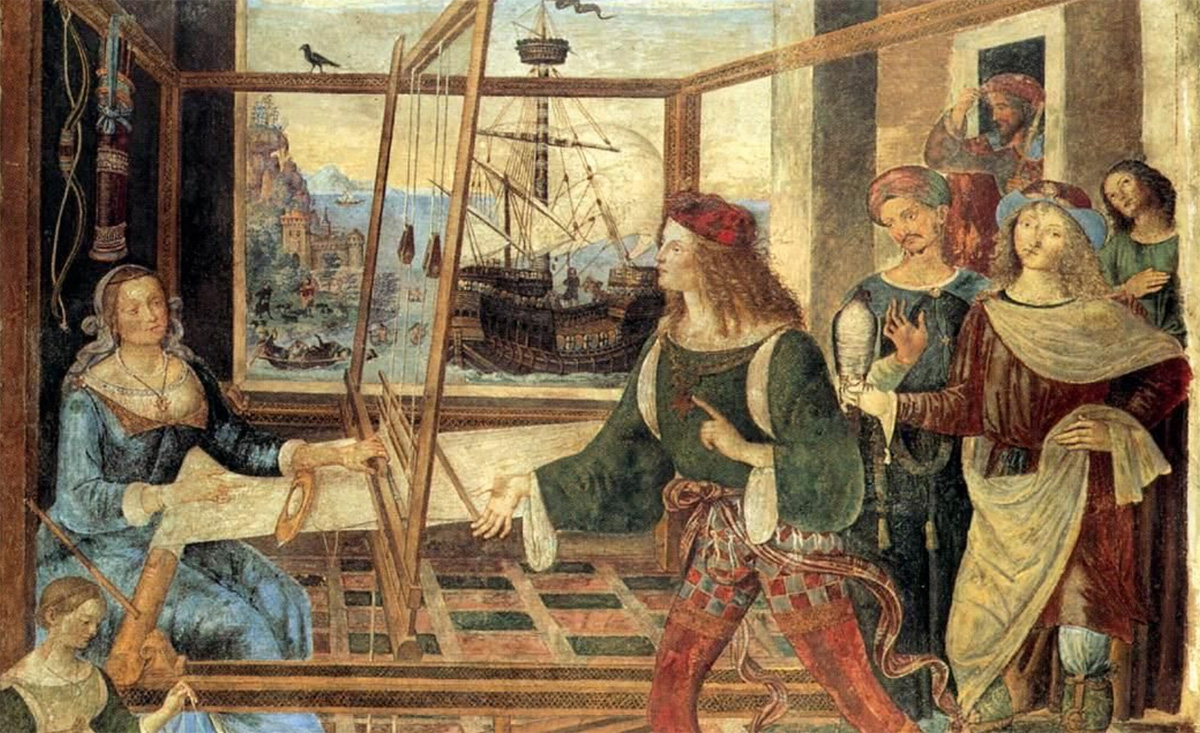
The notion of home is deeply rooted in our cultural consciousness. Consider some of our foundational texts. The Odyssey of Homer is an epic poem of homecoming. The titular hero, Odysseus, has been at war for ten long years and longs for home. After an array of adventures and distractions, he finally returns, only to find his home ravaged by those who desire both his wife and his kingdom. The integrity of the household is restored through a bloody purgation, and his return is ultimately realized in the nuptial embrace in the marriage bed that is literally and symbolically the center of the home. The love of home, and all that it represents, is the magnetic force that motivates the entire epic.
The Bible is permeated with the notion of home both lost and restored. The overarching architecture of the Bible is characterized by an initial at-homeness in Eden, followed by an expulsion that initiates a process culminating in return. Paradise, Canaan, the new heavens and new earth are all conceived as a sort of return to an original state of peace and belonging. There are, at the same time, smaller cycles that depict the same pattern: expulsion from Egypt, wandering in the desert, and finally a homecoming in the promised land. The exile to Babylon and return to Judah follows the same trajectory.
The English philosopher Roger Scruton argued that a proper view of politics and society must begin with oikophilia, a love of home. He writes that “human beings, in their settled condition, are animated by oikophilia.” But while oikophilia is the starting place for a healthy society, Scruton argues that modern liberal societies are increasingly characterized by oikophobia, which, in practice, manifests itself as a “culture of repudiation” rather than a “culture of affirmation,” which is the practical result of oikophilia. Burke’s insight into the contours of the French Revolution provides a pithy critique of the citizen and the society characterized by oikophobia and its attendant culture of repudiation: “You began ill, because you began by despising everything that belonged to you.” A healthy culture cannot be grounded on a rejection of all that has been inherited from the past. Affirmation, even if only selective, critical, and partial, is necessary.
I want to suggest that by digging into the notion of oikophilia, we can locate two key propositions and two imperatives that, together, present an account of cultural life that provides the only intelligible course of health and ultimately of survival.
Proposition 1: Place Matters
The novelist Flannery O’Connor sagely noted that “someplace is better than anyplace.” In her book The Need for Roots, French writer Simone Weil notes that “to be rooted is perhaps the most important and least recognized need of the human soul.” She continues: “A human being has roots by virtue of his real, active and natural participation in the life of a community which preserves in living shape certain particular treasures of the past and certain particular expectations for the future.” If this is the case, then a society characterized in large part by its mobility, a society that seems to take a perverse satisfaction in its own deracination, would be ill-equipped to provide one of the central human needs.
Writing of mid-twentieth-century France, but sounding as if she were writing for twenty-first-century Americans, Weil describes “a culture very strongly directed towards and influenced by technical science, very strongly tinged with pragmatism, extremely broken up by specialization, entirely deprived both of contact with this world and, at the same time, of any window opening to the world beyond.” This suggests that humans have a need for physical or geographical roots in a particular place embodying particular traditions, stories, habits, and practices. But humans equally require roots in a transcendent world, a world of spirit, a world of moral truth. In short, the uprootedness of many today is both geographic and spiritual. The two are related.
Indeed, it is no exaggeration to suggest that our society suffers from what we might call the problem of place. We hear of an epidemic of loneliness. Young people are suffering from unprecedented levels of depression and anxiety, and many are acting out in destructive and violent ways, while others wither in despondent apathy. It is no coincidence that restless mobility increasingly characterizes our lives.
Mark T. Mitchell teaches political theory at Patrick Henry College in Virginia. He is the co-founder of Front Porch Republic.
Share this article with non-subscribers:
https://www.touchstonemag.com/archives/article.php?id=39-03-025-f&readcode=11369
A Journal of Mere Christianity—Delivered to Your Door
- Essays on theology, culture, and the Church
- Contributors from across the Christian traditions

Six print issues (one year) of Touchstone, plus full online access and PDF downloads for only $39.95.

Get a one-year full-access subscription to the Touchstone online archives for only $19.95.
bulk subscriptions
Order Touchstone subscriptions in bulk and save $10 per sub! Each subscription includes 6 issues of Touchstone plus full online access to touchstonemag.com—including archives, videos, and pdf downloads of recent issues for only $29.95 each! Great for churches or study groups.
Transactions will be processed on a secure server.
more on literature from the online archives

24.1—January/February 2011
Ruminations on the Monstrous Envy of the Soul-Devouring State by Anthony Esolen

30.5—Sept/Oct 2017
on Costly Grace in Breece D'J Pancake's Flyover Country by Casey Chalk

30.2—March/April 2017
on Reading Don Quixote in Its Original Christian Context by Luis Cortest
more from the online archives

37.5—Sept/Oct 2024
An Abandoned Ruling Principle & How to Get It Back by Adam MacLeod
37.5—Sept/Oct 2024
A Battle Plan for Peace While Growing Old by Anthony Esolen

36.4—Jul/Aug 2023
Our Political Void & the Disintegration of Truth by Michael Hanby
calling all readers
Please Donate
"There are magazines worth reading but few worth saving . . . Touchstone is just such a magazine."
—Alice von Hildebrand
"Here we do not concede one square millimeter of territory to falsehood, folly, contemporary sentimentality, or fashion. We speak the truth, and let God be our judge. . . . Touchstone is the one committedly Christian conservative journal."
—Anthony Esolen, Touchstone senior editor
