





Knot Now
Brad Wilcox & Grant Bailey on the Case for Twenty-Something Marriages
I definitely want to be married by 25,” Justin Bieber, then 17 years old, told the paparazzi when asked about his future family plans. What followed was a minor inquisition. Oprah Winfrey asked Bieber in a later interview whether the reports were true, if he really wanted to get married by 25. Bieber confessed that he did, to which Oprah pressed in: “Rethink that, will you? . . . [Y]our whole 20s is about discovering who you are, and you owe that to yourself.”
Despite Winfrey’s stern admonition, Justin Bieber married at the age of 24. But Bieber is an outlier, both among the celebrity class and the public broadly. For decades, the median age at marriage has steadily climbed, from 22 in the 1960s to almost 30 in recent years. Young marriages have until quite recently become somewhat taboo. Young adults have been told to wait, for a host of reasons: to enjoy their freedom, to find themselves, to travel, to climb the corporate ladder, and to get settled in life before settling down. If you get hitched too early, the conventional wisdom has held, you’ll miss out on having the best time of your life in your footloose and fancy-free twenties, and you’ll probably get divorced to boot.
Fortunately, the tide is now shifting, in a long overdue course correction. From online influencers like Brett Cooper to public intellectuals like Ben Shapiro to tech billionaires like Palmer Luckey, young marriage is being talked up again as an attractive option for starting a family.
After noting on X that he wishes he’d married his wife earlier, for instance, Luckey commented on the pushback his comment engendered: “It says something about society that the most controversial thing I have said in recent history is that I wish I would have married my wife sooner. Not that whales might have better oral history than humans, not that America should restart nuclear testing, marrying young!”
Discouraging & Delaying, Left & Right
This is not to say this idea is likely to be popular in all circles. The Left has long discounted the value of marriage, and especially younger marriage, particularly for women. Articles telling women things like, “Married heterosexual motherhood in America . . . is a game no one wins,” in this case by the writer Amy Shearn in The New York Times, are a regular staple of mainstream media commentary regarding marriage. More recently, the anti-marriage message has come from the right, with manosphere influencers likeAndrew Tate telling his millions of followers that there is “zero statistical advantage” for men who marry. Brian Atlas, host of the highly viewed Whatever podcast, insists that there is “absolutely no reason to get married,” and that marriage is “all risk” for men, partly because he thinks the risk of divorce for contemporary couples is still sky-high.
With shots coming at marriage from left and right in recent decades, it’s no wonder that Americans have been placing less emphasis on matrimony and more emphasis on other priorities. In recent years, a kind of “Midas mindset” has emerged, where young adults are prioritizing status-seeking activities like education and especially work. According to Pew Research, 71 percent of Americans say that having an enjoyable career is important for a satisfying life, whereas only 23 percent say the same about marriage. Me-focused pursuits have eclipsed love, marriage, and family.
One’s twenties, then, are supposed to be devoted to sowing wild oats and making it, not finding a mate and getting married. One apostle of the sexual revolution, Helen Gurley Brown, former editor-in-chief of Cosmopolitan, urged young adults in her book Having It All that it’s better “to be single in your twenties and thirties when a lot of people have the hots for you and you can have as many affairs as you care to fit in, and married when you’re older.” This kind of hedonism and the Midas mindset help explain the rise of the so-called capstone model of marriage, where young adults marry close to 30, and the decline of the cornerstone model of marriage, where they marry in their early twenties.
But with a growing number of voices on the right questioning the capstone model, the question remains: What is the best age to get married?
The Ideal Age to Marry
It’s not a new question. Advice on the ideal age to marry is nearly as old as Western literature itself. Hesiod advised in his Works and Days that men marry around 30 and women in their fifth-year post-menarche. Aristotle wrote that 37 is the best age for men and 18 for women. In the Middle Ages, Thomas Aquinas took the view that the “perfect age” to marry came when “the movement of growth ends, and from which the movement of decline begins.”
By the early seventeenth century in Europe, men typically married in their mid-to-late twenties and women in their early-to-mid twenties, though regional variations persisted. Then as now, many opined on when to marry. The Puritan minister William Whately cautioned in 1673 not to “unadvisedly rush into this Estate” lest they “find a House full of Trouble, and a Life full of Wo.”
Today, about half of Americans, when asked about the best age to marry, say there is no ideal. Presumably, it’s whenever one feels ready. But among those who give an age, late twenties is the most popular answer, followed by early thirties, and then early twenties. The capstone model clearly still has the most cachet for today’s young adults, as the median age of first marriage has risen to 30.2 for men and 28.6 for women, up from, respectively, 22.8 and 20.3 in 1960. The work-and-have-fun-now/settle-down-later ethos is the default for most twenty-somethings. And getting married before 25 is sure to raise eyebrows in many quarters.
Young Marrieds Are Happier
Just as there are good reasons to marry in general—married people live more meaningful, happier, and more prosperous lives—there are good reasons to marry young.
Consider Kasen Stephensen, a twenty-something who married while still an undergraduate at Stanford. In his experience, “life is better with someone by your side who can share the expenses and chores, difficulties and challenges, and celebrations and wins,” he wrote, adding, “A dog or cat can only do so much.”
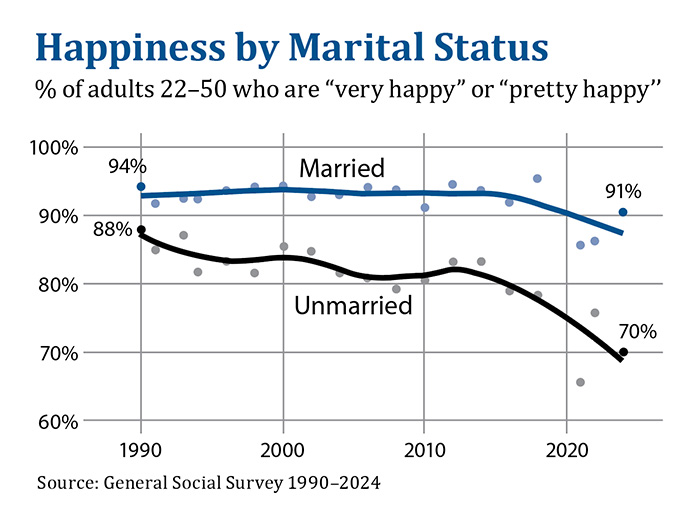
Stephensen is no outlier when it comes to happiness. Among men and women in their twenties, married people are over twice as likely as their unmarried peers to report being very happy, according to our analysis of the General Social Survey (GSS). Married people who work also tend to have higher personal incomes than their unmarried peers, across all education levels. And married twenty-somethings have intimate relations more often than the unmarried: the latest GSS data tells us that 61 percent of married twenty-somethings have sexual relations once or more a week, compared to 42 percent among the unmarried.
Using the 2022 and 2024 American Family Survey, we found that 83 percent of married couples in their twenties report being satisfied with their lives, while only 8 percent report dissatisfaction. Compare this to the one-quarter of unmarried adults in their twenties who report being dissatisfied with their lives, three times the rate of their married peers. When it comes to enjoying a happy life in your twenties, married couples come out on top, despite what Andrew Tate or Helen Gurley Brown would have young men and women think.
What’s also striking about the data is that, today, people who get married young also enjoy happier and more sexually satisfying marriages. One National Marriage Project study at the University of Virginia found that husbands and wives who married in their early twenties reported more marital satisfaction and happier sex lives than those who married at 25 or older. For instance, 63 percent of men who married younger reported they were sexually satisfied, compared to just 49 percent of those married later. Likewise, 62 percent of women who put a ring on younger indicated they were sexually satisfied, compared to just 51 percent of those who married later.
One reason marrying younger may deliver greater sexual and marital satisfaction is that you don’t accumulate a complicated history of partnerships that increases the likelihood you will compare your spouse unfavorably to previous partners. Another reason is that it’s easier to forge a “we-before-me” approach to life and marriage when you’re growing together into your family as twenty-somethings, rather than trying to merge two very distinct, independent lives when you’re in your thirties.
There are also family formation considerations to take into account. Putting family off until after age 30 comes with risks, especially for those who want to have children.
Marrying & Having Kids
One Vogue columnist put the challenges of dating as a thirty-something woman bluntly: “The dating pool is dwindling, your eggs are expiring, and you’re inching closer to death.” Her anxieties are not uncommon or ill-founded.
Our analysis of historical census data suggests that 35–40 percent of individuals who do not marry by age 30 never will, and that the risks of postponing marriage are graver yet for those who want to have kids.
Looking at retrospective fertility histories among women born between 1965 and 1977, we mapped out the odds of having one or more children for every year a woman stayed childless. Eighty percent of women childless at age 20 went on to have children. For women who were childless at 25, that number fell to 70 percent. By age 30, childless women had only a fifty-fifty shot. And among women still childless at age 35, only one in four ever bore a child.
You’ve probably heard similar figures before. But less reported is that, today, three of five women who are childless by their 35th birthday still hope to have children someday. Most of these women will not get the chance to do so.
Aging bachelors do not fare much better. In 2023, the typical newlywed man in his late thirties had married a woman just two or three years his junior. For men postponing marriage until their late thirties or forties, then, fathering a child is challenging.
Later-in-life fertility gets even more challenging when more than one child is desired. Returning to retrospective fertility, we found that just 7 percent of women who were childless at thirty went on to have three or more children—ergo, 93 percent did not. This comports with studies that measure timing when trying to have a desired number of children. One 2015 study found that couples who want a 90 percent chance of conceiving at least one child naturally should start no later than when the female partner is 32 years old. For two children, they should begin trying when the woman is no older than 27, and for three children, no older than 23.
Overstated Divorce Risks
What about divorce? Doesn’t marrying in your early twenties boost your risk of landing in divorce court? Marital instability has been the preeminent concern in modern scholarship regarding the ideal age for marrying—and for good reason. Divorce is often an excruciating experience, especially when it is undesired and seemingly unmerited. This is also the biggest concern the manosphere has with marriage today. If couples that marry in their early twenties are more prone to divorce, that should be of concern. What does the latest research say?
The risk of divorce is lowest for those who marry in their late twenties or early thirties, but there are caveats. Demographer Lyman Stone has shown that those who marry in their twenties without cohabiting have comparatively low risks of divorce, which is consistent with research indicating that cohabiting prior to marriage increases your risk of marital failure. Moreover, sociologist Chuck Stokes found that couples who married in their early twenties but also regularly attend church are almost half as likely to divorce as those who married young but do not attend church.
Together, these studies suggest that those who marry in their early or mid-twenties enjoy a lower divorce rate, provided that neither spouse cohabitated before marriage and that they maintained a record of regular church attendance.
Reviving the Cornerstone Model
The capstone model of marriage surged in popularity in the wake of the divorce revolution and with the end of the family wage by which a married man with children was paid more than his unmarried counterpart. Waiting to marry later was seen as a prudent strategy to avoid divorce court and to enable young men and women to get a strong professional start. But in this new moment, the costs of this approach are becoming unsustainable: marriage and fertility are cratering even as anxiety, anomie, and unhappiness are surging among young adults.
It’s time to end our experiment with the capstone model and return to making marriage the cornerstone of young adult lives. In other words, to maximize your odds of forging a fruitful and happy union, marry in your twenties. Provided, of course, that you have found someone worthy of sharing your life and love, and—ideally—that you have anchored yourself in a community of faith that will stand with you as you embark on the adventure of marriage and family life. •
Brad Wilcox is Distinguished University Professor of Sociology at the University of Virginia, senior fellow at the Institute for Family Studies, and the author of Get Married: Why Americans Must Defy the Elites, Forge Strong Families and Save Civilization.
Grant Bailey is a Research Fellow at the Institute for Family Studies.
A Journal of Mere Christianity—Delivered to Your Door
- Essays on theology, culture, and the Church
- Contributors from across the Christian traditions

Six print issues (one year) of Touchstone, plus full online access and PDF downloads for only $39.95.

Get a one-year full-access subscription to the Touchstone online archives for only $19.95.
bulk subscriptions
Order Touchstone subscriptions in bulk and save $10 per sub! Each subscription includes 6 issues of Touchstone plus full online access to touchstonemag.com—including archives, videos, and pdf downloads of recent issues for only $29.95 each! Great for churches or study groups.
Transactions will be processed on a secure server.
more on Marriage from the online archives

32.1—January/February 2019
Divine Love & the Love of Man & Woman Surpass Mere Consent by Anthony Esolen

21.1—January/February 2008
John Chrysostom’s Discovery of the Blessings & Mysteries of Marriage by Mike Aquilina

more from the online archives

26.1—Jan/Feb 2013
Manly Chastity, Hedonism & the Law of Non-contradiction by Anthony Esolen


calling all readers
Please Donate
"There are magazines worth reading but few worth saving . . . Touchstone is just such a magazine."
—Alice von Hildebrand
"Here we do not concede one square millimeter of territory to falsehood, folly, contemporary sentimentality, or fashion. We speak the truth, and let God be our judge. . . . Touchstone is the one committedly Christian conservative journal."
—Anthony Esolen, Touchstone senior editor
