





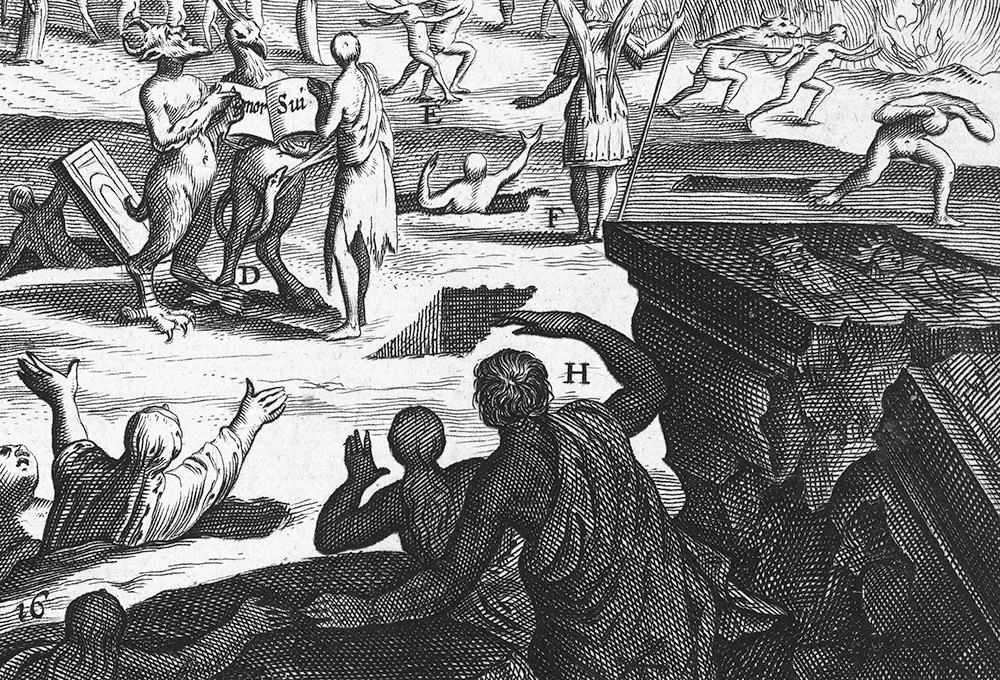
The Fixed Pains of Hell
C. S. Lewis’s Defense of the Doctrine of Eternal Punishment
The Dominical utterances about Hell, like all Dominical utterances, are addressed to the conscience and the will, not to intellectual curiosity. . . . I could not pay one ten-thousandth of the price that God has already paid to remove the fact. And here is the real problem: so much mercy, yet still there is Hell. —C. S. Lewis, The Problem of Pain
C. S. Lewis was perhaps the most influential lay theologian of the twentieth century. His work in apologetics famously helped lead to the conversion of Chuck Colson and has been an influence in the preservation of the faith of countless others in times of doubt. His Chronicles of Narnia have made Christian doctrine come alive for untold thousands. He mounted a brilliant and often insightful defense of traditional, supernatural Christianity that fully justifies his continuing popularity among the faithful.
Because Lewis was a popular and influential defender of classical orthodoxy, it is worthwhile taking a fresh look at his defense of the classical doctrine of eternal punishment. Lewis did not deal directly with annihilationism or conditional immortality because in his lifetime those doctrines were mainly confined to cults, and Lewis concentrated on what he called “mere Christianity.” Nevertheless, he does speak of hell and of the nature of the soul in ways that lend themselves to a defense of eternal conscious punishment. He addresses universalism only indirectly, but clearly denies it, defending the idea that there is a hell and there will be people in it, and in it finally. We will start, then, with a treatment of Lewis’s general eschatology and then move on to focus on its implications for those two currently trending denials of the traditional view.
The Necessity of Choice
In Lewis’s view of personal eschatology, the overriding emphasis is one we could express with one of his book titles: The Great Divorce. As he explains in the preface, that title is a response to Blake’s “Marriage of Heaven and Hell” and the general tendency it represents to deny that reality ever “presents us with an absolutely unavoidable ‘either-or.’” Today the same impulse manifests itself in the fad of pretending to be “non-binary.” By contrast, Lewis’s “great divorce” is that between Christ and Satan, which is a choice between good and evil, leading to a choice between heaven and hell. The two sides of those pairs are not the same, and every human being is unavoidably faced with an irrevocable choice, an “absolutely unavoidable ‘either-or,’” between them.
Lewis thus echoes the biblical motif that “it is appointed unto men once to die, and after that the judgment” (Heb. 9:27). The Great Divorce is ambiguous about whether the choice between heaven and hell can be made after death; George MacDonald’s spirit replies to the voicing of that question, “Ye were not brought here to study such curiosities.” But Lewis is always clear that the great business of life is to choose between God and anything else, with eternal consequences (heaven or hell) depending on that choice. MacDonald continues, “What concerns you is the nature of the choice itself: and that ye can watch them making.” Lewis’s mind is never far from two ideas: first, the inescapability of the choice, and second, how much it matters.
Ultimately, what we are choosing is either God or an idol. But while that choice may be made in a moment of spiritual crisis, it may also be made slowly and unaware throughout our lives, and we may not even realize what we have chosen until the end. Here is how the Narnians face their Day of Judgment in The Last Battle:
As they came right up to Aslan, one or other of two things happened to each of them. They all looked straight in his face. . . . And when some looked, the expression of their faces changed terribly—it was fear and hatred. . . . All the creatures who looked at Aslan in that way swerved to their right, his left, and disappeared into his huge black shadow. . . . The children never saw them again. . . . But the others looked in the face of Aslan and loved him. . . . And all these came in at the Door, on Aslan’s right.
One is reminded of Jesus’ language about the sheep and the goats (Matt. 25:31–46). There are but two paths, two destinations, and there is a final and irrevocable separation between them. How a person relates to Jesus (or Aslan) is the final determination of which path he is on, sometimes not finally revealed until the end.
One either ends up in Aslan’s country or in the shadow.
Evangelicals tend to be conversionists; that is, they expect conversion to be a very conscious decision, to involve a crisis experience when the sinner turns overtly and consciously from sin to Christ as the outcome of the process of conviction and calling. While Evangelicals would not insist that a stereotyped conversion experience is necessary to salvation, the expectation of something very like it tends to be their default setting. Lewis did not deny the role of such a conversion. Indeed, he seems to have had at least two such moments in his own journey to faith, one very definite one when he “gave in,” laid down his arms and surrendered, “admitted that God was God” and became a theist, and another, more subtle, one when he realized after a trip to the zoo that he now believed that Jesus was the Son of God (Surprised by Joy). But he put more emphasis on the smaller, cumulative decisions that may add up to those larger changes that define a life trajectory.
Donald T. Williams is Professor Emeritus of Toccoa Falls College. He stays permanently camped out on the borders between serious scholarship and pastoral ministry, between theology and literature, and between Narnia and Middle-Earth. He is the author of fourteen books, including Answers from Aslan: The Enduring Apologetics of C. S. Lewis (DeWard, 2023). He is a contributing editor of Touchstone.
Share this article with non-subscribers:
https://www.touchstonemag.com/archives/article.php?id=38-06-026-f&readcode=11303
A Journal of Mere Christianity—Delivered to Your Door
- Essays on theology, culture, and the Church
- Contributors from across the Christian traditions
Subscribe (Print + Online) 
Six print issues (one year) of Touchstone, plus full online access and PDF downloads for only $39.95.
Subscribe (Online Only) 
Get a one-year full-access subscription to the Touchstone online archives for only $19.95.
bulk subscriptions
Order Touchstone subscriptions in bulk and save $10 per sub! Each subscription includes 6 issues of Touchstone plus full online access to touchstonemag.com—including archives, videos, and pdf downloads of recent issues for only $29.95 each! Great for churches or study groups.
Transactions will be processed on a secure server.
more from the online archives
27.3—May/June 2014
Facts versus Stereotypes About Love & Marriage in the Land of the Free by Allan C. Carlson

18.4—May 2005
The Idylls, Idols & Devils That Corrupt the Moral Imagination by Vigen Guroian

27.6—Nov/Dec 2014
Tales of Forbidden Stereotypes
Real-Life Men & Women & the Tragic Loss of Human Comedy by Anthony Esolen
calling all readers
Please Donate
"There are magazines worth reading but few worth saving . . . Touchstone is just such a magazine."
—Alice von Hildebrand"Here we do not concede one square millimeter of territory to falsehood, folly, contemporary sentimentality, or fashion. We speak the truth, and let God be our judge. . . . Touchstone is the one committedly Christian conservative journal."
Support Touchstone
—Anthony Esolen, Touchstone senior editor
