




To Close a Swinging Door
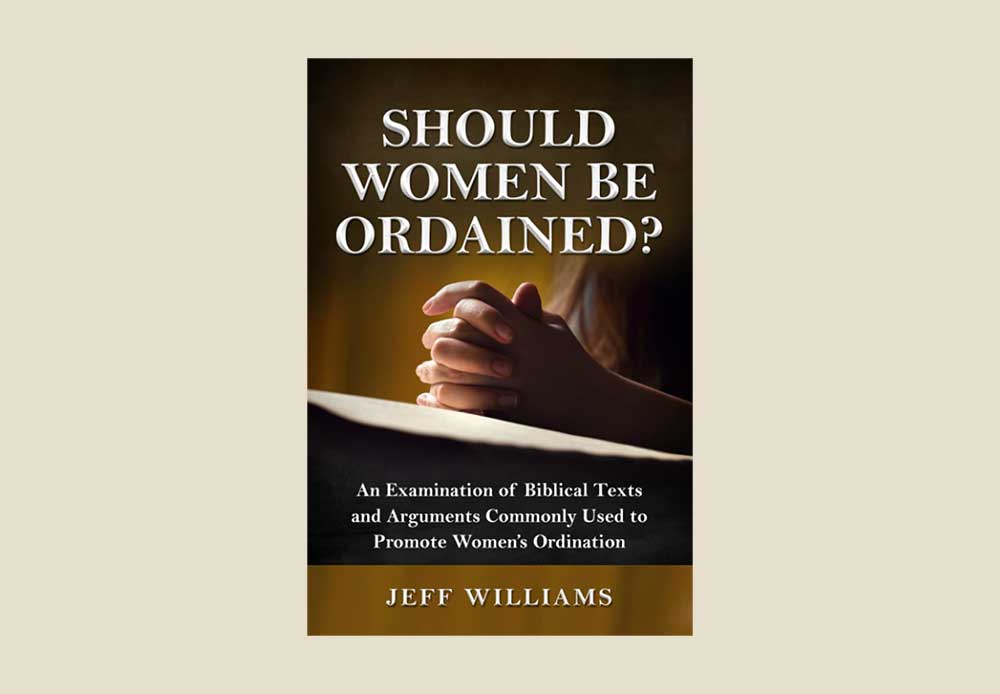
Should Women Be Ordained? An Examination of Biblical Texts and Arguments Commonly Used to Promote Women’s Ordination by Jeff Williams
reviewed by S. M. Hutchens
That women can or should be ordained to the pastoral office is still a minority opinion in Christendom. It is not done among the Orthodox, is favored only among modernized Roman Catholics, and is characteristic only of the shrinking denominations of liberal and liberalizing Protestantism. Among Evangelicals, however, it is still an open question, contested between traditional and progressive factions, with an undecided but well-populated middle group, to whom Jeff Williams’s Should Women Be Ordained? is addressed. His answer is clear: No, they should not; and in this book he marshals the reasons.
It is probably still safe to say that the majority of confessing Christians would not oppose his conclusion, primarily because they are aware that women priests and pastors have never been a feature of Christianity but instead have a suspicious history that follows universally rejected heresies like Montanism in the ancient church, various eccentric medieval sects, and then Protestantism, liberal Protestantism in particular, in the modern age. It is not, historically speaking, Christian. This much is known even to the uneducated, so that to oppose women’s ordination on the simple ground that it does not comport with what all Christians have believed, everywhere and always, is enough to keep the case closed in the sense that it would be not only unreasonable but futile to treat it otherwise, just as it would be absurd for a Muslim to declare himself a polytheist.
A Problem Audience
Williams’s book, however, is written under the very considerable handicap of addressing Evangelicals, for whom arguments like this simple one, from a history or tradition that militates against its thinkability, cannot be treated as sufficient to exclude women clergy. They are at best only supportive of what is found in the Bible. For Evangelicals, if a decisive denial of the institution cannot be found in the Scriptures, there is none to be found; and if what the Bible supplies is arguable, then the resolution of the matter—since the Bible, and not history or tradition, is the final authority—must be determined by the debate of experts on what the Bible says.
One set of experts, for example, emphasizes the unbiblical injustice of denying women the freedom under God to do everything they are able (i.e., “gifted”) to do, while their opponents point to the Lord’s appointment of only men to the apostolic college and to the assumption of the Pastoral Epistles that the incumbents of the presbyter’s office are male.
The possibility, however, that a universal, defining tradition renders the debate itself illegitimate among Christians—just as whether Christ rose from the dead cannot be placed on a Christian agenda—and that it is found in the very definition of the Christian faith as a historical identity, is not available to the strictly biblical Christian until he also becomes the historical Christian, attentive to “what the Spirit says to the churches.” (Unlike Newman, I believe one can do this and easily remain a Protestant.) Until then, the solution must be found solely in the Bible, the interpretation of which can only be established on the opinions of experts who qualify as “Evangelical.”
The Locus of Evangelical Authority
The spirit of Evangelicalism and the center of its magisterial authority is the magazine Christianity Today, which, since its inception in 1956, has been recognized, both inside and outside its own environs, as holding the license to determine who and what is “Evangelical,” that is, what beliefs, practices, opinions, and their carriers rank as such and so are to be recognized as most biblical in this confessedly biblical movement. The magazine holds, and has always held, the reins of this defining power, and it has no rival, which is exactly what its founders intended as a happy result of their labor.
Among accredited Evangelicals Christianity Today includes, by some occult editorial calculus, both egalitarians and those who oppose them. It thus almost single-handedly perpetuates among this class of Protestant the alliance with the Spirit of the Age upon which rests its ambivalence on women’s ordination. The confusion of Evangelicalism on the issue is a nearly direct result.
Williams, however, adopts an essentially “catholic” form of argument when he points out with some vigor that women’s ordination has been limited historically to heretics, eccentric Protestant sects like the Quakers, and those influenced by the egalitarianism of Enlightenment liberalism—which in its most recent manifestation, from the nineteenth century forward, has been fortified by feminism in each of its various “waves.”
But in the Evangelical sphere this historical apologetic is faced with (1) the requirement of proofs validated by the Bible alone, and (2) an attitude toward history and tradition that denies authority to tradition in biblical interpretation. The Evangelical cannot therefore rely upon the strongest argument, the historical argument from the Whole, that marches with the Vincentian Canon, by which the denial of eldership to women, like the denial of creation to a demiurge, is simply, and always has been, an indisputable aspect of Christianity and directs from above what may or may not be concluded from the Bible by the various scribal schools.
Keeping the Question Open
S. M. Hutchens is a senior editor and longtime writer for Touchstone.
A Journal of Mere Christianity—Delivered to Your Door
- Essays on theology, culture, and the Church
- Contributors from across the Christian traditions

Six print issues (one year) of Touchstone, plus full online access and PDF downloads for only $39.95.

Get a one-year full-access subscription to the Touchstone online archives for only $19.95.
bulk subscriptions
Order Touchstone subscriptions in bulk and save $10 per sub! Each subscription includes 6 issues of Touchstone plus full online access to touchstonemag.com—including archives, videos, and pdf downloads of recent issues for only $29.95 each! Great for churches or study groups.
Transactions will be processed on a secure server.
more from the online archives
27.5—Sept/Oct 2014
The Culture of Death's Campaign Against the Catholic Church by Brantly Millegan
24.2—March/April 2011
Certain Death & the Last Lectures of Socrates & Jesus by Randall B. Smith
22.8—November/December 2009
on the Real Men Behind the Christmas Carol by Michael Baum
calling all readers
Please Donate
"There are magazines worth reading but few worth saving . . . Touchstone is just such a magazine."
—Alice von Hildebrand
"Here we do not concede one square millimeter of territory to falsehood, folly, contemporary sentimentality, or fashion. We speak the truth, and let God be our judge. . . . Touchstone is the one committedly Christian conservative journal."
—Anthony Esolen, Touchstone senior editor
