




Community Properties
Modern Post-Conversion Identity in the Light of Augustine’s Example
I have come to bristle at the word “community,” so often is it used in our time to describe and to justify any group of people, living in the same area or not, who are united by an ethnicity, a debility, or a common behavior, and whom the Church is supposed to approach ducking and scraping. This business of communities warrants some attention.
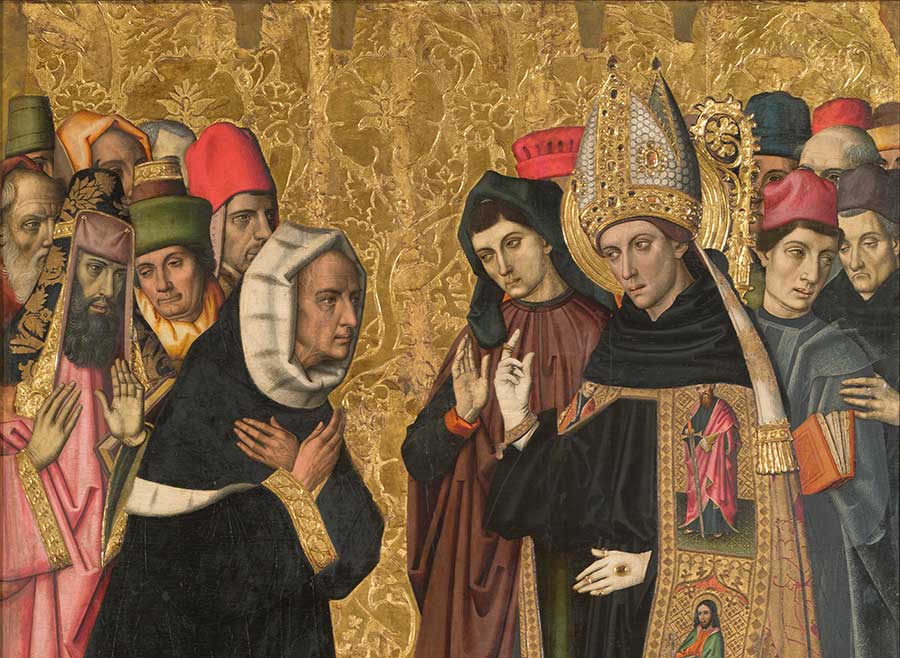
When Augustine finally gave his life up to Christ, it was to allow the Lord to sever the bonds that bound him to the corrupt courses of his past. It did not just mean that he would no longer seek the pleasures of the bedchamber. It meant that he would enter one community, the Church, a true community though populated by the common run of human sinners, such as we are, and leave several pseudo-communities or anti-communities he had once belonged to, regardless of the degrees and kinds of human goods he might find there.
The Import of a Sign
Let us come to the details. Augustine gave up his position as a teacher of rhetoric, because he saw it as corrupt at the root—as instruction for young men in how to bandy words in the law courts, not in the service of truth but of wealth and ambition. Now, there is nothing inherently wicked in the decorous and intelligent choice and arrangement of words. Far from it—it is a good thing, and Augustine would spend the rest of his literary life putting his old instruction in the humanities to powerful use in preaching the word of God.
But Augustine made a clean break with—what shall we say—the community of rhetoricians, a network of professional connections and personal friendships. Whether another man in his place must needs have made that break, I cannot say. Much would depend on the specifics of the common instruction, the worldly temptations the work would present, and the import, for the general public and for members of the Church, of the sign:for our deeds are also signs, and the meaning of a sign is not in the determination of the individual. A human sign means what the common people take it to mean, and he who intentionally gives the sign intends the expected and foreseeable interpretation.
Repudiating Both Action & Sign
Augustine also had to break with the Manicheans. This, too, was not simply a turn in the mind. The Manicheans did form a community or quasi-community. They knew one another. They helped one another find employment. No doubt they cared for Manichean widows and orphans. They were united, so to speak, by their energetic contempt for the Old Testament and for much of the New, and by their enthusiastic devotion to the ravings of the self-described holy spirit, Mani. I am sure the Manicheans threw many a social soiree, with rich food and drink for the commoners, and conspicuously abstemious fare for the “saints.”
You can build up plenty of powerful memories that way: smiles, slaps on the shoulder, discussing a false god while reclining on couches set outdoors on a balmy summer evening; surely the Manicheans were not completely devoid of natural goodness. Even Faustus, the Manichean bishop who Augustine once hoped could settle all his doubts, was a man of considerable personal charm and even natural modesty. Snares of the devil, Augustine would later say. And why not? If you want to lead a man to his damnation, natural sweetness and light—beeswax and honey—are always ready to hand.
Had Augustine continued to hang around with the Manicheans, it would be as if an alcoholic continued to work at a liquor store—but with a couple of considerable differences. First, there is nothing inherently wicked about taking a drink; but what the Manicheans believed and preached about God and the created world was blasphemous and ineluctably destructive to the human soul. We are not talking about stale bread instead of a feast. We are talking about poison.
Second, there is nothing inherently significant about working at that liquor store: the common people do not take it as a sign. If I say, “I am a dentist,” all I mean is that I am a dentist. If I give up my dentistry but attend a convention of my old friends in tooth-drilling, that, too, has no power as a sign. Dentistry has no charge, carries no moral freight beyond the specifics of the work. But if I say, “I am a pornographer,” that does indeed signify:it means that I believe that sexual relations are not sacred, not to be bound only to the haven of marriage.
When I enter the Church, then, I must repudiate the action and the sign. I do not say, “I am a pornographer, but I don’t make movies anymore,” nor do I go watch the production of such. But I also do not make myself visible to the public as belonging to the “porn community”—and surely there must be such a thing. Shame alone should keep me from doing so, but if shame is insufficient, surely charity should prevail. For the last thing I would want to do would be to suggest, in the slightest, that what I did was all right. That would be to set a snare in the path of my brothers and sisters.
Deliberate Rebellion
But now let us suppose that the Manicheans and the pornographers are inextricably mingled. I mean this: suppose that we have, in the pornography, not a mere denial of the truth, but an “evangelistic” movement preaching what must undermine or invert the Church’s whole understanding of creation and man’s place in it. Suppose that the common people, though they do not grasp the import, know very well that the pornographers represent that movement, and that the Church is at odds with the movement, but that many want the Church to be changed.
Now we are no longer talking about personal sin, intellectual error, or even idolatry. We are talking about rebellion. The front lines are drawn, and the weapons are in place. To then wave the flag of the pornographers while you make yourself visible in the Church is to preach an alternate gospel and to rally to your side supporters from the pews. We are no longer talking about weakness, muddle-headedness, or half-measures. We are talking about a deliberate and direct attack.
Minister, but Abjure the Badge
I trust that the reader will see the difference between any of these situations and our call to minister to those who are lost, as we follow the example of our Lord, who ate with sinners. When Augustine left what had been his life’s work, he surely did not say to himself, “I will never speak with another rhetorician again.” Far from it. To read his Confessions is to enter the company of a man who learned by bitter experience the harm of keeping bad company, but who also learned by sweet experience, and perhaps more dreadful experience, the blessedness of being ushered by God into good company. As the wise bishop Ambrose never disdained to meet the young teacher and to speak with him when he could, so Augustine, following Ambrose’s example, must not have disdained in his turn to speak with young people entangled in the sins that had entangled him. That is, in fact, one of the main reasons why he allowed his flock and his fellow bishops to prevail upon him to write the Confessions in the first place.
But it is one thing to eat with a sinner, and another to wear his badge. It is one thing to minister in front of a brothel, and another to enter it, watch a ballgame on television in the lobby, have a few drinks, and jest with the customers.
The former is to take things from the vantage of the evangelist, who works from within the Church to reach those who are without. From the vantage of those who have been evangelized, who enter the Church from without, we must insist, for their own good, for the good of the vulnerable, and for the integrity of the gospel we preach, that they make a clean break not from actual sin—impossible for fallen man in this world—but from a commitment to or approval of sin, and especially from all words and actions that signify such commitment or approval, even from words and actions that signify indifference.
The SS guard is welcome to the Church, as himself and not as an SS guard:he must not only cease from such employment, but he must also abjure the signs that preach the Nazi doctrines abroad. The pornographer is welcome to the Church, as himself and not as a pornographer:he must give up that evil work and throw the Playboy signs and badges into the trash where they do indeed belong, regardless of how kind and generous various members of that club have been to him.
No Alternate Gospel
Someone here may object that I am treating certain classes of sinners in an especially severe way, while other classes get away with whatever their chief sins happen to be, even murder. Again, we must make distinctions. The petty thief falls to temptation, and if he steals, he should confess and make restitution, but he can certainly enter the Church without making any changes in how he presents himself in public. That is because, presumably, he is not a member of a quasi-community of thieves who appear to the public as such, with their characteristic and publicly recognized signs.
The man who sometimes fails to resist the evil pull of looking at porn can also enter the Church without making any changes in how he presents himself in public. He must confess his sin and pray for the grace of God so that he shall never commit the sin again. It may not be too much to say that he must—or at least the healthy part of him must—prefer that God should take him away by death rather than that he should fall into that grave evil once more. But there is no quasi-community for him to leave, and no signs for him to abjure.
Neither he nor the thief is preaching an alternate gospel. When you enter the Church, you do genuinely submit to its authority to teach you, and though you may often be a slow or grouchy student, you must at the very least give up all intention to preach against it, and in this regard there are no half-measures.
Some Decency Retained
What, finally, about those quasi-communities? Let us graciously grant that human beings do not lose all their humanity, such as it is, no matter how evil is the cause to which they have given themselves. Dein goldenes Haar, Margarete, writes the Nazi chief of the concentration camp to his beloved, in Paul Celan’s chilling poem Todesfuge, “Fugue of Death.”If you told me that the Aztec emperor Montezuma might leave the temple after a particularly bloody day of human sacrifices, to exchange kindly words with one of his mistresses and play with their little child,
I would easily believe it. When Milton’s Satan insists on going to the new created world alone, the other devils praise him for it—fulsomely, to be sure, but it is something:
Nor failed they to express how much they praised,
That for the general safety he despised
His own: for neither do the Spirits damned
Lose all their virtue, lest bad men should boast
Their specious deeds on earth, which glory excites,
Or close ambition varnished o’er with zeal.
Of course, we Christians must do the decent things at least as well. Let our contemporary Julian the Apostate grumble that the Christians take better care of pagans who are poor or sick than the pagans themselves do. We must invite sinners into a genuine community of mutual trust, concern, and love, love for one another and for God.
Not in Control
And that brings me back to the beginning of this essay. We are not, as individuals, in control of what the signs we employ must mean; in fact, the signs we employ exert considerable influence over us, over what we think and do, and even over what we can conceive to be thought or done.
Take the word “community,” whose etymology suggests duties to be shared and goods to be enjoyed not individually but as a people. Replace it with “conspiracy,” literally a breathing-together or whispering campaign of thieves or traitors. Or replace it with “cabal,” suggesting, from the medieval sense of the Jewish qabalah, a group of people with secret knowledge and, as we use the word now, a group of people sharing such secrets in order to secure for themselves positions of power.
Or replace “community” with “club,” a relatively innocuous thing in itself, focused on hobbies perhaps, or ethnicity, or social exclusiveness—a haven for stamp collectors, Portuguese Americans, or graduates of Princeton. But then replace “club” with “clique,” with all the smugness and snobbery that make the group a clique rather than a club. See how that changes our sense of the thing?
Any group of human beings whose unifying principle is in itself wicked does not warrant the name of a community, regardless of the sometimes virtuous actions of its members, just as the Church is the Church regardless of her members’ inevitable sins. We may call it a conspiracy, because the people in it do blow the bellows to each other’s fires; a network of evil hot spots, of connections to be made for the principal purpose of pursuing, enjoying, purveying, and promoting the evil.
A man may go to a gay bar to watch a ballgame, but that is not why there are gay bars. The friend he meets there may help him out with the bad plumbing in his house, but that is not why there are gay bars.
We may call the group a cabal, because the people in it believe themselves to be privy to special knowledge and experience, to be used to secure influence for themselves and to work as leverage against their opponents. We may call it a club, when satiety or inattention or a dull afternoon keeps thought and action at bay. We may call it a clique, as its members believe themselves to be superior to others, “special” in some way, and as they employ signs to advertise their superiority. But it is not a community.
The True Community
Jesus did not “reach out” to conspiracies—he had nothing to do with the Zealots as such. He did not “reach out” to cabals—he had nothing to do with the Essenes as such. He did not “reach out” to clubs or cliques—he had nothing to do with Pharisees, Sadducees, Roman Veterans of Foreign Wars, or Idol-Worshipers Abroad, as such. He reached out to this sinner and that sinner, wherever they were to be found, to invite them into the true community, that of the Church.
Deck the Temple in all the colors of our contemporary rainbow. Set colossi of Julius Caesar and Augustus in the imperial courtyard of Tiberias. Build the Autobahn, drape the brothels of Las Vegas in lights and strings of diamonds, heap a thousand honors upon schools that conspire in the heady pleasures of common hatred—and grant to all the members of such circles the ordinary virtues of mankind, exercised with consideration for one another. To all of it the Lord says what stunned his apostles—and what should stun us, too—that not one stone shall remain upon a stone.
Anthony Esolen is Distinguished Professor of Humanities at Thales College and the author of over 30 books, including Real Music: A Guide to the Timeless Hymns of the Church (Tan, with a CD), Out of the Ashes: Rebuilding American Culture (Regnery), and The Hundredfold: Songs for the Lord (Ignatius). He has also translated Dante’s Divine Comedy (Random House) and, with his wife Debra, publishes the web magazine Word and Song (anthonyesolen.substack.com). He is a senior editor of Touchstone.
A Journal of Mere Christianity—Delivered to Your Door
- Essays on theology, culture, and the Church
- Contributors from across the Christian traditions

Six print issues (one year) of Touchstone, plus full online access and PDF downloads for only $39.95.

Get a one-year full-access subscription to the Touchstone online archives for only $19.95.
bulk subscriptions
Order Touchstone subscriptions in bulk and save $10 per sub! Each subscription includes 6 issues of Touchstone plus full online access to touchstonemag.com—including archives, videos, and pdf downloads of recent issues for only $29.95 each! Great for churches or study groups.
Transactions will be processed on a secure server.
more on Culture from the online archives

32.6—November/December 2019
Historical Truth, Beguiling Stories & Three Kinds of Hearers by Anthony Esolen
20.7—September 2007
Paul Didn’t Build Bridges to Popular Culture by Russell D. Moore

more from the online archives

24.1—January/February 2011
Ruminations on the Monstrous Envy of the Soul-Devouring State by Anthony Esolen

31.4—July/August 2018
Labels & the Ecumenism of Discipleship by James M. Kushiner

33.3—May/June 2020
On Flight & Fight in the Present Tribulation by Douglas Farrow
calling all readers
Please Donate
"There are magazines worth reading but few worth saving . . . Touchstone is just such a magazine."
—Alice von Hildebrand
"Here we do not concede one square millimeter of territory to falsehood, folly, contemporary sentimentality, or fashion. We speak the truth, and let God be our judge. . . . Touchstone is the one committedly Christian conservative journal."
—Anthony Esolen, Touchstone senior editor
