




Praise Everlasting, Rest Eternal
Ken Myers
In 1885, Mrs. Jeannette Meyers Thurber—a New York socialite and wife of a prosperous grocery wholesaler—founded in Manhattan the National Conservatory of Music of America. In her student years, Mrs. Thurber had studied at the Paris Conservatory and came to appreciate the importance of the role of the arts in nurturing national identity. The American Founders, however, and several generations of their practically minded heirs, were significantly less confident about encouraging the pursuit of beauty than their Old World predecessors had been. “Democratic nations,” observed Alexis de Tocqueville, “cultivate the arts which serve to render life easy, in preference to those whose object is to adorn it. They will habitually prefer the useful to the beautiful, and they will require that the beautiful should be useful.”
The daughter of an immigrant violinist from Copenhagen, Jeannette Thurber found this negligence disturbing. She lamented that “America has, so far, done nothing in a National way either to promote the musical education of its people or to develop any musical genius they possess, and that in this, she stands alone among the civilized nations of the world.” Several other philanthropists helped her launch the conservatory, which benefited from the leadership of its first director, the famous baritone Jacques Bouhy, a product of the conservatories of Liège and Paris. When he returned to Europe in 1889, Mrs. Thurber began a quest for a new director, and finally persuaded Antonin Dvořák—after relentless badgering via letters, telegrams, and personal emissaries—to come to America.
The Te Deum
Dvořák arrived in New York in 1892, conducting his first concert at Carnegie Hall on October 21, an event commemorating Columbus’s arrival in the New World 400 years earlier. Mrs. Thurber had asked Dvořák to compose a new work for the occasion, and the result was his setting of the Te Deum for soprano and bass soloists, chorus, and orchestra. For centuries, this fourth-century liturgical text has been a regular feature in Christian liturgies, but compositions based on this semi-credal hymn of praise have also been performed in large, public celebrations (e.g., Sir William Walton’s Coronation Te Deum, written for the coronation of Queen Elizabeth II in 1953).
The Te Deum naturally falls into three sections, but Dvořák—possibly influenced by the traditional structure of symphonies—divided the text into four movements. The first of these bursts out in what one critic describes as “a spontaneous blaze of jubilation,” ignited by energetic triplets played on timpani, soon joined by strings and woodwinds repeating a fluttering phrase, accented by syncopated octaves played by trombones and tubas.
After ten measures, when all is a-boil, the choir enters with “Te Deum laudamus”—“Thee, God, we praise”—sung in simple and insistent phrases. When the choir sings, “To thee all Angels cry aloud,” voices and instruments intensify the sound, which continues until the words “Sanctus, sanctus, sanctus,” which are then sung quietly, with significantly reduced accompaniment. This diminuendo is a signal for a drastically slower tempo and the first entrance of the soprano soloist, who sings “Holy, Holy, Holy, Lord God of Sabaoth; Heaven and earth are full of the Majesty of thy glory.” Beneath her somber solo we hear quiet chords from the choir, punctuated occasionally by bird-like phrases by a solo flute and a solo English horn. The movement ends with a fortissimo reprise of the opening words of the text.
The second movement begins with a brass fanfare before we hear “Thou art the King of Glory, O Christ” sung by the bass soloist, who alternates with the upper, then the lower, voices of the choir, through the words “whom thou hast redeemed with thy precious blood.” Critic Nick Jones writes: “Dvořák is reported to have been deeply affected by these lines . . . and they are given one of his loveliest melodies.” The third movement—in an agitated triple meter, like the Scherzo of many symphonies—gives the soloists a break, while the choir is often heard in quiet unison or octaves, predominantly in a minor key: “Make them to be numbered with thy Saints in glory everlasting. . . .”
The soprano soloist introduces the final movement devoutly: “Vouchsafe, O Lord, to keep us this day without sin.” She is joined eventually by the chorus and the bass soloist, who conclude the work with an amendment to the hymn’s traditional text—“We bless the Father and the Son with the Holy Spirit”—and one of the most dramatic and jubilant “Alleluias” in the repertoire.
The Requiem
When this Te Deum was first sung, each movement was reportedly interrupted by rapturous applause. It’s hard to imagine a similar response to Dvořák’s Requiem, which had premiered in England a year earlier. More mysterious and more complex, it is also much larger (a performance takes about 90 minutes) and demonstrates how great music—like a good life—takes time to be what it is. Having been commissioned by the Birmingham Music Festival to compose a major choral work, Dvořák had considered producing an oratorio based on John Henry Newman’s The Dream of Gerontius, but, as critic Tom Janssens explains, he “felt that he lacked insight into the nuances of the text, and decided to write an opulent Requiem instead.” (Edward Elgar set Newman’s poem in 1900, with much success.)
Rather than trying to outline this entire composition (a summary that would fill several pages), let me entice readers to listen to the work itself, an enticement that may be effected by presenting the first and the most important five notes of the piece:
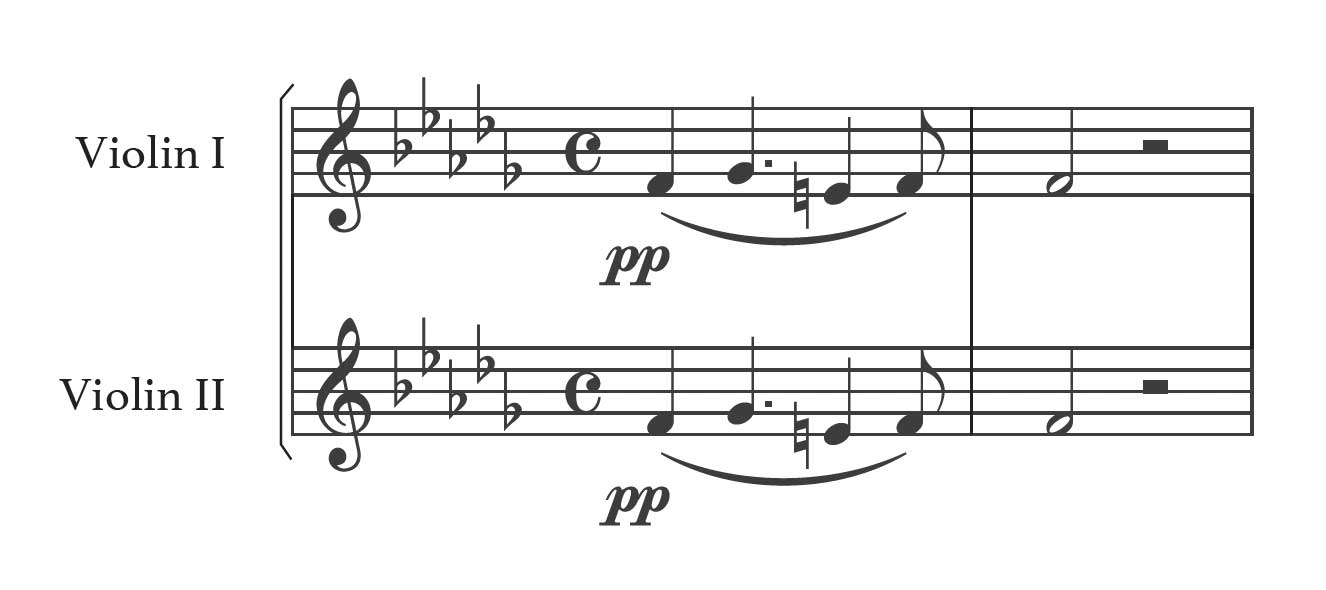
Up a half-step, down a whole step, and up a half-step again, returning to where we started. It couldn’t be simpler. But those several notes, heard dozens of times in numerous configurations, impart to this sprawling composition a coherence and gravity that is indescribable; it is evidence of how the essence of musical meaning defies—transcends—translation into words. Tom Janssens writes:
Dvořák employs a short chromatic motif, which his biographer Otakar Šourek suggested might represent ‘the remembrance of death.’ It is there in a quiet way from the very beginning, sighing out from the violins and cellos before expiring on a long note. . . . The little motif steals doggedly into every movement of Dvořák’s grand work, taking centre stage at key dramatic moments, as if Dvořák were continually trying to remind the listener of the reason for his Requiem: the omnipresence of death.
His Requiem may be Dvořák’s most original and reverent work, but it is sadly neglected. In biographer Neil Wenborn’s judgment, “Although the work is by no means deficient in drama, it never aims at theatricality, and perhaps for that reason has not become as regular a feature of concert programmes as the nineteenth-century Requiems of Berlioz, Verdi and Fauré.”
When that little musical motif described above is heard in the final measures of the Agnus Dei, one may sense the inevitability of death. But the coherence of the structure of Dvořák’s work reminds us that both life and death have an intelligibility and meaning in light of an eternal rest. Grief for the departed is fitting, but hope is grounded in the Logos who is life and love.
Ken Myers is the host and producer of the Mars Hill Audio Journal. Formerly an arts editor with National Public Radio, he also serves as music director at All Saints Anglican Church in Ivy, Virginia. He is a contributing editor for Touchstone.
A Journal of Mere Christianity—Delivered to Your Door
- Essays on theology, culture, and the Church
- Contributors from across the Christian traditions

Six print issues (one year) of Touchstone, plus full online access and PDF downloads for only $39.95.

Get a one-year full-access subscription to the Touchstone online archives for only $19.95.
bulk subscriptions
Order Touchstone subscriptions in bulk and save $10 per sub! Each subscription includes 6 issues of Touchstone plus full online access to touchstonemag.com—including archives, videos, and pdf downloads of recent issues for only $29.95 each! Great for churches or study groups.
Transactions will be processed on a secure server.
more on Music from the online archives
33.3—May/June 2020
Bach's Cantata BWV 106, Gottes Zeit ist die allerbesteZeit (God's time is the very best time) by Ken Myers
more from the online archives

37.5—Sept/Oct 2024
Why Law Schools Can't Teach Law
A sidebar to How Law Lost Its Way by Adam MacLeod
32.5—September/October 2019
on the Inhuman Transformation of Transgenderism by Anthony Esolen
22.3—April 2009
Neil Postman's Amusing Ourselves to Death: Public Discourse in the Age of Show Business by J. Daryl Charles
calling all readers
Please Donate
"There are magazines worth reading but few worth saving . . . Touchstone is just such a magazine."
—Alice von Hildebrand
"Here we do not concede one square millimeter of territory to falsehood, folly, contemporary sentimentality, or fashion. We speak the truth, and let God be our judge. . . . Touchstone is the one committedly Christian conservative journal."
—Anthony Esolen, Touchstone senior editor
