





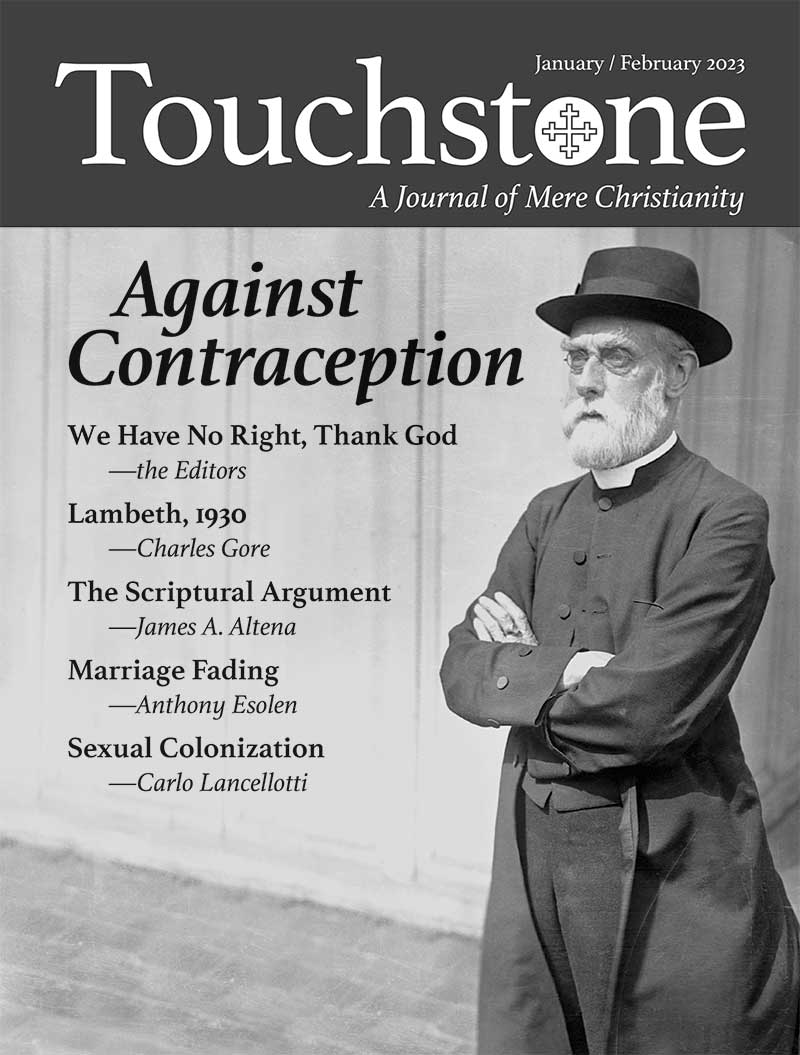
Marriage Fading
Revolutionaries to the Romantics: Drop Dead
We Christians in the West are suffering a dreadful crisis in vocations, dreadful but forgotten, though how we can be so oblivious to it is hard for me to fathom, since it is all around us. Perhaps that itself is the reason. It is too near. It may be too painfully near. We are all implicated in it. We are like a man who forgets where his checkbook is because he would rather not look inside it. The crisis I am talking about is in the vocation to marriage.
On Thursday, October 30, 1975, one of the most famous headlines in American journalism appeared on the front page of the New York Daily News. It read simply, “Ford to City: Drop Dead.” The city was nearly bankrupt from its own bad fiscal policies, and it had appealed to the federal government to bail it out. The appeal was couched in terms of a threat. If New York City went under, Mayor Abe Beame and Governor Hugh Carey suggested, the economy of the whole nation would stagger. But the president, Gerald Ford, would have none of it, and he bristled at that hint of economic blackmail. He did promise that Washington would make sure that urgent and necessary services, not including public education, would continue.
New Yorkers, predictably enough, reacted with anger and resentment. It probably cost Ford his chance to be re-elected in 1976, when he lost New York and its 41 electoral votes to Jimmy Carter, by a slim margin. But he did what he believed was right, avoiding what would have been thought by many, at that time, to be constitutionally impermissible.
The Lonely Revolution
Why I bring this up will soon be clear. The situation applies, in a peculiarly vicious and treacherous way, to what is going on now with marriage and the churches, both in America and in the Western world generally. But first let me make this clear: if grace perfects nature, if the seedbed of the Church is the ecclesia domestica, the church of the well-ordered home and hearth, then the land has been put to the torch, and the swamp nearby has been allowed to breach its banks and to spill its filth into what used to be green fields.
The statistics are horrible. There is no way to paste a smile on them. I will use my own church for an example. In 1970, there were more than 426,300 Catholic marriages in the U.S., then a country of 205.1 million people. In 2021, there were 97,200 Catholic marriages, in a country of 329.5 million people. Put those two statistics together, and you have a collapse of 86 percent.
And that does not capture the whole of the problem. It understates it considerably. It passes by the 40 percent of American children born out of wedlock, with all the terrible pathologies that go along with fatherlessness. It passes by the 40 percent of marriages that end in divorce. It passes by the fact that in America, people are marrying later than ever before—the median age standing at about 29 years.
The sexual revolution really is the Lonely Revolution, whereby we live as if we were meant to be islands unto ourselves, especially during what should be the years of our greatest social energy and joy. “Rejoice with the wife of thy youth,” says Solomon; “let her be thy dearest hind, and most agreeable fawn; let her breasts inebriate thee at all times; be thou delighted continually with her love” (Prov. 5:18–19). Who can now understand those words? The way of life—rather a way of death—that our young people enter sexually prepares them for marriage by a series of disappointments, treacheries, sexual liaisons without love, cold dull lust, and sullen rejection of the opposite sex. It is to have the dead soul of someone who can no longer sing a love song without the snarl of irony.
A Fall Within the Fall
When St. Paul sums up his evaluation of fallen man, he describes a kind of fall within the Fall. First, men “changed the truth of God into a lie; and worshiped and served the creature rather than the Creator” (Rom. 1:25). Then God delivered them over to their vain imaginations, and they ended up losing their hold upon nature besides, “for their women have changed the natural use into that which is against nature, and, in like manner, the men also, leaving the natural use of the woman, have burned in their lusts toward one another” (1:26–27).
And yet it is still telling that Paul can write those words, and can associate them with the folly of idolatry and with the wickedness of a long list of sad and miserable sins, and can expect everyone to understand it and not to take it ill. He can also follow the lead of our Lord himself. Not using a mere metaphor, but expressing a metaphysical reality, Paul calls the Church the Bride of Christ. “For this cause,” he says, repeating the mighty words of Genesis, as Jesus himself did, “shall a man leave his father and mother, and shall cleave to his wife, and they two shall be one flesh. This is a great sacrament; but I speak concerning Christ and the Church” (Eph. 5:31–32). So, too, the beloved disciple John, beholding the New Jerusalem, sees it “coming down out of heaven from God, prepared as a bride adorned for her husband” (Rev. 21:2). For we are invited to the great and ultimate wedding feast, the feast of the Lamb, and “the Spirit and the Bride say, ‘Come’” (22:17).
I dare say that the first Christians, and even those pagans who heard these words but who did not turn to Christ, did not have to work their imaginations hard to understand them. But for us the words have become vague, gauzy, indistinct. What is a wedding but a party to celebrate mere affection between two persons regardless of sex, with only a pro forma promise of permanent fidelity, a bit of antiquarian lace? But I am not merely decrying how we now marry. The stunning and disheartening thing is that marriage itself is fading fast, in numbers, in social influence, in political power, and in the hearts and imaginations of all people, even among those who attend religious services.
What we have now is, I believe, the worst calamity to befall mankind since Adam and Eve ate the forbidden fruit and sought their good from themselves, or from a mere created thing, rather than from God. I do not mean that we are the worst sinners the world has known. I mean that as terrible as human history has often been, with plague and famine and war, man has never, in principle, denied his own sexual being. Never has it been assumed that the interests of the sexes were severable, that man was not for woman and woman was not for man.
That is the essential feminist lie, which until recently could get no traction, for the simple reason that people needed to survive from one winter to the next, and so the sexes could hardly pretend to get on without one another. That is still the case, I believe, but our wealth and our technology insulate us from feeling the lie’s consequences so directly and severely. We can engage in the experiment against reality, and not worry about getting the wheat crop in; while the poorest among us lose their best chance to work their way out of poverty via the strong and youthful family.
The Testimony of Love Songs
The diabolical and murderous purpose of that lie, I said to a stunned liberal colleague 25 years ago, losing his friendship for good, is to kill love between man and woman. If feminism was supposed to give us a female Michelangelo or Isaac Newton, it has failed. It seems more likely to keep us from getting the boy geniuses that become Michelangelo or Newton. But at its diabolical task it has been a smashing success.
Let the old love songs testify: “And for bonnie Annie Laurie, I’d lay me doon an’ dee.” I do not ask where are the Scotsmen who write such words now. I ask where are the men who feel those feelings. I ask where are the women who inspire the feelings. Here is a stanza of a song the like of which has not been written in many years, and whose aching and longing for the lost love is incomprehensible to young men now—and to young women also:
I long for Jeanie with the day-dawn smile,
Radiant in gladness, warm with winning guile;
I hear her melodies, like joys gone by,
Sighing round my heart over the fond hopes that die,Sighing like the night wind and sobbing like the rain,
Wailing for the lost one that comes not again.
Oh, I long for Jeanie, and my heart bows low,
Never more to find her where the bright waters flow.
If you doubt me on this, I ask you to name the current love song best known and cherished by people of all ages. Are there any love songs at all? Name a single feature of popular culture, a single wholesome custom, that teaches boys and girls about each other, about how to admire and appreciate the other sex, about how to fall in innocent love, and how to prepare for what ought to be real life for almost every human being on earth, the life of married love.
Name one.
In 1943, in the town of Warner, New Hampshire, where I live, there were dances at the town hall every Saturday night, even while more than a hundred young men from the village were enlisted in the army and far away. I can show you a photograph of a ten-year-old boy dancing merrily with a grown woman, which the author of an article about Warner in Life magazineobserved he liked best to do. I will wager there has not been a single such a dance here in thirty years.
Church Leaders’ Betrayal
And now I come to the churches. What have they been doing lately? Put the case. Here is a young woman who will not go bed-hopping to find a husband. Do not believe that an on-line dating site or two can make up for the loss of thousands and thousands of ordinary human ventures everywhere in the land—for the loss of the dances, the ice cream parlors, the bowling alleys, the amusement parks, the public lakeside beaches with concession stands and arcade games, the countless ways in which boys and girls could get together and have fun, usually along with people of all ages.
I imagine her going up to Bishop Robert McElroy, a gay-friendly fellow to whom Pope Francis has recently given the red hat. She pleads with him to affirm what the Church teaches. She says that the loss of the sense that the man is for the woman and the woman is for the man, the thorough abrogation of the moral law that says that sexual intercourse is for a man and a woman in marriage, and all the evil and self-destructive means that people have used to try to assuage the resulting loneliness, like drink that dulls the senses and makes you want to drink all the more, have made it practically impossible for her to find a decent man to marry.
What does the new cardinal say? What the rest of society says, the society he follows along with, like the ingratiating fat boy who hangs around his friend the athlete so that he can be on the inside with the people who matter. Oh, he will not be brusque about it. That’s not to his taste. But it amounts to the same thing. Cardinal to lonely young woman: “Drop Dead.”
Put another case. You have a young man growing up without a father. His sense of masculinity is often tenuous. He does not want to be attracted to other boys, but he sometimes is, despite himself. Still, he has not acted on the attraction, and he longs to marry in the ordinary way of nature. But the same moral law that forbids him to seek consolation in unnatural ways forbids him also to try to establish his masculinity on the firm basis of experience with girls. And the last girl who approached him laughed in his face when he demurred, and called him a foul name. He will hear that laugh all the rest of his life. So he goes to the pastor of Our Lady of Perpetual Progress, which celebrates a special rainbow Mass in June for Pride Month. He asks for help in rejecting the unnatural and building up the natural.
What does the pastor say? What the rest of society says, the society he follows along with to get invited to the best banquets, because he is far more comfortable around sexually loose worldlings than he is around men trying to be virtuous in a very bad time. Pastor to uncertain young man: “Do what you like; go with your heart. Jesus loves you. It isn’t a big deal.” And he gives him a nice squeeze of the shoulder. In other words: “Drop Dead.”
But my comparison with Gerald Ford is, in the most crucial respect, not apropos. It was New York, not Washington, that was profligate. New York was begging for help to duck the consequences of her sins. That is not the case here. The young man and woman do not want to pay the price of grave sin to be lonely no more. They want to do the right thing. It is the Church in her practical life, in her most public presentation of herself, who has been the wastrel.
It is as if a poor but still Christian town somewhere in Appalachia, taxed near to death, were to appeal to fat, rich Washington for just a little recognition, a little assistance, the mere occasional acknowledgment that the poor town does not deserve its fate, and that the law of the nation and the law of God are with the town and not with the spendthrift capital. But the powers shrug and say, “There’s nothing we can do,” while acting so as to perpetuate and aggravate the town’s condition.
“If you will not help us,” say the few faithful young people to church leaders decking themselves in the garb of every sexual innovation that thrusts a dagger at the heart of the truth that man is for woman and woman is for man, “will you at least stop hurting us? Will you at least stop celebrating with our enemies?”
“Drop Dead,” they reply.
Our Task Now
It is long past time for us to forget about the traitors, whether they are motivated by malice or blockheaded refusal to see what is in front of their noses. When Adam and Eve sinned and saw that they were naked, they wreathed some large fig leaves together for a makeshift garment, so they would not have to look upon their shame. But God did not leave them in that pathetic state. As soon as he delivers to them the punishment they will suffer—punishment which conceals a blessing, since Adam will eat bread and Eve will have children—he condescends to their incapacity: “And the Lord God made for Adam and his wife garments of skins, and clothed them” (Gen. 3:21).
If God would do that for the perpetrators of that first Fall, we in the Church, we who are by no means sinless, should do all we can for those among us who are innocent, or who are trying very hard to be innocent, in the midst of the new fall within the Fall, into the terrible and apparently bottomless crater beneath our feet. It is our task now to recover the natural things. No one else will do so.
What it requires of us, at the least, is to give no quarter to the great and fundamental lie, the lie that says, essentially, that it is good for the man or the woman to be alone, because man is not for woman and woman is not for man—and I am speaking not statistically, not of the general case, but absolutely, naturally, as created by God. We must stop telling that lie in all its forms, the lie that contradicts the verse so near to Jesus’ heart, again, that “a man shall leave his father and mother, and shall cleave to his wife, and they shall be one flesh” (Gen. 2:24). And then we need to repair, restore, and build anew.
I am not talking about discussion groups. We have some of those. There is no mirth in them; they are not the place for mirth. Again, keep in mind that every good custom that brought young men and women together, doing things that prompted shouts of laughter, and song, and wonder, and love, has first been poisoned with evil and then left to wither and die. For many millions of young people now, the view before them is either a hellscape of sin and the punishments that sin necessarily brings in the act, or a desert of loneliness and hopelessness.
We must build, always build. I call every church to commit to doing what the town fathers did for Warner eighty years ago. If it is not against your moral teaching, let there be dances, not one or two a year, but time and again, regularly, perhaps every month at first—but always regularly, such as you might show up at casually. Advertise them to the neighborhood.
Get out of the house, get out from behind the screen. Let there be processions and parades. A hundred years ago, as our colleague Allan Carlson has shown, America used to have parades of mothers with their children, and of course those mothers were all married women. Let us celebrate married women and their children once again—and bring out the young people to help cheer.
Before around 1970, in my hometown, the only basketball court was the one on the third floor of our parish school. Both the public school and our school had basketball teams, and that was where they played. Boys played, and girls cheered; and those games, too, were events for the mingling and the meeting of young people, in a healthy and happy way. Let the churches play.
We need here a kind of archaeology, for which that issue of Life magazinemight as well be the Dead Sea Scrolls. We are living in the environs of a new Dead Sea, a region of death that spans entire continents. We need to learn more about what people far removed from us did to get the foundations of their culture established, the foundations of their churches—I mean families, young mother and young father and their shouting and merry children. Far removed from us—for the people alive in America in 1943 were closer in this crucial regard to the people of Jesus’ time, 2,000 years ago, than we are to either. Bowling leagues, concerts, public celebrations, parties, any excuse for a feast—I am afraid that I myself have been born too late to know more than a little of what normal people used to do.
To Fill Our Churches
That brings me to my final point. Imagine Cana, shelled by the air raids of the world. The problem is not just that there is no marriage. The worship of God is fading, too. The two are related.
In that first and encompassing Fall, man sank below man by attempting to be like God. But he was still aware of himself as man, whenever he had to come to terms with the created world around him, the storm against his roof, the beast in the wilds he needed for his food, the corn in ear to be reaped in season. The world was full of terrors and wonders, and each sex was beautiful and mysterious to the other. But now it is not so. Now it is possible not so much to sink below man in fits of sinfulness, but to step aside from man, to fail to attain to full humanity even as fallen.
We are not dealing with pagans whose love songs are too earthy. We are dealing with sub-pagans who have no love songs. We are not dealing with pagans who see gods in the thunder and lightning, and who spill libations to the rich soil beneath their feet. We are dealing with praeter-pagans who have almost no connection to the sky and the soil. We are not dealing with the pagans that Paul said were vain in their imagination. We are dealing with un-pagans whose imaginations, stifled by mass entertainment, have never come to life. In man’s affective life, love and wonder and worship are not so separate after all. God wants man fully alive. Satan is content with grubs.
If we want to fill our churches, we must, in the order of nature, form the human beings who will fill them. Marriage, then, is a necessity. But marriages do not simply happen—certainly not in our time. We must raise boys and girls determinedly, to form young men and young women eager and ready for marriage. But we cannot do that by talk and good wishes. We must act.
The world is against us. Church leaders tell us to get lost. Schools hang rainbow signs that read to every boy struggling to be a man, and to every girl looking for a real man she can marry, “Drop Dead.” But what we must do, we must do. We may dare to add a verse to our Lord’s promise and warning. “Come, ye blessed of my Father,” I imagine him saying, “possess you the kingdom prepared for you from the foundation of the world. For my cousin was single, and you found her a husband. I was single, and you found me a wife.”
Anthony Esolen is Distinguished Professor of Humanities at Thales College and the author of over 30 books, including Real Music: A Guide to the Timeless Hymns of the Church (Tan, with a CD), Out of the Ashes: Rebuilding American Culture (Regnery), and The Hundredfold: Songs for the Lord (Ignatius). He has also translated Dante’s Divine Comedy (Random House) and, with his wife Debra, publishes the web magazine Word and Song (anthonyesolen.substack.com). He is a senior editor of Touchstone.
A Journal of Mere Christianity—Delivered to Your Door
- Essays on theology, culture, and the Church
- Contributors from across the Christian traditions

Six print issues (one year) of Touchstone, plus full online access and PDF downloads for only $39.95.

Get a one-year full-access subscription to the Touchstone online archives for only $19.95.
bulk subscriptions
Order Touchstone subscriptions in bulk and save $10 per sub! Each subscription includes 6 issues of Touchstone plus full online access to touchstonemag.com—including archives, videos, and pdf downloads of recent issues for only $29.95 each! Great for churches or study groups.
Transactions will be processed on a secure server.
more on family from the online archives

24.4—July/August 2011
The Cultural Marxists’ Strategic Assault on Religion, Life & Family by Patrick F. Fagan

32.1—January/February 2019
on Down Syndrome & the Lives That Matter by David F. Watson
36.1—Jan/Feb 2023
A History of the Protestant Debate over Contraception by James A. Altena
more from the online archives

32.1—January/February 2019
Divine Love & the Love of Man & Woman Surpass Mere Consent by Anthony Esolen
28.5—Sept/Oct 2015
on Our Sacred Duty to Teach the Devil to Death by Marcus Johnson
24.6—Nov/Dec 2011
on the Tyranny of Modern Freedom versus the Freedom of Jesus by Gillis J. Harp
calling all readers
Please Donate
"There are magazines worth reading but few worth saving . . . Touchstone is just such a magazine."
—Alice von Hildebrand
"Here we do not concede one square millimeter of territory to falsehood, folly, contemporary sentimentality, or fashion. We speak the truth, and let God be our judge. . . . Touchstone is the one committedly Christian conservative journal."
—Anthony Esolen, Touchstone senior editor
