




Culture Clash
An Ancient Festival's Enduring Lessons
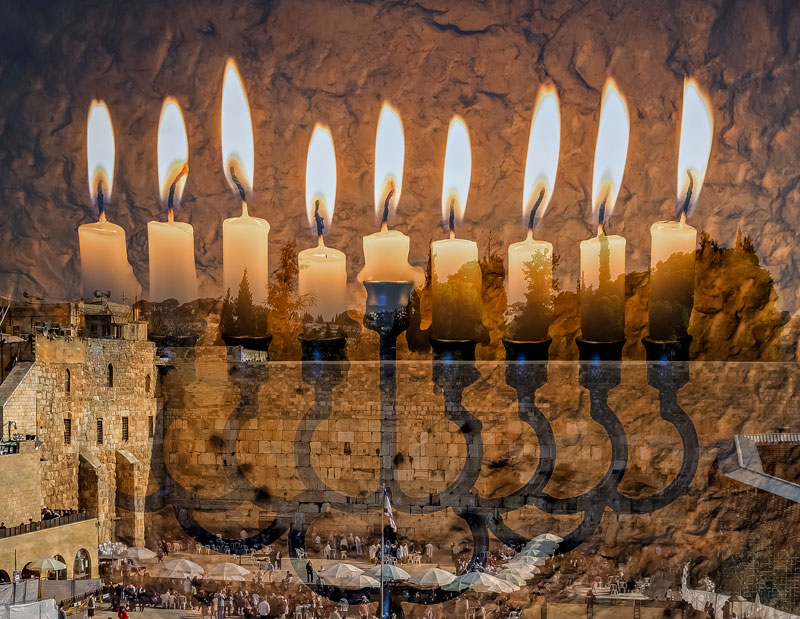
Back when I was still young and strong enough to pastor a congregation, I made sure, each year, that our folks did at least something—usually a Vespers service—to mark the Jewish festival of Hanukkah. After all, I reasoned, Jesus observed it (cf. John 10:22). In our popular culture, I fear, the lessons of Hanukkah are rather general and abstract. One suspects that few Americans think of the festival as the anniversary of an "event." Much less, perhaps, do they suspect which event.
Well, the event was the purification and rededication of the Second Temple (on December 14, 164 b.c.) after its defilement by Hellenic pagans three years earlier. The hero most notably responsible for that salutary enterprise, -Judas Maccabaeus, decreed an annual feast of eight days to commemorate it. One wishes that history were better known among us now.
In the beginning of the second century before Christ, the religion of the Holy Land endured what today we call "culture wars." Many Palestinian Jews, chafing under the restrictions imposed by the reforms of Ezra and Nehemiah, coveted the softer life represented in the ambient Hellenic culture. This was especially true of the ruling class, and more particularly of the priestly family. The high priesthood itself became a political prize, sold to the highest bidder.
Among those who reacted to this cultural apostasy, mention should be made of Ben Sirach, who wrote his book near the beginning of the second century. Just below the surface of Sirach's important work lay a deliberate cultural polemic. His purpose included a vindication of the superiority of Jewish religious culture over the Hellenism of Judea's overlords.
The Jews found themselves forced into conformity with the worldviews and cultural standards of paganism, on a scale surpassing their experience of Assyria, Babylon, and Persia in the past. The Jewish religion had been able to survive the Babylonian Captivity. Now, the question was, could the Jewish religion even survive in the Holy Land!
The height of the outrage came on December 7, 167, when an altar to Zeus was erected in the Temple itself (cf. Dan. 11:31), constructed over the traditional altar to the Lord before the Holy of Holies. Idolatry became rampant, and violent efforts were made to destroy Israel's defining religious literature. Open persecution followed. In response to these developments, the family of the Maccabees arose in rebellion.
A Festival for Cultural Warriors
A major task was to purify and rededicate the Temple. The Jews learned—the hard way—that friendship with the world is enmity with God. The worship of the true God is not something that can simply be attached to a worldly life. The world wants nothing less than to violate the holiness of the Temple, to set up its idols right in the Holy of Holies, the very heart of the life of God's people.
The reaction of Judas and his brothers testifies that the world cannot be permitted to do this. The influence of the world must be kept at a distance from the heart of the identity of God's people.
This was, and is, the real meaning of Hanukkah. Far from being a calm, peaceful, harmless celebration of general spiritual significance, Hanukkah is a festival for cultural warriors, who know the strength of the enemy and the difficulty of the battle.
Patrick Henry Reardon is pastor emeritus of All Saints Antiochian Orthodox Church in Chicago, Illinois, and the author of numerous books, including, most recently, Out of Step with God: Orthodox Christian Reflections on the Book of Numbers (Ancient Faith Publishing, 2019).
A Journal of Mere Christianity—Delivered to Your Door
- Essays on theology, culture, and the Church
- Contributors from across the Christian traditions

Six print issues (one year) of Touchstone, plus full online access and PDF downloads for only $39.95.

Get a one-year full-access subscription to the Touchstone online archives for only $19.95.
bulk subscriptions
Order Touchstone subscriptions in bulk and save $10 per sub! Each subscription includes 6 issues of Touchstone plus full online access to touchstonemag.com—including archives, videos, and pdf downloads of recent issues for only $29.95 each! Great for churches or study groups.
Transactions will be processed on a secure server.
more on Christianity from the online archives
8.4—Fall 1995
The Demise of Biblical Preaching
Distortions of the Gospel and its Recovery by Donald G. Bloesch
33.3—May/June 2020
Human & Divine Societies Require Careful Thought & Discourse by Anthony Esolen

32.4—July/August 2019
on Probability, Death & the Existence of God by Graeme Hunter
more from the online archives
29.5—Sept/Oct 2016
on Past & Present Atheism & the Invention of Happiness by Jordan Bissell


26.5—Sept/Oct 2013
The Perils of Pragmatism in Christian Attitudes Toward the Liberal Arts by Robin Phillips
calling all readers
Please Donate
"There are magazines worth reading but few worth saving . . . Touchstone is just such a magazine."
—Alice von Hildebrand
"Here we do not concede one square millimeter of territory to falsehood, folly, contemporary sentimentality, or fashion. We speak the truth, and let God be our judge. . . . Touchstone is the one committedly Christian conservative journal."
—Anthony Esolen, Touchstone senior editor
