




Esther's Dilemma
Her Wise Strategy in Response to Slavery, Racial Hatred & Genocide
by Stephen Noll
At a pivotal moment in the build-up to the American Revolution, Patrick -Henry famously declared, holding his wrists together in imaginary manacles: "Is life so dear, or peace so sweet, as to be purchased at the price of chains and slavery?" Then dramatically bursting his "bonds," he cried: "Forbid it, Almighty God! I know not what course others may take; but as for me, give me liberty or give me death."
But what if Henry had been an African slave in Virginia, consigned by Almighty God to perpetual bondage? What if his choice then had been slavery or death? There is biblical precedent for this dilemma.
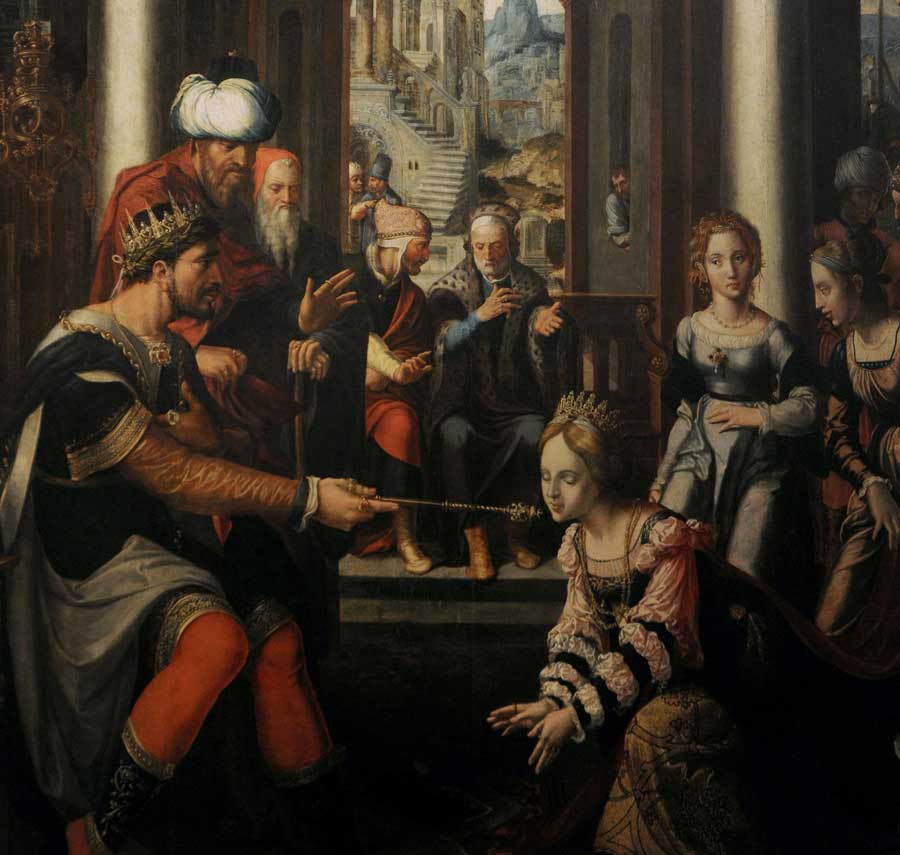
At the climactic moment of the book named after her, Queen Esther approaches the Persian King Ahasuerus (the mighty Xerxes I), informs him of a deadly edict against the Jews, and pleads:
If I have found favor in your sight, O king, and if it please the king, let my life be granted me for my wish, and my people for my request. For we have been sold, I and my people, to be destroyed, to be killed, and to be annihilated. If we had been sold merely as slaves, men and women, I would have been silent, for our affliction is not to be compared with the loss to the king. (Est. 7:3–4; emphasis added)
The King is taken aback: "Who is he, and where is he, who has dared to do this?" Esther's answer is, "This wicked Haman!" Haman, your prime minister! Esther's exposure of Haman leads to his being hoisted on his own gibbet.
But a conundrum remains. Why did the king not know about this deadly edict, and why did Esther argue that her people would not have objected to being sold into slavery? To answer that, we need to go back to the issuing of the decree.
Hoodwinked with a Homonym
Haman the Agagite, it seems, was a descendent of Israel's inveterate enemy the Amalekites, who had attacked Moses and the people of Israel without cause, with dire consequences to themselves (Ex. 17:8–14; cf. the fate of King Agag in 1 Sam. 15). Hence, Haman's instinctive hatred of the Jew Mordecai, heightened by the latter's refusal to bow to him (Est. 3:1–5), morphs into a genocidal plot against the whole Jewish people. Since the Persians did not share Haman's hatred, he ensnares the king by means of a matter of imperial pride: the ironclad law of the Medes and the Persians (cf. Dan. 6:8).
Then Haman said to King Ahasuerus, "There is a certain people scattered abroad and dispersed among the peoples in all the provinces of your kingdom. Their statutes are different from those of every other people, and they do not keep the king's statutes, so that it is not to the king's profit to tolerate them. If it please the king, let it be decreed that they be destroyed, and I will pay 10,000 talents of silver into the hands of those who have charge of the king's business, that they may put it into the king's treasuries." (Est. 3:8–9)
Haman insinuates that Jews, in following their own "statutes," necessarily disobey the royal statutes. Haman uses the Persian word dat for particular "statutes," whereas the Hebrew Torah includes a wider sense of moral instruction, divinely revealed. Jews in exile, like Daniel, were more than willing to observe imperial law so long as it did not violate the first principle of Torah, honoring God alone. Mordecai's refusal to bow to Haman, a conscientious protest against the king's appointing a diabolical Jew-hater as his plenipotentiary, is an extension of this principle.
Haman adds for good measure an economic incentive, arguing that it does not profit the king to tolerate the Jews. To tip the scales further, he offers a personal donation of 10,000 talents to the royal treasury. A savvy king might wonder, is the extinction of an entire people indeed profitable, and where is Haman going to come up with his multi-billion-dollar donation?
Haman hoodwinks the king with a homonym. In Hebrew, the word translated destroyed ('abad) sounds like the word enslaved ('abad), sold into slavery. (Of course, this trope works only in Hebrew, not in Persian, but this fact need not interfere with a good story.) Xerxes, whose empire was undergirded by the labor of captive peoples, did not scruple to add one more.
Good bureaucrat and fool that he is, the king delegates the messy work of implementation to Haman and hands over his signet ring to seal the decree. Haman then commands the scribes to specify that the provincial governors are "to destroy, to kill and to annihilate ('abad) all the Jews, men and women, and to plunder their goods" (Est. 3:13). The first clause nullifies any idea of enslavement, and the final clause explains where the 10,000 talents will come from—no doubt with a hefty surcharge to Haman and his henchmen (shades of the piles of eyeglasses and gold teeth in the Nazi death camps).
Sealed with the royal signet, genocide has now become the irrevocable law of the empire, and Haman is mightily satisfied. Clearly, the king knows not what he has done. Later in the story, when Xerxes learns how Mordecai had saved him from two other conspirators, he commands Haman to parade "Mordecai the Jew" around the city in royal robes on the royal horse. Did he actually intend for Haman afterwards to disrobe Mordecai and hang him publicly? Not likely.
Esther's Clever Appeal
Nevertheless, the law is the law, and Haman is its executor—until Queen Esther intervenes. In the famous dialogue between Mordecai and Esther (Est. 4:12–17), she comes to realize, unlike many Jews in Nazi Germany centuries later, that a Jew-hater like Haman will find her out, and she chooses the mortal risk of approaching the king unasked: "If I perish, I perish." Seeing her, the king—or rather, the hand of Providence—favors her, and she proceeds to orchestrate a sequence of banquets at which Haman begins to fall from favor (his wife Zeresh recognizes that this Providence is not blind but distinctly Jewish—Est. 6:13).
We now return to the queen's appeal at the climactic banquet, in which she reveals for the first time her own Jewish identity, speaking of the threat to "my people." Further, she cites the language of the edict: "we have been sold, I and my people, to be destroyed, to be killed, and to be annihilated." She appeals to the king's profit motive, just as Haman had. She subtly notes the duplicity inherent in the law: "selling" into slavery is a market calculation, whereas extermination is a matter of asset forfeiture. Had the law involved enslavement, she would not appeal, but that was not the case. The scales fall from the king's eyes—"Who has done this?"—and Haman's fate is sealed. Like many a chief executive, the king shirks his own responsibility for the decree, and Esther is not about to say, "Because of your negligence, O King! You are the enemy!"
A problem remains. Haman is dead, but the law is alive and irrevocable. There is only one solution. The king now charges Mordecai, who has replaced Haman as vizier, to issue a second solemn edict authorizing the Jews to defend themselves and to "destroy, kill and exterminate" anyone who would try to carry out the first decree! (Est. 8:7–14). The Jews are more than happy to comply with this second decree, but without taking any plunder (Est. 9:1–19).
Three Key Circumstances
It should be clear by now that the Book of Esther is something of a farce, to be celebrated with hilarity at the annual feast of Purim, one month before Passover; however, the deliverance of the Jews cannot be celebrated without recalling the threat that led to it and the circumstances that led to that threat.
The first circumstance is the law itself. The book portrays with a touch of irony the weakness of the vaunted "law of the Medes and Persians." Although this law looks mighty and fearsome on the surface, sealed by the ring of the Great King, in fact it is morally vacuous in the hands of a fool like Xerxes and dangerous in the hands of a villain like Haman.
In the first scene of the book, the king in a drunken stupor commands Queen Vashti to appear in all her finery at his imperial feast. When she refuses, he feels compelled to issue a royal edict banishing her and further commanding all wives in the realm to obey their husbands (Est. 1:10–22). Next, following the advice of his young courtiers—who else?—he decrees a "Miss Persia" pageant to determine Vashti's successor. Throughout these royal follies, the hand of divine Providence is preparing a way to save the Jews and to provide the king with wise counsel. Esther herself will prove the foil to Vashti's and Xerxes' impetuousness.
The second circumstance has to do with race hatred, embodied in Haman the Agagite. I use the word "race" here advisedly, recognizing that the Bible has no concept of race based on skin color but rather on geography, language, tribe, and, most importantly, nationhood, with its distinct covenant polity (Gen. 11:1–9; Acts 2:7–11; 17:26; Rev. 14:6). Haman's motive, though seemingly opaque like Iago's, is ancestral, going back centuries, no doubt passed on through tribal lore. Often the most horrific acts occur within tribal groups or classes, such as the genocide in Rwanda. But the one constant of history is the persistence of anti-Semitism down to the present.
Haman veils his antipathy by referring to the Jews' different customs, which is reason enough for King Xerxes to consign them to slavery (he thinks), consent for which Haman twists into permission for genocide. Haman's rhetoric is reminiscent of the shabby Darwinian rationales and Lost Cause fables used to rationalize the Jim Crow laws in the post-Reconstruction South. In our day, "anti-racism" witch hunts are being propped up by impenetrable Critical Race Theory, the mythology of ineradicable "white fragility" and/or "white privilege" and the "1619" narrative.
The third circumstance has to do with Esther's willingness to accept enslaving the Jewish people. One can question the seriousness of her offer or see it as a prudential choice of the less horrible of options. Slavery has existed throughout history, in harsher and milder forms. Defeat in battle, deportation, and exile was its common starting point, and while Daniel and Esther and Mordecai might rise as exiles to high station, they were never true Babylonians or Persians, and their status was ever vulnerable to the whims of a ruler or a change of regime. And for all its evils, slavery contains a seed of hope of ultimate redemption, "that we should be saved from our enemies and from the hand of all who hate us" (Luke 1:71).
Underpinned by Hope
The former slave Frederick Douglass was an Esther of his day. Writing in 1854, a decade before the bloody war that ended slavery for good in the United States, Douglass spoke of the twinned destiny of the races: "I have said that the negro and the white man are likely ever to remain the principal inhabitants of this country." He rejected the options of colonization and extermination of blacks as fantastical and concluded:
The history of the negro race proves them to be wonderfully adapted to all countries, all climates, and all conditions. Their tenacity of life, their powers of endurance, their malleable toughness, would almost imply special interposition on their behalf. The ten thousand horrors of slavery, striking hard upon the sensitive soul, have bruised, and battered, and stung, but have not killed. The poor bondman lifts a smiling face above the surface of the sea of agonies, hoping on, hoping ever [his emphasis]. ("The Claims of the Negro Ethnologically Considered," The Portable Frederick Douglass, p. 246)
More than a century later, this hope was eloquently reiterated by Martin Luther King, Jr., in his "I have a dream" speech.
A similar hope may underpin Esther's offer: she sees the Exile not only as divine judgment on the Jewish people but also as a providential act of redemption. The inscrutable God whom the Prophets preached had dispersed his people to the pagan lands and ordered them to build houses there and have children (Jer. 29:5–6). Jeremiah had prophesied a seventy-year exile, and many Jews assumed that God intended them to return home en masse and rebuild. But according to Daniel's vision, the Exile had been extended exponentially due to the pervasive and ongoing sin of the people (Dan. 9; cf. Jer. 34:13–19).
What to make of this indefinite interim period? The Book of Esther portrays a time when Jews suffer periods of persecution but also enjoy periods of peace during which they rise to the highest rank and give guidance from the wisdom of the divine law. But the vision of Esther goes even beyond that. The book never mentions a return to Israel nor any obligation to support the rebuilding project of Ezra and Nehemiah. The Purim festival itself is a kind of second Passover, maybe even a rival Passover (cf. Jer. 16:14–15). In short, the Book of Esther seems to foresee a permanent diaspora in which, rather than all nations going on pilgrimage to Jerusalem to be instructed (Is. 2:1–5; Micah 4:1–5), Jews will take the divine law to the nations.
The Dilemma Answered
Who in Esther's day could have imagined that, five centuries later, redemption from the slavery of sin and fulfillment of the law of love would be accomplished by a Galilean, hung on a gibbet and cursed according to the Law under the auspices of Pontius Pilate, a satrap of the last great empire? Who could have conceived that the gospel of that Galilean (Matt. 4:12–17) would be taken to the uttermost ends of the earth? But so it happened. In the diaspora synagogue at Pisidian Antioch, two diaspora Jews, Paul and Barnabas, "spoke out boldly":
"It was necessary that the word of God be spoken first to you. Since you thrust it aside and judge yourselves unworthy of eternal life, behold, we are turning to the Gentiles. For so the Lord has commanded us, saying, 'I have made you a light for the Gentiles, that you may bring salvation to the ends of the earth.'" And when the Gentiles heard this, they began rejoicing and glorifying the word of the Lord, and as many as were appointed to eternal life believed. (Acts 13:46–48)
Esther's dilemma—"Give me slavery or give me death?"—expressed as best she could in words of human wisdom, was answered in the fullness of time through the hidden wisdom of Almighty God—for Jew and Greek, slave and free: "None of the rulers of this age understood this, for if they had, they would not have crucified the Lord of glory. But, as it is written, 'What no eye has seen, nor ear heard, nor the heart of man imagined, God has prepared for those who love him'" (1 Cor. 2:8–9).
Stephen Noll is Professor Emeritus of Biblical Studies at Trinity School for Ministry in Ambridge, Pennsylvania, and former Vice Chancellor of Uganda Christian University. He wrote the commentary on the Book of Esther in the Evangelical Commentary on the Bible (Baker, 1989).
A Journal of Mere Christianity—Delivered to Your Door
- Essays on theology, culture, and the Church
- Contributors from across the Christian traditions

Six print issues (one year) of Touchstone, plus full online access and PDF downloads for only $39.95.

Get a one-year full-access subscription to the Touchstone online archives for only $19.95.
bulk subscriptions
Order Touchstone subscriptions in bulk and save $10 per sub! Each subscription includes 6 issues of Touchstone plus full online access to touchstonemag.com—including archives, videos, and pdf downloads of recent issues for only $29.95 each! Great for churches or study groups.
Transactions will be processed on a secure server.
more on bible from the online archives
27.4—July/August 2014
The Bible, Sacred Theology & the Mind of Christ by Patrick Henry Reardon
32.3—May/June 2019
on the Implications of Changing the Pater Noster by John M. McCarthy
more from the online archives

calling all readers
Please Donate
"There are magazines worth reading but few worth saving . . . Touchstone is just such a magazine."
—Alice von Hildebrand
"Here we do not concede one square millimeter of territory to falsehood, folly, contemporary sentimentality, or fashion. We speak the truth, and let God be our judge. . . . Touchstone is the one committedly Christian conservative journal."
—Anthony Esolen, Touchstone senior editor
